Tag Archives: TieBlog

#TieBlog #Tzav

13 Mar
The eternal flame

The eternal flame

Parashat Tzav continues discussion of the order of sacrifices and contains the instruction that the kohanim (priests) maintain a perpetual flame on the altar. That would be enough for displaying my fiery tie this week. However, this week is also Shabbat Zakhor. We remember the attack on our ancestors by Amalek that was a precursor to their descendant Haman’s planned attack on the Jews of Persia as described in Esther. On Shabbat Zakhor we pause to recall all times in history when mightier powers preyed upon weaker and more vulnerable Jews. The eternal flame of remembrance reminds us of these sacrifices as well as the need never to let ourselves prey on the weak and vulnerable in our society.

#TieBlog #Vayikra

7 Mar
Sacrificial lambs

Sacrificial lambs

Parashat Vayikra brings us into the world of sacrifices. As arcane as animal sacrifice seems to us today, it’s helpful to reflect on how our ancestors understood sacrifice. For them, sacrifice was an occasion to feel God’s presence, not out in the distant cosmos, but right at their own table. Society’s view of religion tends to be biased toward the transcendent, more distant, view of God. However, Vayikra presents a strong and equally valid position of the Torah that God is also immanent, right there with us at our meal. When we sit down to a meal with loved ones, particularly on Shabbat or holidays, rather than focusing on the stress we receive from the “black sheep” in our family (see the Tie!), we should focus on the aspects of God’s presence that bring us together. Even if we don’t sacrifice sheep and other livestock as they did in Temple times, they can still be symbols of coming together with dear ones and experiencing God’s presence.

#TieBlog #Vayak’hel

20 Feb
The symbols of Shabbat

The symbols of Shabbat

Most of the last five portions of Exodus concern the construction of the Mishkan (Tabernacle). In the middle of these instructions is the Golden Calf narrative that was read in last week’s portion. Flanking the Golden Calf narrative on either side are instructions for observing Shabbat, the day of rest. Parashat Vayak’hel begins with the second of these expositions of Shabbat in this section. The Torah emphasizes that even the sacred work of constructing the Mishkan, representing a divine dwelling place, must not be done on Shabbat. The construction of the Mishkan must mirror God’s creation of the universe–six days of creation, followed by a day of rest. For a fuller exploration of the significance of the text’s juxtaposition of Shabbat and the construction of the Mishkan, read this week’s JTS Commentary by Dr. Eitan Fishbane. In the meantime, I will enjoy Shabbat with my Shabbat tie.

#TieBlog #Valentine

14 Feb
A tie of love

A tie of love

I know, some readers are probably saying Valentine’s Day is not a Jewish holiday. But when else am I going to wear this tie? Let’s bring more love into the world.

#TieBlog #Ki-Tissa

13 Feb
Moses breaking tablets

Moses breaking tablets

Parashat Ki-Tissa contains the famous–or infamous–story of the Golden Calf. The Israelites fear that Moses is not returning from the mountaintop, and they make a graven image–a golden calf–in direct violation of the second of the Ten Commandments that they had just received. God is incensed threatens to destroy the people. Moses, not having yet seen the idolatry has enough distance to put God “on the couch” as it were, and talk him out of destroying the people. However, once Moses sees the idolatry himself, his rage is so great he throws down and breaks the tablets of the Decalogue.

The above is the plain sense of the text. The Midrash and commentators probe a little deeper to try to get inside the head of Moses to see what he was really thinking and why he would take such an extreme measure.

The Midrash in Shemot Rabbah says: When Moses saw there was no future hope for Israel, he threw in his lot with theirs and broke the tablets and said to the Holy one blessed be He: They have sinned, but so have I with the breaking of the tablets. If you forgive them, forgive me too; as it is said; “and now, if you will forgive their sin” forgive mine too. But if thou do not forgive them, do not forgive me but “blot me out I pray from Your book which You have written.”

According to the Midrash, Moses has a flair for the dramatic, and it is none other than God whom he needs to impress. Abravanel, the 15th century Spanish commentator agrees that Moses has a flair for the dramatic but takes a different approach: Moses did not break them on the mountain itself when he was first apprised of the sin of the calf, but he broke them in the camp. For had Israel not seen the Tables intact, the awesome work of the Lord, they would not have been moved by the fragments, since the soul is more impressed by what it sees, than by what it hears. He therefore brought them down from the mountain to show them to the people and then break them before their very eyes.”

Moses may have been the great lawgiver, but his job description also included Actor-In-Chief. It’s possible that both the Midrash and Abravanel are correct and that Moses was playing to different audiences at the same time–God AND the people. In this case he gave the performance of his life.

#TieBlog #Terumah #Menorah

31 Jan
The Menorah

The Menorah


Parashat Terumah  contains initial instructions for the construction of the Mishkan, the portable sanctuary in the wilderness that was to be God’s dwelling place. In addition to the outer structure, we read about items from the interior, including the Menorah, the seven-pronged candelabrum.


#TieBlog #TuB’Shevat

16 Jan
Celebrating trees on Tu B'Shevat

Celebrating trees on Tu B’Shevat

Vincent Van Gogh’s “Yellow Wheat and Cypresses” helps #TieBlog celebrate Tu B’Shevat, the birthday of trees. The Mishnah records a dispute between Shammai and Hillel. Shammai says the first of Shevat is the birthday of trees, while Hillel says it’s the fifteenth. Hillel’s school carries the day, and we celebrate it on the fifteenth of Shevat, which is today.

#TieBlog #Beshalah #ShabbatShirah

10 Jan
Shabbat Shirah/Sabbath of Song

Shabbat Shirah/Sabbath of Song

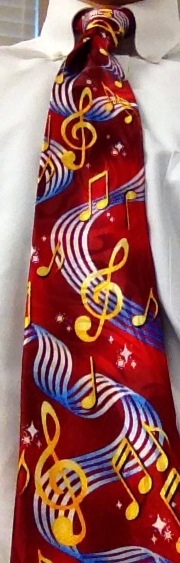
Parashat Beshalah contains the climactic moment of the Israelites crossing of the Sea and their assured redemption from slavery in Egypt. Moses and Miriam lead the people in song and dance celebrating their salvation. The Shabbat in which this portion is read is traditionally called Shabbat Shirah/Sabbath of Song. The theme of of music and song is expressed by this week’s tie.

#TieBlog #Bo

3 Jan
"They shall eat [the Paschal lamb] roasted over fire with matzah and bitter herbs" (Exodus 12:8).

“They shall eat [the Paschal lamb] roasted over fire with matzah and bitter herbs” (Exodus 12:8).

When people see me wear this tie in the winter they often fret that Passover is around the corner and that they have to start preparing their kitchens to be kosher for Passover, an arduous rite of spring. Have no fear, that’s still three months away. However, our Torah reading this week, Parashat Bo, describes the final three of the ten plagues. As a prelude to the climactic tenth plague, the slaying of the first born, the Torah describes the ritual of the Passover sacrifice that becomes the basis of the Passover Seder observed to this day. The roasted lamb must be eaten with matzah (unleavened bread) and maror (bitter herbs). The Passover rituals are designed to spark discussion about the significance of the Exodus from Egypt in Jewish consciousness. Even if it’s not spring, it’s never to early to engage in these important teachings.

#TieBlog #Shemot

20 Dec
"And the bush was not consumed"  (3: 2).

“And the bush was not consumed” (Exodus 3:2)

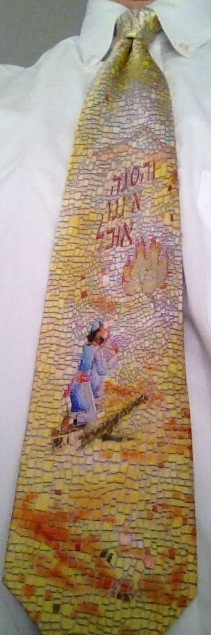
In Parashat Shemot , Moses bursts onto the scene as the man appointed by God to go before Pharaoh to demand freedom for the Israelites. He hears the call from a humble bush–indicating that God’s presence can be found in places both majestic and modest. Moses was astute enough and open enough to experience God’s presence in the burning bush. As inscribed on the tie, “V’hasneh einenu ukal,” “And the bush was not consumed.”