Tag Archives: Judaism

#TieBlog #Yitro #TenCommandments

17 Jan
The Ten Commandments

The Ten Commandments

Parashat Yitro tells of the Israelites’ encounter with God at Mt. Sinai. It is not enough for the people to have obtained physical freedom from slavery. They need spiritual freedom that is framed by a system of law. The Ten Commandments provide this basic framework that is essential for a society rooted in law.

#TieBlog #Beshalah #ShabbatShirah

10 Jan
Shabbat Shirah/Sabbath of Song

Shabbat Shirah/Sabbath of Song

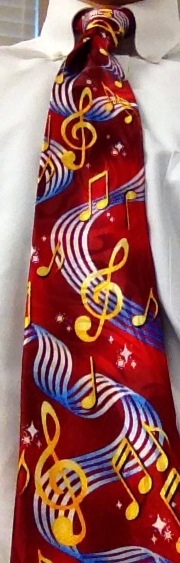
Parashat Beshalah contains the climactic moment of the Israelites crossing of the Sea and their assured redemption from slavery in Egypt. Moses and Miriam lead the people in song and dance celebrating their salvation. The Shabbat in which this portion is read is traditionally called Shabbat Shirah/Sabbath of Song. The theme of of music and song is expressed by this week’s tie.

#TieBlog #Bo

3 Jan
"They shall eat [the Paschal lamb] roasted over fire with matzah and bitter herbs" (Exodus 12:8).

“They shall eat [the Paschal lamb] roasted over fire with matzah and bitter herbs” (Exodus 12:8).

When people see me wear this tie in the winter they often fret that Passover is around the corner and that they have to start preparing their kitchens to be kosher for Passover, an arduous rite of spring. Have no fear, that’s still three months away. However, our Torah reading this week, Parashat Bo, describes the final three of the ten plagues. As a prelude to the climactic tenth plague, the slaying of the first born, the Torah describes the ritual of the Passover sacrifice that becomes the basis of the Passover Seder observed to this day. The roasted lamb must be eaten with matzah (unleavened bread) and maror (bitter herbs). The Passover rituals are designed to spark discussion about the significance of the Exodus from Egypt in Jewish consciousness. Even if it’s not spring, it’s never to early to engage in these important teachings.

#TieBlog #Shemot

20 Dec
"And the bush was not consumed"  (3: 2).

“And the bush was not consumed” (Exodus 3:2)

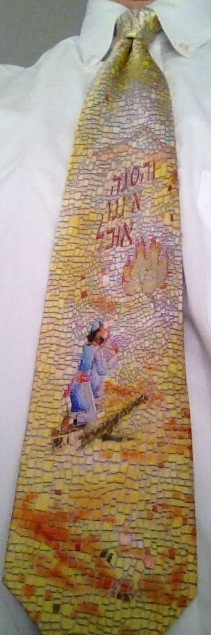
In Parashat Shemot , Moses bursts onto the scene as the man appointed by God to go before Pharaoh to demand freedom for the Israelites. He hears the call from a humble bush–indicating that God’s presence can be found in places both majestic and modest. Moses was astute enough and open enough to experience God’s presence in the burning bush. As inscribed on the tie, “V’hasneh einenu ukal,” “And the bush was not consumed.”

Vayehi: One Year after #Newtown, Affirming Life in the Face of Death

13 Dec

Sandy Hook victims

Sandy Hook victims

Benjamin Franklin once said: I wake up every morning at nine and grab for the morning paper. Then I look at the obituary page. If my name is not on it, I get up.

Franklin’s sentiment is evident in the title of this week’s Torah portion, Vayehi, literally, “and he lived.” The portion deals largely with the death of Jacob the Patriarch and, later, the death of Joseph. Despite the prevalence of death, the first word of the portion affirms life. The Sages note mah zar’o ba-hayyim, af hu ba-hayyim, so long as his children live, so long does the parent live; even after Jacob dies, he lives on by virtue of the legacy he passed on to his children.

On his death bed, Jacob affirms life by offering blessings to his sons and grandsons. A strange thing happens, though. Some of the sons don’t fare as well as others in receiving their last testament from their father. Shimon and Levi stand out for the harsh rebuke they receive from their father.

In blessing his second and third born sons, Shimon and Levi, Jacob must come to account with one of the most disturbing events in Genesis—the slaughter of the Shechemites following the rape of Jacob’s daughter Dinah. In the event, it was Shimon and Levi who orchestrated the brutal response. They demanded that the Shechemites circumcise themselves on the pretext that that then Jacob’s clan would intermarry and trade with them. Once the Shechemites were weakened from the circumcision, the brothers proceeded to slaughter the Shechemite males (Gen. 34). Jacob, in his “blessing” says the following:

Shimon v’Levi ahim, klei hamas m’cheiroteihem.
Simeon and Levi are a pair; Their weapons are tools of violent lawlessness (Gen. 49:5).

The text continues: “Let not my person be included in their council, Let not my being be counted in their assembly. For when angry they slay men, and when pleased they maim oxen. Cursed be their anger so fierce, and their wrath so relentless, I will divide them in Jacob, Scatter them in Israel (6-7).

The Hebrew word m’cheiroteihem is hard to translate. It seems that the New Jewish Publication Society translation that appears in the Etz Hayim Humash that renders “tools of lawlessness” may be based on Ramban (Nachmanides):

“As I understand it, the weapons of violence are their habitations, their life…for the weapons of violence are themselves their dwelling place, for with them they live and eat….As a result of this they must be divided in Jacob and scattered in Israel (reference to Gen 49:7) so that they will not congregate in one place. Thus the lots of the tribe of Shimon are amongst the people of Judah…and their cities were separated one from another through Judah’s tribal lands, and the lots of Levi, the cities of refuge, are scattered in all of Israel.”

Jacob recognized in Shimon and Levi that they had crossed the line into a culture and a life of violence. They were no longer merely possessing weapons in case they were needed, but they were possessed by their weapons. Their weapons were their habitation. Their weapons defined their lives and therefore they were dangerous and had to be dispersed so as not to endanger Israel or her neighbors—because “when angry, they slay men.” (Gen. 49:6) (Rabbi Aryeh Cohen)

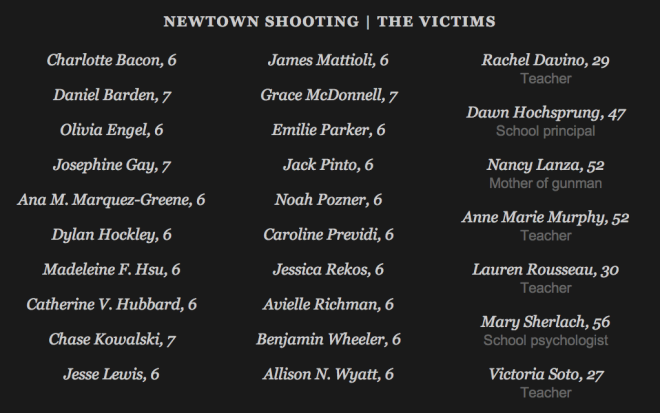
Jacob had the blessing of living out the full measure of his days, some 147 years. Today, though, we recall a day of horror in our nation in which innocent children were denied the right to live out the measure of their days. December 14 marks the first anniversary of the bloodbath that occurred at the Sandy Hook school in Newtown, CT. Twenty first-graders, all of them age five or six, were shot to death in school in cold blood, along with six teachers. More than any other shooting tragedy in recent memory where innocent people have been shot to death in schools, movie theaters, and grocery stores, this tragedy captured the attention of the nation.

Millions of Americans voiced outrage at the easy access to guns and ammunition available to mentally ill people and people with criminal records. Millions of Americans voiced outrage at the easy access many people have to sophisticated, military-grade, automatic weapons and ammunition. There was a widespread sense that common-sense legislation would be enacted to respond to this scourge of our country. Tragically, the legislation that would have kept guns out of the wrong hands died last April in a tone-deaf Congress, despite polls showing 90% support for the legislation. In the meantime, in the last year alone there have been 26 other school shootings, mostly in minority communities that don’t attract the press coverage of mostly white communities like Newtown. It’s estimated that some 38,000 people have died in the last year as a result of gun violence.

This country is a nation of laws, and when children are dying, yes, existing laws need to be enforced. At the same time, when it’s obvious that there are systemic flaws, new laws are necessary to fix the system.

With Shimon and Levi in the Torah, their weapons of violence became their habitations. They became possessed by their weapons and were defined by them. When they were angry, they would slay men. The echoes of Jacob’s rebuke of his sons ring true today. Our society has become habituated to gun violence and indifferent to its consequences. If we remain silent and complacent, how many more thousands will be left dead by next December?

This week’s parasha describes death, but affirms life. For us, our task in honoring the memory of the victims of Newtown is to call on our leaders to take action so that they will not have died in vain. In closing, let me read the names of the 20 children and eight teachers who died one year ago:

Charlotte Bacon, Daniel Barden, Rachel Davino, Olivia Engel, Josephine Gay, Ana M. Marquez-Greene, Dylan Hockley, Dawn Hochsprung, Madeline F. Hsu, Catherine V. Hubbard, Chase Kowalski, Jesse Lewis, James Mattioli, Grace McDonnell, Anne Marie Murphy, Emile Parker, Jack Pinto, Noah Pozner, Caroline Previdi, Jessica Rekos, Avielle Richman, Lauren Rousseau, Mary Sherlach, Victoria Soto, Benjamin Wheeler, Allison N. Wyatt—may their memories be for a blessing.

#TieBlog #Vayehi

12 Dec
Egyptian-themed tie

Egyptian-themed tie

Several years ago, I visited the King Tut exhibit at the Field Museum of Natural History in Chicago. Naturally, I was drawn to the gift shop afterwards and found this tie that I knew would be just perfect for Parashat Vayehi. The patriarch Jacob dies, and Joseph has him embalmed–Egyptian mummy style–so that the children of Israel could escort their father’s remains on the long journey back to Canaan where he was to be buried. Later, Joseph dies. While he too leaves instructions to be buried in Canaan, his remains will be taken when the children of Israel leave Egypt permanently. In the meantime, he too is embalmed and entombed in Egypt. So, Parashat Vayehi is the one Torah portion with mummies, giving it a very King Tut-esque flavor.

Truth and Reconciliation: A Link Through the Ages from Joseph to #Mandela

6 Dec
Nelson Mandela, 1918-2013

Nelson Mandela, 1918-2013

There’s a story told about a group of rabbis in Poland returning to their Yeshiva from a long journey to another town. They travel through thick forests and open meadows until one day they come to a raging river, where a beautiful young woman stands. She approaches the eldest rabbi and says, “Forgive me, Rabbi, but would you be so kind as to carry me across the river? I cannot swim, and if I remain here or attempt to cross on my own I shall surely perish.” The rabbi smiles at her warmly and says, “Of course I will help you.” With that he picks her up and carries her across the river. On the other side, he gently sets her down. She thanks him, departs, and the rabbis continue their journey.

After five more days of arduous travel, the rabbis arrive at their yeshiva, and the moment they do, they turn on the elder in a fury. “How could you do that?” they admonish him. “You violated Jewish law—you touched a woman who is not your wife!”

The elder rabbi replies, “I only carried her across the river. You have been carrying her for five days.”

The story illustrates the danger of carrying within us resentments that impede our ability to form strong bonds with others. This week’s Torah portion, Vayigash, teaches the value of letting go. Following the cliffhanger on which last week’s Torah reading ends, Benjamin, the youngest son of Jacob and full brother of Joseph, is in danger of being thrown in jail. The brothers were warned by Jacob to ensure no harm to Benjamin, and now they are all in mortal danger. Judah steps forward and approaches the Egyptian ruler before him and pleads for Benjamin’s life, offering to take his place for the sake of his father. The Egyptian ruler before him can no longer contain his emotions and reveals himself as their brother Joseph. The brothers are stunned. They are also probably terrified that Joseph may now truly unleash his fury and exact revenge for what they did to him years ago, selling him into slavery. The opposite occurs.

Joseph says (45:5): v’al yihar b’eineichem ki m’khartem oti heinah—do not be distressed or reproach yourselves because you sold me here. Ki l’mikhiyah sh’lahani Elohim lifneichem—it was to save life that God sent me ahead of you. He later says (8): v’atah lo atem sh’lahtem oti heinah ki Elohim—it was not you who sent me here but God.

Rabbi Harold Kushner notes in his commentary that God’s role was to sustain Joseph and guide him to bring something good and life affirming out of the unfairness afflicted on him. Joseph has the wisdom and strength to recognize this, and he is not interested in holding grudges over past slights. He wants to move forward and bring about healing.

This weekend the world mourns the passing of Nelson Mandela at the age of 95. He was the legendary leader of the movement to end apartheid in South Africa and was its first post-apartheid president. In an uncanny way, his biography mirrors that of Joseph. Joseph was sold into slavery, suffered years in prison, and yet rose above it all when he was finally free and a leader. He never took revenge on his brothers; rather, he ensured their safety.

Mandela spent 27 years in prison, and yet when he ultimately became president he was able also to lead with a sense of dignity, fairness and even forgiveness. In reviewing the extensive obituaries over the last couple of days, the aspect of his legacy that stands out most for me is the Truth and Reconciliation Commission that he established during his presidency. The panel was devised to balance justice and forgiveness in a reckoning of the country’s apartheid history where the majority black population was systematically abused by the white minority and its regime. The panel offered individual amnesties for anyone who testified fully on the crimes committed during the apartheid period.

The goal of the TRC was to give victims of brutality a forum where their accounts would be heard and vindicated, where their dignity and sense of justice would be restored, and where they could express their grievances in front of the perpetrators themselves. In exchange for amnesty, the perpetrators had to drop their denials, evasions, and self-justifications and admit the harm they had done, including torture and murder. The commission emphasized the “need for understanding but not for vengeance, a need for reparation but not for retaliation, a need for ubuntu [humanity toward others] but not for victimization.”

The goals of the TRC were inspiring, if not entirely honored in practice. The commission produced grumbling, mockery, protests, and anger. Many black victims of apartheid, such as the family of activist Stephen Biko, who had been murdered in prison, were furious at the provisions of amnesty to the perpetrators. Many white perpetrators did not apologize with anything remotely like true feelings of remorse, and many white supporters of apartheid were not interested in listening to the broadcast confessions of their peers. South Africa has hardly become a paradise; it is still suffering from poverty and high crime rates. Yet it averted a bloodbath. Solomon Schimmel, a professor of psychology at Hebrew College in Boston, traveled to South Africa, interviewing people across the political and cultural spectrum for his book on victims of injustice and atrocities. He expected to hear people describe their rage and desire for revenge. “What most impressed me overall,” he reported, “was the remarkable lack of overt rancor and hatred between blacks and whites, and the concerted effort to create a society in which racial harmony and economic justice will prevail” (Carol Tavris and Elliot Aronson, Mistakes Were Made (But Not By Me), pp. 255-256, iBook Edition).

Among his great achievements in standing for freedom and rebuilding a nation, Mandela’s Truth and Reconciliation Commission is a remarkable achievement.

Mandela’s passing this week on the eve of our reading of Parashat Vayigash, is yet another reminder that life imitates Torah As we reach the climax of the Joseph story this Shabbat in the Torah portion of Vayyigash, we are reminded of Nelson Mandela who, like Joseph, knew from an early age that he was destined for something special. Like Joseph, he spent many years in prison separated from his family. Like Joseph, it was in prison that he developed the skills — especially the ability to listen — that would later make him a great leader. Like Joseph, he had the fortitude to forgive those who were responsible for his imprisonment and to achieve reconciliation with them. Like Joseph, once regarded as part of a despised minority, Mandela ascended to national leadership. Like Joseph, as a national leader he was not without controversy and was far from perfefct. Nevertheless, he was able to steer his country through a crisis that, without his wise stewardship, could have led to civil war and complete destruction (from Rabbi Rob Scheinberg).

May God grant each of us the strength and courage to be inspired by Joseph and Nelson Mandela to repair the broken relationships in our lives.

#TieBlog #Vayigash

6 Dec
The Lion of Judah

The Lion of Judah

In next week’s Torah portion, Vayehi, Jacob blesses his sons and likens Judah to a lion. A lion is symbolic of courage and grace under fire. Judah earns this reputation in this week’s Torah portion, Vayigash, when he boldly approaches Joseph and pleads with him to spare Benjamin from punishment and to take him instead. Hence, this Shabbat my tie bears the lion of Judah.

#TieBlog #Thanksgivikkuh

26 Nov
Dreidel tie for Hanukkah

Dreidel tie for Hanukkah

We spin the dreidel into another Hanukkah, and this time, in America at least, Hanukkah combines with Thanksgiving. In fact, with the quirks of the lunar calendar and its adjustments to the solar calendar, this is the first time Hanukkah and Thanksgiving have ever fallen one same day, and it won’t happen again for another 75,000 years! I like this tie because it has the two kinds of dreidels–nes gadol hayah sham (a great miracle happened there–in Israel) and nes gadol hayah po (a great miracle happened here–for those living in Israel). The miracle refers to the miracle of lights. According to the Talmud, the Maccabees liberated the Temple and found only enough oil to kindle the lights for one day, but they lasted for eight days. This year, we Americans might also reflect on the great miracle that is America and the blessings of freedom, including and especially religious freedom, that we enjoy on these shores. The “Peh” dreidel can work here too, at least on Thursday.

Looking ahead to Shabbat, #TieBlog proposes a connection between this tie and Parashat Mikketz. Joseph’s life has been like a game of dreidel. He landed on some hard times and is lying forgotten in an Egyptian jail. Then his fortunes turn dramatically when he interprets Pharaoh’s dreams an disappointed viceroy of Egypt. He saves the people from starvation and ultimately his own family as well. In the musical “Joseph and the Amazing Technicolor Dreamcoat,” Joseph says upon his new appointment: “Anyone from anywhere can make it if they get a lucky break!”

Yes, the game of dreidel is a game of chance and luck. At the same time people have to make miracles happen, whether it’s crushing olives to make enough olive oil to kindle fire even for one day, let alone eight, or to cross the Atlantic in the Mayflower to a strange new land in search of religious freedom.
Happy Thanksgivikkuh!

Like #Lincoln and #Kennedy, we all can change the world

22 Nov
President Abraham Lincoln and President John F. Kennedy

President Abraham Lincoln and President John F. Kennedy

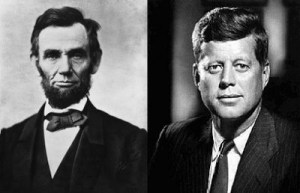
On Thursday of this week, I was pleased to participate in the formal kickoff of our adult education season in tandem with Temple Shaarei Shalom. Rabbi Fratello and Cantor Bain from Shaarei Shalom, and Cantor Mondrow and I each reflected on different aspects on the state of American Jewry today against the backdrop of two monumental anniversaries in America this week. On November 19, we marked the 150th anniversary of President Lincoln’s Gettysburg Address. Yesterday, November 22, we marked the 50th anniversary of the assassination of President Kennedy in Dallas. The coincidental proximity of these anniversaries may have lent fuel to those who suggest that there must have been some cosmic, pre-ordained connection between these two slain Presidents. It’s easy to get caught up in the trivia that they were both shot in the head on a Friday, that they were each succeeded by Johnson and that Kennedy’s secretary was named Evelyn Lincoln. I think we would be better off reflecting on who these men were, why they were important and how we might strive to carry on with their unfinished work.

In recalling two momentous events in American history, it’s worthy first to explore a momentous event in this week’s Torah reading, Parashat Vayeshev. The parashah begins with the ironic statement that Jacob had settled down in the land where his fathers wandered. Based on what happens next, nothing is settled about daily life in the house of Jacob. Jacob showers favor upon Joseph, son of his favorite wife, Rachel. he presents him with a k’tonet passim, a striped, or, perhaps, “technicolor” coat. The favoritism naturally created a rift between Joseph and his brothers. Joseph’s arrogant personality did not help to assuage the tension. One day when the brothers are away, Jacob sends Joseph to find them and see how they’re doing. What a fateful mistake that was. Or was it?

On his way towards Shechem (Genesis 37:15), Joseph meets a man who says basically he saw them and they went “thataway” towards Dothan. Joseph finds his brothers. They pounce on him, nearly kill him, and ultimately sell him into slavery.

Rabbi Harold Kushner, who is coming to Temple Torah on January 15 (and you should all buy tickets), writes in his Torah commentary about this mysterious man on the road who meets Joseph.

“We never hear of this man again,” he writes. “Yet if Joseph had not met him, he never would have been sold into slavery. The family would not have followed him into Egypt. There would have been no Exodus. The history of the world would have been so different! Could that man have known how his chance encounter changed history? Do we ever know the consequences of the little acts of thoughtfulness we perform?”

Each one of us may be that man or woman on the road that knowingly or unknowingly profoundly influences the life of someone else. Knowing that, our task in life is to try to do so with positive energy and intentionality. This week, we pause to reflect two giant historical leaders, President Lincoln and President Kennedy. There may be coincidental similarities between the two, but they served with great purpose and intentionality. Without their leadership, the world as we know it might be a very different place.

For Lincoln, the Gettysburg Address is a masterpiece not only for its brilliant, concise rhetoric, but also for stating in clear terms Lincoln’s vision of his lasting legacy, the end of slavery and the defense of the union. Had Lincoln not entered the historical stage, how would America have evolved from its status quo in the mid-1800s? Would there even be a single United States of America? We can only speculate, but we know our world is different because Lincoln lived. As we reflect on the meaning of Lincoln this week, let me share all 272 words of the Gettysburg Address:

“Four score and seven years ago our fathers brought forth on this continent, a new nation, conceived in Liberty, and dedicated to the proposition that all men are created equal.

“Now we are engaged in a great civil war, testing whether that nation, or any nation so conceived and so dedicated, can long endure. We are met on a great battle-field of that war. We have come to dedicate a portion of that field as a final resting place for those who here gave their lives that that nation might live. It is altogether fitting and proper that we should do this.

“But, in a larger sense, we can not dedicate — we can not consecrate — we can not hallow — this ground. The brave men, living and dead, who struggled here, have consecrated it, far above our poor power to add or detract. The world will little note, nor long remember what we say here, but it can never forget what they did here. It is for us the living, rather, to be dedicated here to the unfinished work which they who fought here have thus far so nobly advanced. It is rather for us to be here dedicated to the great task remaining before us — that from these honored dead we take increased devotion to that cause for which they gave the last full measure of devotion — that we here highly resolve that these dead shall not have died in vain — that this nation, under God, shall have a new birth of freedom — and that government of the people, by the people, for the people, shall not perish from the earth.”

For Kennedy, his term was shorter and his legacy less clear-cut but still significant. The Cold War weighed heavily on the mood of the time of his inauguration. His rhetoric that day acknowledged the national stress, and inspired principled leadership of the free world. He said: “Let every nation know, whether it wishes us well or ill, that we shall pay any price, bear any burden, meet any hardship, support any friend, oppose any foe, to assure the survival and success of liberty.”

During his term, he averted nuclear catastrophe during the Cuban missile crisis. He went to Berlin and inspired the people in this enclave of democracy stuck in the midst of Communist East Germany that freedom and democracy were precious and necessary. Back at home, he laid the groundwork for the sweeping Civil Rights legislation that his successor President Johnson would sign into law. On June 11, 1963, during the desegregation of the University of Alabama, President Kennedy said: “If an American, because the color of his skin is dark, cannot eat lunch in a restaurant open to the public, if he cannot send his children to the best public schools available, if he cannot vote for those public officials that represent him, if, in short, he cannot enjoy the full and free life which all of us want, then who among us would be content to have the color of his skin changed and stand in his place? Who among us would then be content with the counsels of patience and delay?

“I hope that every American, regardless of where he lives, will stop and examine his conscience about this and other related incidents. This nation was founded by men of many nations and backgrounds. It was founded on the principle that all men are created equal, and that the rights of every man are diminished when the rights of one man are threatened.”

Finally, President Kennedy channeled his magnetic charisma to inspire a generation of Americans to think beyond their personal wants and desires and to serve their nation. The Peace Corps is one product of that legacy. “Ask not what your country can do for you; ask what you can do for your country,” are his immortal words from his inauguration that continue to resonate today.

Had Kennedy not served as President, what would our world look like today? Would we have experienced nuclear war? Would we have put astronauts on the moon? We can only speculate, but certainly our world is different because President Kennedy lived.

In reflecting this week on these two fallen Presidents, we can think about that man on the road to Shechem whom Joseph encounters. He’s a reminder to us that our words and our actions matter. Anything we do or say can have a profound effect on the lives of others and even to affect the course of history. Presidents Lincoln and Kennedy were great statesmen who channeled powerful oratory and deft leadership skills towards serving our nation and making our world a bit better. Their lives were both tragically cut short, and their work was unfinished. It is up to each of us to see ourselves as that “person on the road to Shechem” who can change the world. May we be blessed to make the world a bit brighter and better.