Tag Archives: Torah

Rabbi Bernstein’s YouTube videos on Sukkot

18 Sep

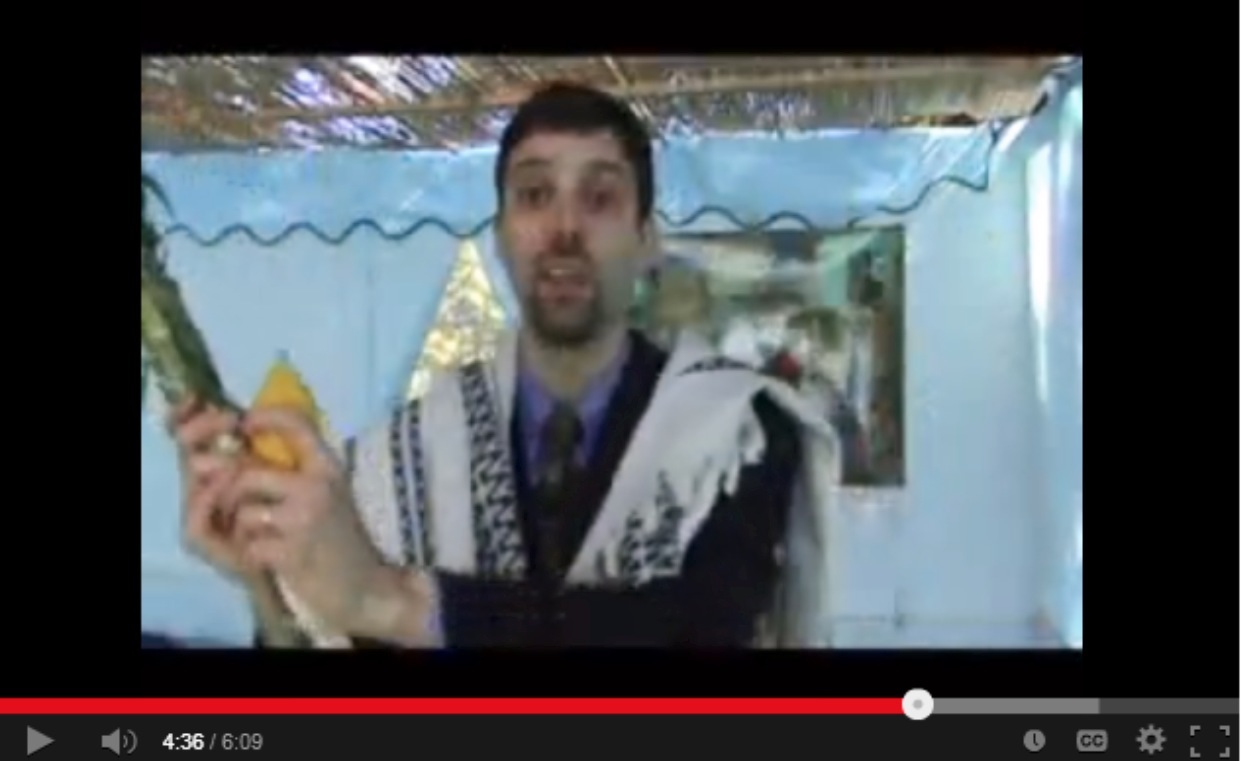
imageFor an overview to the Sukkot holiday, here are three YouTube videos that I recorded in 2009.

Introduction to Sukkot: https://www.youtube.com/watch?v=huYx1lwtQQA

Introduction to Lulav and Etrog: https://www.youtube.com/watch?v=ELgUzaGQzIM

How to Make the Lulav Shake: https://www.youtube.com/watch?v=nOPjQaFRzxU

18 Sep
Corn stalks represent the fall harvest, and they can also be used for skhakh, the roof of the Sukkah.

Corn stalks represent the fall harvest, and they can also be used for skhakh, the roof of the Sukkah.

On Sukkot, we dwell for seven days in a Sukkah, a fragile, temporary dwelling. It symbolizes the fragility and impermanence of life, yet is also a time to offer gratitude to God for the divine sheltering presence and the abundance that we are able to enjoy in this world. The roof of the Sukkah is called skhakh and is made of plants. During the day, it must provide more share than sun light, and during the night, one must be able to see the stars. Corn stalks, like the ones on my tie, are a popular form of skhakh where they are available.

Writing the Next Act on Yom Kippur

15 Sep
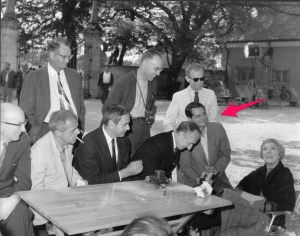
Sam Lesner, my grandfather, had a storied career as the film and entertainment critic for the Chicago Daily News. Here he is (seated on right in checkered blazer) with  other reporters interviewing Julie Andrews in Austria on the set of "The Sound of Music." Sam began his career by reviewing the Yiddish Theater.

Sam Lesner, my grandfather, had a storied career as the film and entertainment critic for the Chicago Daily News. Here he is (seated on right in checkered blazer) with other reporters interviewing Julie Andrews in Austria on the set of “The Sound of Music.” Sam began his career by reviewing the Yiddish Theater.

This sermon was published in the Huffington Post. http://www.huffingtonpost.com/rabbi-edward-bernstein/yom-kippur_b_3916468.html

A slightly updated and corrected version appears below.

Writing the Next Act on Yom Kippur
Rabbi Edward C. Bernstein
September 15, 2013

I recently discovered some lost treasures. My late grandfather, Sam Lesner, of blessed memory, came back to life after 23 years when I heard his voice once again after finding and digitizing some old cassette tapes. My Grandpa Sam was the film and entertainment critic of the former Chicago Daily News. In the early 1930’s, while working in an entry-level job filing clippings in the newspaper’s library, it became known to the editors that he was a trained musician and that he was fluent in Yiddish. As a result, his first “beat” was covering Chicago’s Yiddish theater and reviewing these productions. Nearly fifty years later, he recalled the golden years of Chicago’s Yiddish theater in a lecture to the Chicago Jewish Historical Society. A cassette tape of that lecture in November, 1978, is among the old tapes that I rediscovered this summer. He opened this lecture as follows:

“It has been written that ‘[a]ll the world is a stage, and all the men and women merely the players’ (Shakespeare). For Jews everywhere, that is more than a literary catch phrase. It’s a philosophy for living, for surviving. For, do we not daily reenact our traditions? Do we not daily reenact our faith? And do we not daily rededicate ourselves to continuity of a vast, varied and colorful heritage, the Jewish heritage?

Grandpa Sam continues, “It has also been written that ‘[t]here is that smaller world which is the stage, and that larger stage which is the world.'” (Isaac Goldberg, early 20th century journalist)

“And yet another sage has written the theater is not a game. It is a spiritual compulsion. Once it celebrated the gods. Now it broods over the fate of man. Mensch trocht, Gott lacht (Man plans, God laughs).”

My Grandpa Sam’s voice emerged from the past to discuss the vital role of theater in capturing the human condition and the remarkable interplay between the theater and Jewish values. In reflecting on this lecture, I’m reminded that Yom Kippur is a play of sorts. Each one of us is a player, and we are acting out our own deaths. We wear white costume, just like we dress a loved one to be buried. We have a script, the mahzor (High Holiday prayer book), that guides us with language to confess our sins, just as one does before dying. We fast and deprive ourselves of bodily pleasures that the dead don’t enjoy. We can call these rituals method acting. If ever there was a day to act out as if it’s our last, it’s today, Yom Kippur. Everything up until now has been Act I, maybe also Act II. We can shape the next act and how we interact with the characters in our lives.

Over the High Holy Days, we prepare to raise the curtain on the next act. We reflect on how we can live a life that matters in which we enrich our lives through our relationships with others. In that context, if today were our last day, what would we do to ensure such a legacy? Would we seek to settle old scores and exact revenge for past wrongs done to us? Would we do nothing because a day is too short for anything meaningful? Chances are, we’ve tried those scripts already, and they’re getting stale.

On Yom Kippur, our day of renewal, our tradition provides us with stage directions and a powerful script. The day is further enriched by the improvisational theater that we provide ourselves.

Our stage directions that we’ve inherited call on us to emulate the Master Player on our world’s stage, God. The Torah instructs us lalechet bidrachav, to walk in the ways of God. In the 13 divine attributes, God tells us in the Torah that He is El rachum v’chanun, merciful and gracious God, erekh apayim v’rav hesed v’emet, slow to anger and abounding in loving kindness and truth. The Midrash says, mah Hashem rachum v’chanun, af ata tehiye rahum v’chanun. Just as God is merciful and compassionate, so too you should be merciful and compassionate (Sifre Devarim, Ekev).

Next, we turn to the script of our tradition. The mahzor attempts to capture the complexity of God that we strive to emulate. As I wrote for Rosh HaShanah, in the Un’tane Tokef prayer, we declare that God is zokher kol ha nishkachot, God remembers everything that has been forgotten. In other words, God is the ultimate data bank of everything in human history. Or is He?

God is a versatile cast member who plays many parts. Our rich liturgy offers another metaphor: not God the data bank, but God the parent who uses selective memory. Avinu Malkeinu, zochreinu b’zikkaron tov lefanecha—Our Father Our King, remember us before You with a good memory. Use Your selective memory, God, for good. God knows how to let go, but do we?

Here’s a classic story about not using selective memory. A man complained to his friend that whenever his wife gets angry, she becomes historical. “You mean hysterical,” the friend corrected him. “No,” said the husband, “I mean historical. She starts listing everything I did wrong in the middle of an argument that begins with: “You always…” or “You never….”

Why do we opt for the blame game script? We do so because this satisfies our sense of outrage and indignation. Since we are the injured party, we feel righteous. Our victimhood makes us morally superior as we look down with scorn on the person who hurts us. It provides us with the weapon of guilt to use against the offender. Our mahzor script invites us through prayer to think differently.

Since we pray, and since the rabbis envision us imitating God’s best attributes, the rabbis reach the conclusion that God also prays. The question is what, and to whom, does God pray?

“The rabbis ask: What does God pray? May it be My will that My mercy may suppress My anger, and that My mercy may prevail over My [other] attributes, so that I may deal with My children through the attribute of mercy and, on their behalf, stop short of the limit of strict justice.” (Babylonian Talmud, Berakhot 7a)

God understands the enormous negative power of anger and so He prays to be rid of it. God’s vulnerability is a mirror image of our own. God models for us openness to vulnerability and change. So, having engaged with stage directions and a rich script, we now have the task of turning to “improv.”

The renowned Hasidic rabbi and psychiatrist, Abraham Twerski, provides some guidance on how we can essentially write our own play, or at least the next act. He writes about some of his patients feeling paralyzed by resentment and the liberation that forgiveness brings about. He quotes one of his patients saying: “I came to realize that hanging on to anger was not affecting the people who hurt me. They don’t have headaches, indigestion, or insomnia. I do. Why should I suffer because of their wrong behavior? So I just stopped thinking about them, and my anger evaporated. Hanging onto resentment is akin to letting people you don’t like live rent-free inside your head without paying rent. I’m not the kind of person to let people do that, so I evicted them from my head.”

Rabbi Twerski’s anecdote resonated with me earlier this spring in a deeply personal way. I was forced to confront a demon from my life’s first act that was occupying space in my head without paying rent, and I suddenly had to do some “improv” to chart my path. A guy I went to school with from pre-school through high school sent me a friend request over Facebook. It gave me great pause. My recollection is that from preschool through fifth grade this fellow teased me relentlessly. In later grades, the memories of those early years haunted me. We then went our separate ways, and I haven’t seen him since high school. However, as I moved through adulthood and became an educator, any time I encountered the concept of bullying, the image that came to mind was being tormented by this fellow when we were young boys. In recent years, as I connected with more and more friends from childhood on Facebook, I noticed that several old friends from school were friends with my old nemesis. While I have many Facebook friends whom I barely know, I just couldn’t pull the trigger and send him a friend request. My image of this guy from 35 years ago was renting space in my mind. Then, out of the blue, he asked me to be his Facebook friend. Part of me wanted to accept it right away, but I also wanted to take advantage of this opportunity to ask him to bear witness to my pain. I felt it was the honest thing to do.

I wrote him an email. I hit the send button. Then I waited. The next day, I officiated at a funeral. At the cemetery, I finished the service and walked from the grave site to my car. I pulled out my phone to check my email. I saw there was a response to my Facebook message. Despite the long car ride back home ahead of me, I had to read it in full. It was a beautiful, contrite letter that was completely validating. The writer not only apologized for the way he made me feel, but out of his own initiative he went on to describe in vivid, accurate, detail a specific incident from childhood in which he teased me and his deep regret over it. He concluded his letter: “I do understand. I do acknowledge. I am sorry.” I accepted his friend request.

I couldn’t have staged the scene any better. I was sitting in a cemetery. It was the perfect setting to bury the fear, dislike and distrust I had of this person for most of my life. I felt the curtain rising on a new act. I was so moved by the risk this man took in “friending” me, for his courage in responding to me, and for his eloquent and humble note. I said the blessing of thanksgiving:

Praised are You, Adonai our God, Sovereign of the universe, who has given us life and sustained us and allowed us to reach this moment. It was liberating writing back and officially forgiving him and signing off as “Your Friend.”
If life is a play that is carried out on the world’s stage, then sometimes we have to consider that our total life experiences up to the present moment are only the first or second act. We have the ability to shape the next act.

For those of us who have unresolved tensions with people who are living, the time is NOW to get to work towards healing. Our loved ones whom we lovingly recall in Yizkor would expect nothing less from us. We can write the next act of our lives.

Writing a successful next act requires teshuvah, a complete return to shleimut, wholeness or integrity. This process includes saying selichah, I’m sorry, to others for wrongs we’ve committed towards them, and it includes granting mechilah, forgiveness to others for their slights towards us. We say to God, “Selah lanu, mehal lanu, kaper lanu, forgive us, pardon us grant us atonement.” What we expect of God, we must also demand of ourselves.

So, those of us giving free rent in our minds to the anger and resentment that we hold towards someone, we give ourselves a gift to evict those thoughts. Let’s change the script from a tragedy to a story with a happier ending. If there are relatives or friends with whom there is unresolved tension, speak to them on Yom Kippur or immediately thereafter. Say that you’ve given thought to your relationship and want a fresh start. Each of us can raise the curtain on a new act.

We recall our departed loved ones on Yom Kippur because we acknowledge our own mortality. We are acting today as if it is our last day. Recognizing our mortality, as we do now, reminds us of the urgency to change our ways. It may be the last act.

Let us honor the memory of our loved ones with a Jewish Tony Award of zikkaron tov, remembering them for their goodness. Let us bring zikkaron tov, good memories, into our present relationships. Let us not live like we’re going through the motions on stage. Let us live a life that matters.

Israel: The People Who Struggle with God and One Another

15 Sep

Israel: The People Who Struggle With God and One Another
Rabbi Edward C. Bernstein
Kol Nidre, September 13, 2013

There’s an old story about a rabbi who auditions to be the rabbi of a new synagogue. The interview goes well, but at the end, the president of the congregation says, “Rabbi, there are just three things you’re not allowed to speak about from the pulpit: Don’t speak to us about ritual observance; don’t speak to us about social action; and don’t speak to us about Israel.” The rabbi asks: “Well then, what am I supposed to speak about?” The president says: “Jewish stuff.”

Tonight, I’d like to speak about one of those topics: Israel. We note with appropriate solemnity that this is the 40th anniversary of the Yom Kippur War. It’s tempting for me to recount Israeli history and rally us to support Israel’s continued security as our one and only Jewish state.

Tonight, however, I am moved to do something different. I wish to speak not about Israel per se but about how we talk to one another about Israel. It’s all about relationships and, as Rabbi Harold Kushner says, “living a life that matters.” We have a great tension in Jewish tradition between the need to take care of ourselves, the Jewish people and the need to be concerned about the world as a whole. Hillel expressed this tension in his famous statement, “If I am not for myself, who will be for me? If I am only for myself, what am I? And if not now, when?” There is a natural tension between the first two parts of this statement. They are of equal importance–particularism, concern for ourselves, and universalism, concern for others. For the most part, the tension in our tradition between these two forces is healthy. When it comes to the State of Israel, though, conversations among contemporary Jews can sometimes get ugly.

The way in which American Jews talk to one another about Israel is one barometer of the health of our relationships, particularly between different generations. I’m concerned that Israel has become a sort of third rail in Jewish conversations that is best left untouched for the sake of shlom bayit, peace in our family. Many in our community feel that as Jews we have a duty to hold Israel to the highest standards, and it’s our duty to call Israel to account when there is injustice there. Many others say, “Shah, shtill. Be quiet. Don’t wave Israel’s dirty laundry in public. Diaspora Jews have to show a united front in support of Israel.”

Rabbi Ed Feinstein of Los Angeles wrote recently about this tension. He says that for generations, Jews have adjusted as needed in finding the balance between concern for ourselves and concern for others. When we hold on to both, Jewish life thrives. He argues, though, that in recent years the balance is broken. “Perhaps this is the residual effect of living in the shadow of the Holocaust.” He writes that the Jewish people suffer from a collective post-traumatic stress disorder. Some Jews turn inward and think the world is out to get us and that another Shoah, God forbid, can happen any moment if we don’t take care of Israel and the Jewish people first. Other Jews feel that if we don’t aspire to the highest ethical standards and show concern for all people, we sink to the level of our oppressors over the centuries. Feinstein writes: “Instead of an active tension, we are left with severe polarization,” and says further “todays increased polarization will suffocate Judaism.” I appreciate Rabbi Feinstein’s wisdom from which I learn two things: a) there are multiple ways to approach and be supportive of Israel; and b) we need to find respectful ways for fellow Jews to speak and engage in relationship.

Rabbi Feinstein was writing in response to a particularly troubling exchange between two rabbinic colleagues last November that was a microcosm of the tension between the particularistic and universalistic camps. The two rabbis are Daniel Gordis and Sharon Brous. Both, like me, are graduates of JTS. They are both highly accomplished in their respective rabbinates, and I have been inspired to quote both of them on occasion in my sermons over the years. Rabbi Gordis, a renowned public intellectual, made aliyah to Israel in the late 1990s and has provided keen insight on the life of Israelis in a turbulent Middle East. Rabbi Brous is a contemporary of mine and founded the Ikar congregation, an innovative start-up shul in Los Angeles that has attracted hundreds of young Jewish adults in their 20s and 30s. They have a long-standing personal and professional relationship with each other dating back to when both lived in LA. This relationship was severely tested in a public dispute that they had over Israel.

Last November, after hundreds of rocket attacks terrorized southern Israel, Israel launched an air-raid attack on the Gaza Strip to destroy munitions and launch sites. A ground invasion by the Israeli Army was averted at the last moment when the US and Egypt were able to broker a cease-fire. Anytime Israel faces a tense military situation such as this, emotions throughout the Jewish world run high. We anguish over loss of life on all sides, and we anguish over Israel being punished in the court of public opinion over the killing of civilians when terrorists deliberately embed themselves among their own people in order to draw Israel’s fire. In response to the last Gaza showdown, Rabbi Brous published a letter to her congregation reflecting on the suffering of both Israelis and Palestinians. Rabbi Brous writes:

“I believe that the Israeli people, who have for years endured a barrage of rocket attacks targeting innocents and designed to create terror, instability and havoc, have the right and the obligation to defend themselves. I also believe that the Palestinian people, both in Gaza and the West Bank, have suffered terribly and deserve to live full and dignified lives….”

Later, she writes, “However you feel about the wisdom and timing of Israel’s response to the Hamas threat, the people of Israel need our strong support and solidarity. At the same time, supporting Israel’s right to protect and defend itself does not diminish the reality that the Palestinian people are also children of God, whose suffering is real and undeniable.”

Rabbi Gordis responded with an article in the Times of Israel a few days later in which he criticized Rabbi Brous for being too even-handed. “Yes, we are all deeply entrenched in our narratives of good and evil. But why does Rabbi Brous not feel that it’s her place as a rabbi to tell her community…which side is good and which side is evil?” The end of Rabbi Gordis’s article gets highly personal, and this generated the controversy:

“As I read Rabbi Brous’s missive, I couldn’t stop thinking about my two sons, both in the army, each doing his share to save the Jewish state from this latest onslaught. What I wanted to hear was that Rabbi Brous cares about my boys (for whom she actually babysat when we were all much younger) more than she cares about the children of terrorists. Especially this week, I wanted her to tell her community to love my family and my neighbors more than they love the people who elected Hamas and who celebrate each time a suicide bomber kills Jews. Is that really too much to ask?”

Gordis continues, “I knew, even before reading Rabbi Brous’s missive, that we Israelis are surrounded by enemies. When I finished reading her, though, I understood that matters are much worse than that. Yes, we’re surrounded, but increasingly, we are also truly alone, utterly abandoned by those who ought to be unabashedly at our side.”
It is clear at this point that two well respected and thoughtful rabbis have different perspectives on Israel. Yet, respect of the other is crucial even amidst disagreement. Living a life that matters requires civil discourse. The question is whether this discussion has gone beyond civil.

It wasn’t long before Rabbi Brous responded:

“Wielding the power of the pen, Gordis sets me up as a straw (wo)man, a representative voice of a naïve Jewish ideology, one that is willing to jettison allegiance to the Jewish people for the sake of some self-congratulatory humanism. Such Judaism, he claims, is ‘utterly universalized… almost entirely divorced from the richness of Jewish heritage and the worldview of our classic texts.’”

“What is shameful is that Gordis knows what many of his readers do not. For years my teacher and friend, he knows precisely what is the character of my Judaism, he knows just how deeply Jewish traditions and texts run in my blood. But it is far easier to cast aspersions on a straw man than engage in discourse with a real live colleague who shares his concern for Israel, the Jewish people and its future but nevertheless sees things differently than he does.”

Rabbi Gordis then wrote a rejoinder. He attempted to take back his more inflammatory personal statements while restating his strong commitment to Jewish particularism, the Jewish concern to take care of ourselves first and foremost.

He writes: “I believe that four thousand years of Jewish tradition are committed to the proposition that particularism is key to who we are, and that the inability to love our people before we love others cuts out the heart of one Judaism’s great sustaining characteristics.”

By this point, numerous other commentators were weighing in on the Gordis-Brous Internet spat. Rabbi Ed Feinstein, whom I quoted earlier, served as kind of an online referee. He writes that they are both Jewish intellectual heroes struggling to inspire contemporary Jews. “That is what makes their controversy so painful to witness.”

Rabbi Feinstein says: “So incendiary is Rabbi Gordis’s critique of Rabbi Brous, it obscures the simple fact: He needs her. First, he needs her Torah.” Rabbi Feinstein says that Rabbi Brous’s teaching of Torah has engaged younger Jews, teaching them to interpret their universalism and humanism through traditional Jewish lenses.

“Second,” Rabbi Feinstein continues, “he needs her conscience. The voice of Jewish particularism needs the balancing voice of Jewish universalism, else it turns chauvinistic, narrow, and cruel. Too easily do we fall into a narrative of victimhood and wallow in attitude that overlooks brutality and excuses all moral infractions.”

“Finally,” Rabbi Feinstein says, “he needs her moral vision. The primary task of Zionism, as Gordis so well understands, was to make a safe place for Jews and Jewish life. But that was never its sole purpose. Zionism was always an expression of Jewish moral aspiration.” For example Israel’s Ambassador Michael Oren went on American TV during this conflict and explained in detail how Israel was taking steps to avoid civilian casualties. Because of its moral vision, Israel resisted a call by some to carpet bomb Gaza. Such moral vision is what makes Israel a Jewish state. Rabbi Feinstein clearly favors Rabbi Brous’s concern for more than just Jews in Israel but also the values for which Israel stands. In so doing, he reminds us that there are multiple ways in which we can express our support for Israel and that we can and must be respectful of one another in doing so.

As we think about issues of global Jewish importance, like Israel, we have to consider not only the issues at hand. We have to consider how community conversations about Israel serve as a litmus test for our relationships with one another. We can argue issues passionately, but we must remember that concern for both ourselves and the outside world are integral parts of our rich Jewish heritage. Yom Kippur is a time for us to reconnect with one another, with the synagogue and its traditions, with the Jewish people, with Israel and with God. In this new year, let us not shy away from discussing the vital issues of our day because we fear to offend. At the same time, let us always remember the human beings with whom we share dialogue so that we may listen and be strengthened by our differences. We are a richer, more vibrant tradition because we value both ourselves and others. Finding the balance between the two is sometimes challenging, but our effort to strike that balance is part of living a life that matters. May we all be so blessed.

#TieBlog #YomKippur #Goats

11 Sep
Goats for Yom Kippur

Goats for Yom Kippur

The goats on my tie are of course in honor of the goats of the ancient Yom Kippur ritual in the Temple. This ritual is mentioned in the Torah:

Leviticus, Chapter 16: “7 Aaron shall take the two he-goats and let them stand before the Lord at the entrance of the Tent of Meeting; 8 and he shall place lots upon the two goats, one marked for the Lord and the other marked for Azazel. 9 Aaron shall bring forward the goat designated by lot for the Lord, which he is to offer as a sin offering; 10 while the goat designated by lot for Azazel shall be left standing alive before the Lord, to make expiation with it and to send it off to the wilderness for Azazel.”

We no longer have the Temple nor this arcane ritual. We instead offer our sincere prayers, fasting and genuine teshuvah (return to the ways of God). May we be inscribed for life and good health.

#TieBlog #Nitzavim

29 Aug
"It is not in heaven"  (Deuteronomy 30:12)

“It is not in heaven” (Deuteronomy 30:12)

While human beings have acquired the ability to launch rockets and people into space and explore the heavens, Deuteronomy tells us that Torah–the totality of our received tradition from God–is “lo bashamayim hi,” “it is not in heaven” (Deuteronomy 30:12). This phrase has been understood that the Torah is not an esoteric document. It is meant for human beings in this world to explore, interpret and reinterpret. This verse plays a central role in one of the most famous passages in the Talmud, Bava Metzia 59b, in which Rabbi Eliezer is in a dispute with Rabbi Joshua and the majority of sages. Rabbi Eliezer performs miracles and even has a divine voice from the heavens call out that the law is in accordance with him. Rabbi Joshua, however, says “Lo bashamayim hi,” “[The Torah] is not in heaven. God laughs in response and says, “My children have defeated me.” The Torah is meant to be studied and reinterpreted in each generation.

The Roots and the Fruits of “I Have a Dream”

23 Aug
Rev. Dr. Martin Luther King, Jr., delivering "I Have a Dream speech, August 28, 1963

Rev. Dr. Martin Luther King, Jr., delivering “I Have a Dream” speech, August 28, 1963

This coming Wednesday, August 28, marks a momentous anniversary in American history. It is the 50th Anniversary of the March on Washington for Jobs and Freedom that was highlighted by Rev. Martin Luther King, Jr.’s “I Have a Dream” speech. The speech is known for its soaring rhetoric and piercing, prophetic call for equality and justice for all. The concluding portion of the speech has become part of our civic liturgy, alongside the Star Spangled Banner and the Gettysburg Address. As a great piece of liturgy, Dr. King turned to three key elements: 1) history; 2) recognition of an Eternal God of all; and 3) an appeal to social justice.

It’s appropriate that this week’s Torah portion contains a classic piece of liturgy that is built upon these same three pillars. Anytime a passage from the Torah makes it into the Jewish liturgy, it is a sign that our tradition grants it a special importance and that the text embodies an aspect of the soul of Judaism. Examples include the Shema (Deut. 6:4-9) and the Friday night Kiddush (Gen. 2:1-3). This week’s Torah reading, Ki Tavo, opens with Parashat Bikkurim (the first fruits) (Deut. 26: 1-11), which includes the Bikkurim recitation that was recited once a year by those who brought Bikkurim to the Temple. After the destruction of the Temple, the Sages made this passage a central component of the Passover Haggadah, from which many recognize the words: “Arami oved avi” (26: 5-10)

“My father was a fugitive Aramean. He went down to Egypt with meager numbers and sojourned there; but there he became a great and very populous nation. 6 The Egyptians dealt harshly with us and oppressed us; they imposed heavy labor upon us. 7 We cried to the Lord, the God of our fathers, and the Lord heard our plea and saw our plight, our misery, and our oppression. 8 The Lord freed us from Egypt by a mighty hand, by an outstretched arm and awesome power, and by signs and portents. 9 He brought us to this place and gave us this land, a land flowing with milk and honey. 10 Wherefore I now bring the first fruits of the soil which You, O Lord, have given me.”

Rabbi David Golinkin, a leader of the Conservative/Masorti movement in Israel suggests that if we look closely at this passage, Parashat Bikkurim, we find that it contains three of Judaism’s most core values: 1) History, or remembering and connecting with events of our past 2) Gratitude to God for the blessings in our lives and 3) Concern for the weak and less fortunate.

Let’s look at each part more carefully. Personal identification with the history of our people is found in verses 3-10, including the text recited in the Temple and the portion of that text that made its way into the Haggadah. The text is couched in the first person singular or plural. The reciters thereby expressed their complete identification with events which had occurred hundreds or even thousands of years before their time, just as we recite in the Haggadah every year: “In every generation a person must consider himself as if he had personally gone forth from Egypt.” The mitzvah of Zakhor, Rememberance, is an essential one in our tradition, which we can all relate to. By identifying personally with events of our past, we can work to ensure that dark chapters in our history are not repeated.

Dr. King invoked history at the very beginning of his speech:

“Five score years ago, a great American, in whose symbolic shadow we stand today, signed the Emancipation Proclamation. This momentous decree came as a great beacon light of hope to millions of Negro slaves who had been seared in the flames of withering injustice. It came as a joyous daybreak to end the long night of their captivity.

“But one hundred years later, the Negro still is not free. One hundred years later, the life of the Negro is still sadly crippled by the manacles of segregation and the chains of discrimination. One hundred years later, the Negro lives on a lonely island of poverty in the midst of a vast ocean of material prosperity. One hundred years later, the Negro is still languished in the corners of American society and finds himself an exile in his own land. And so we’ve come here today to dramatize a shameful condition.”

Our Torah portion’s call to us to internalize our history may at times seem ominous, particularly when recalling slavery, whether in Egypt or the American South. Therefore, this message is tempered by the call to express gratitude for the blessings in our lives. In the Bikkurim prayer, the theme of gratitude is emphasized through the repetition of the verb “natan” “gave.” Six times this word appears in our portion, reminding us that God gives the gift of first fruits and other blessings, which requires the people to thank him anew every year.

As Dr. King was building towards his climactic conclusion, he said, “I have a dream that one day every valley shall be exalted, and every hill and mountain shall be made low, the rough places will be made plain, and the crooked places will be made straight; “and the glory of the Lord shall be revealed and all flesh shall see it together.”2 He was quoting one of Isaiah’s messages of consolation, the section we read in synagogue in the weeks leading up to Rosh HaShanah. Like in the Bikkurim prayer, King reminded us that God is a force for sustenance and good.

By taking stock of our own past misfortunes as well as the blessings in our lives, the Bikkurim passage then reminds us of the next step, which is to improve the lot of those around us who less fortunate. Concern for the weak is found in verse 11. The text reads, “You and the Levite and the stranger shall enjoy all the bounty which the Lord your God has bestowed upon you.” In other words, the Israelite farmer must share his harvest with the strangers in the Land. Indeed, this message repeats itself many times in the Torah where we are instructed to leave gleanings (leket) and the corner of the field (pe’ah) and forgotten sheaves (shikheha) “to the poor, the stranger, the widow and the orphan” so that we should remember that we too were once strangers in Egypt.

Dr. King’s soaring rhetoric on social justice is unparalleled in modern history:
I have a dream that one day this nation will rise up and live out the true meaning of its creed: “We hold these truths to be self-evident, that all men are created equal.”
I have a dream that one day on the red hills of Georgia, the sons of former slaves and the sons of former slave owners will be able to sit down together at the table of brotherhood.

Jewish tradition carries the themes of the Bikkurim prayer into the most solemn prayer of the upcoming penitential season, “Un’tane Tokef,” recited on Rosh HaShanah and Yom Kippur. We declare: U’teshuvah, u’tefillah u’tzedakah maavirin et roa ha-gezeira, Repentance, Prayer and Righteousness avert the severity of the decree.” Through repentance, we take account of our history and make an effort to change our ways. Through prayer, we not only express hope for a better future, but give thanks to God for the blessings of Creation. Through acts of righteousness and loving kindness we maintain Judaism’s longtime concern for the weak and downtrodden.

In the final peroration of Dr. King’s speech, he quotes the American song “My Country ‘Tis of Thee” and focuses on the words “let freedom ring.” In so doing, he neatly brings together history, God’s goodness, and an appeal to social justice:
Let freedom ring from Stone Mountain of Georgia.
Let freedom ring from Lookout Mountain of Tennessee.
Let freedom ring from every hill and molehill of Mississippi.
From every mountainside, let freedom ring.
And when this happens, and when we allow freedom ring, when we let it ring from every village and every hamlet, from every state and every city, we will be able to speed up that day when all of God’s children, black men and white men, Jews and Gentiles, Protestants and Catholics, will be able to join hands and sing in the words of the old Negro spiritual:

Free at last! Free at last!
Thank God Almighty, we are free at last!3

As the High Holiday season approaches, may we be inspired by our Torah and our liturgy to examine our past, give thanks for the gifts God has given us and promote justice for all.

My relationship with Chicago’s baseball teams: It’s complicated

7 Aug
Opening night at Chicago's Wrigley Field, 8/8/88

Opening night at Chicago’s Wrigley Field, 8/8/88

Twenty-Five years ago today, 8/8/88, the Chicago Cubs turned the lights on for the first time for a night game at Wrigley Field. At the time, I identified as a die-hard Cubs fan. As a native South-Sider, however, I found myself in adulthood gravitating towards the White Sox as the first box score I check in the morning. The White Sox won the 2005 World Series. More recently, the Chicago Blackhawks won their second Stanley Cup in four years, so all of Chicago’s major sports teams have won at least one championship in my lifetime–except the Cubs. What’s more, they haven’t even won a championship in the lifetime of my 99-year-old grandmother. On this momentous anniversary in Chicago sports, here is a sermon that I delivered eight years ago in Cleveland after the White Sox won the pennant in which I describe my complicated relationship with Chicago’s two baseball teams.

Baseball and Sukkot: Lessons in Irony
Rabbi Edward C. Bernstein
10/22/05

This past Monday night as we sat down in our Sukkot for the first time this year, we said the traditional sheheheyanu prayer of thanksgiving in which we express our gratitude to God for giving us life and sustaining us and allowing us to reach this occasion. For me, this blessing had special significance. You see, as a native of Chicago I entered Sukkot with the knowledge that for the first time in my life, a Chicago baseball team was going to play in the World Series. Tonight, the Chicago White Sox face the Houston Astros in their return to the World Series for the first time since 1959 and seek to win their first championship since 1917. I am still pinching myself that this is really happening.

Some of you may be sitting here wondering, isn’t Bernstein a Cubs fan? Two years ago he was kvetching about the Cubs falling short, now we’ve got to hear about the White Sox!? It is complicated, I admit. But the confluence of the White Sox winning the pennant with both Yom Kippur and Sukkot have forced me to reflect on the religious significance of this historical moment in my life.

First, Yom Kippur. It was only a week ago, after all, and the spirit of confession is still in the air. Furthermore, our tradition holds that final, final judgments aren’t made until Hoshana Rabba, the last day of Sukkot, and that it is appropriate to offer confessions through that time. So, I have a confession to make. I always liked the Cubs and the White Sox, but having grown up on the South Side of Chicago, I was originally more of a Sox fan than a Cubs fan. In 1984, when the Cubs made a valiant run for the pennant, I shifted my allegiance to the Cubs. For many White Sox fans, including close members of my own family, this was utter heresy. They accused me of being a fair-weather fan. For various reasons that I won’t burden you with now, I don’t think this was the case. For one thing, time has proven that I have stuck with the Cubs for over 20 mostly futile years. Nevertheless, I have retained an affinity for the White Sox. While they don’t always have the glitz or media attention of the Cubs, there is a certain charm about them. As the second team of the Second City, they are very much the team of common working folks, who, with some justification, see the Cubs as an elitist team that excludes working fans by playing mostly day games. While I think the Cubs’ commitment to baseball in the daytime is family friendly and good for children, I have always respected the loyal White Sox fan. The problem is that over the years their teams have been so darn boring. Until this year.

A few weeks ago as the Cleveland Indians, the team of my adopted hometown, made a serious challenge to overtaking the Chicago White Sox, I was forced to reflect more closely on my views of the White Sox. As my official biography on the Shaarey Tikvah web site notes, I am a Cubs fan. This year, though, with the tremendous season enjoyed by the White Sox, I have been repeatedly asked by members of this congregation how I feel about it. My stock answer has been that I am a Cubs fan, but still support the Sox. Of course, I was rooting for the Indians to make the playoffs, but not at the expense of the Sox. My public confession is that I have a complicated history in rooting for the White Sox, and I hope they win.

With Yom Kippur out of the way, let me turn to Sukkot. Sukkot and Shemini Atzeret are both known as z’man simchateinu, the season of our joy. Certainly, for Chicago White Sox fans, this is a great season of joy. Yet, the name z’man simchateinu is somewhat of a paradox. In Chicago, people are excited about playing a summertime sport on a 40-degree, drizzly October night in Chicago. Furthermore, the history of Chicago sports, particularly baseball, is one of such futility, Chicagoans have a fatalistic attitude. We question if this is really happening and if a World Series victory will ever actually occur. Is another Black Sox scandal looming, God forbid? Will an innocent fan interfere with the game and lead to defeat, as happened with the Cubs two years ago? Will the Sox continue to benefit from the umpires’ calls or will they go against them this time? Or, more prosaically, will the Houston pitching simply be better than their own? If they fail this year to win it all, will it take another 46 years to get this far?

A Bartlett Giamatti, the late Commissioner of Major League Baseball, once wrote about baseball:

“It breaks your heart. It is designed to break your heart. The game begins in the spring when everything else begins again, and it blossoms in the summer, filling the afternoons and evenings, and then as soon as the chill rains come, it stops and leaves you to face the fall alone.”

Giamatti, a New Englander and former president of Yale University, wrote these words in the 1970s after his beloved Boston Red Sox endured another season of just falling short. Little did he know then that Boston would eventually win a World Series in 2004, after an 86 year drought. This year, it is Chicago that seeks to end an 88-year drought, but Giamatti’s fatalistic attitude resonates for us Chicagoans. There is a great paradox in rooting for a Chicago baseball team in October: abundant joy and hope mingled with fatalism and doubt.

Indeed, this paradox precisely parallels the rituals associated with Judaism’s season of joy. For seven days, we leave the comfort of our homes and dwell in sukkot, fragile, open-air booths. We do this not in the summer months when it would be more convenient, but in the fall when the weather is much more capricious. We do not pamper ourselves with luxuries or recline like we do on Passover. The sukkah reminds us not of our strength and security, but of our vulnerability.

There are other practices that contradict the nickname z’man simchateinu. Every day of Sukkot we beseech God, Hosha Na, please save us! In the season of our joy, one of the holiday’s central liturgical pieces cries out that we are mere mortals and that we need God to save us. Is this a declaration of our joy?

In a little while, we will read from the cynical, fatalistic Book of Kohelet (Ecclesiastes). “Vanity of vanities, all is in vain,” Kohelet teaches us. All of life is hollow, meaningless, amounting to nothing. “There is nothing new under the sun.” Our striving for knowledge and power is futile. We are all mortal. So begins the special Biblical book that we read on Sukkot, the season of our joy.

This coming week, on Shemini Atzeret, we will pray that God will bless us with rain so that we don’t starve. Furthermore, we recite the Yizkor memorial prayers in memory of our loved ones who have passed away. The next day, on Simchat Torah, the day we rejoice over the gift of the Torah, we read about the death of Moses. All of this again on z’man simchateinu, the season of our joy.

The renowned theologian Rabbi Neil Gillman calls this paradox “the emotional ambiguity of Sukkot.” This ambiguity is captured in the book of Kohelet, which is why we read it on this holiday. Kohelet’s conclusion is the opposite of our first impressions. Kohelet’s message in the end is that we should not give up. We must confront and live with the inherent ambiguities of life. “We can find joy,” Rabbi Gillman writes, “in the sheer fact of living, in work, in love, in companionship, in the serenity that comes with understanding and accepting our limitations.”

The statement z’man simchateinu, therefore, is a statement of defiance. Despite all of the pain and suffering in the world, we will go on living. Despite it all, we will express joy. Despite all of the curveballs life throws us, we will not be deterred from celebrating life’s blessings.

For a Chicagoan like me, and I suspect for Clevelanders as well, October baseball is a precarious time. We are joyful over the success that helped us reach this point and hopeful for the future. At the same time, we are humbled by the countless failures in the past and cynical, like Kohelet, that it can ever be any different. Baseball, like Sukkot, is a metaphor for life: joy and frustration playing off each other in a never-ending cycle. For Chicagoans of my generation, never has the cold chill of October felt so good, and yet we acknowledge that it is still cold.

During this season, despite our sense of fragility and uncertainty, let us heed the Psalmist’s teaching, ivdu et Hashem b’simcha, serve God with joy!

Amen

#TieBlog #Shofetim

7 Aug
The scales of justice

The scales of justice

“Justice, justice you shall pursue.” This is the clarion call of Parashat Shofetim (Deuteronomy 16: 20). It is in the context of Moses instructing the Israelites to create the institutional infrastructure for a just society. The scales of justice on my tie evoke this central and eternal Jewish quest for justice.

5 Aug

http://www.huffingtonpost.com/rabbi-edward-bernstein/with-great-power-comes-gr_b_3702078.html