Tag Archives: TieBlog

#TieBlog #Vayehi

12 Dec
Egyptian-themed tie

Egyptian-themed tie

Several years ago, I visited the King Tut exhibit at the Field Museum of Natural History in Chicago. Naturally, I was drawn to the gift shop afterwards and found this tie that I knew would be just perfect for Parashat Vayehi. The patriarch Jacob dies, and Joseph has him embalmed–Egyptian mummy style–so that the children of Israel could escort their father’s remains on the long journey back to Canaan where he was to be buried. Later, Joseph dies. While he too leaves instructions to be buried in Canaan, his remains will be taken when the children of Israel leave Egypt permanently. In the meantime, he too is embalmed and entombed in Egypt. So, Parashat Vayehi is the one Torah portion with mummies, giving it a very King Tut-esque flavor.

#TieBlog #Thanksgivikkuh

26 Nov
Dreidel tie for Hanukkah

Dreidel tie for Hanukkah

We spin the dreidel into another Hanukkah, and this time, in America at least, Hanukkah combines with Thanksgiving. In fact, with the quirks of the lunar calendar and its adjustments to the solar calendar, this is the first time Hanukkah and Thanksgiving have ever fallen one same day, and it won’t happen again for another 75,000 years! I like this tie because it has the two kinds of dreidels–nes gadol hayah sham (a great miracle happened there–in Israel) and nes gadol hayah po (a great miracle happened here–for those living in Israel). The miracle refers to the miracle of lights. According to the Talmud, the Maccabees liberated the Temple and found only enough oil to kindle the lights for one day, but they lasted for eight days. This year, we Americans might also reflect on the great miracle that is America and the blessings of freedom, including and especially religious freedom, that we enjoy on these shores. The “Peh” dreidel can work here too, at least on Thursday.

Looking ahead to Shabbat, #TieBlog proposes a connection between this tie and Parashat Mikketz. Joseph’s life has been like a game of dreidel. He landed on some hard times and is lying forgotten in an Egyptian jail. Then his fortunes turn dramatically when he interprets Pharaoh’s dreams an disappointed viceroy of Egypt. He saves the people from starvation and ultimately his own family as well. In the musical “Joseph and the Amazing Technicolor Dreamcoat,” Joseph says upon his new appointment: “Anyone from anywhere can make it if they get a lucky break!”

Yes, the game of dreidel is a game of chance and luck. At the same time people have to make miracles happen, whether it’s crushing olives to make enough olive oil to kindle fire even for one day, let alone eight, or to cross the Atlantic in the Mayflower to a strange new land in search of religious freedom.
Happy Thanksgivikkuh!

#TieBlog #Vayeshev #OurGang

21 Nov
"The Little Rascals" get into mischief, and so do the sons of Jacob in this week's Torah portion.

“The Little Rascals” get into mischief, and so do the sons of Jacob in this week’s Torah portion.

In Parashat Vayeshev, we meet Joseph, the spoiled brat and favorite son of Jacob. He torments his eleven brothers with his dreams in which he predicts his dominance over them. They can’t take it any more. In a puzzling act of parenting, Jacob sends Joseph out one day to find his brothers and inquire after their welfare. They plot to kill him but relent when Judah sells him into slavery instead. Joseph goes down to Egypt and eventually achieves a position of immense power. One can only imagine what living in a house of twelve sons must have been like on a day-to-day basis. The mischief of the “Little Rascals,” may offer some clue into the brothers’ lives when they were young boys.

#TieBlog #Vayishlach #JacobWrestling

14 Nov
Jacob wrestles with a mysterious being in Parashat Vayishlach and is renamed Yisrael.

Jacob wrestles with a mysterious being in Parashat Vayishlah and is renamed Yisrael.

Parashat Vayishlah presents the climax in Jacob’s journey from a trickster youth who gets his way through deception to a mature adult who faces life’s challenges with integrity. He is about to confront his estranged brother Esau for the first time in 20 years. He fears for his life as he believes Esau is still angry over being cheated out of his birthright. The night before meeting Esau, Jacob encounters a mysterious being on the banks of the Jabbok and they wrestle all night. Towards dawn, Jacob prevails but the sparring partner strikes him in his hip and causes permanent injury. Jacob emerges triumphant but wounded. He is renamed Yisrael- the one who wrestles with God and man and prevails. Later (33:18), Jacob is described as “Shalem,” whole or at peace. Even though Jacob is hurt in a wrestling bout, he is a much more whole person for finding within him the integrity to repair his relationship with his brother.

#TieBlog #Vayetze #Jacob’s Ladder

7 Nov
Jacob's Ladder

Jacob’s Ladder

A stairway to heaven that could very well be Jacob’s ladder.

#TieBlog #Toledot

31 Oct
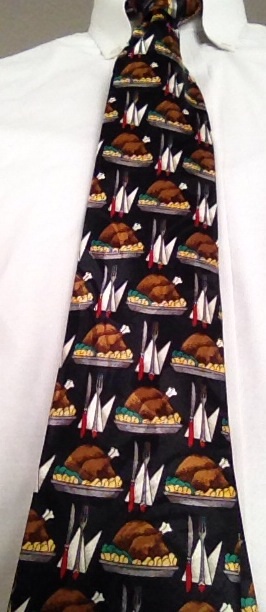
Often Parashat Toldot corresponds with Thanksgiving. This year, they're a few weeks apart. Nevertheless, the turkeys on this week's tie represent the prominent role of food in the drama of Jacob and Esau.

Often Parashat Toldot corresponds with Thanksgiving. This year, they’re a few weeks apart. Nevertheless, the turkeys on this week’s tie represent the prominent role of food in the drama of Jacob and Esau.

Food and sustenance play a prominent role in Parashat Toledot. Jacob tricks Esau out of his birthright for a bowl of stew. He later deceives his blind father by wearing hairy skins to appear like his brother as if he had just returned from a hunt. His mother Rebecca prepares the purported game for Jacob to present to Isaac and receive in return his innermost blessing intended for the first born. In between these two narratives centered around food, we learn that Isaac reclaims the wells that his father had dug in Canaan. The family legacy cannot continue without sustenance from water, nor can it continue without nourishment from food. Often Parashat Toldot corresponds with Thanksgiving. This year, they’re a few weeks apart. Nevertheless, the turkeys on this week’s tie represent the prominent role of food in the drama of Jacob and Esau.

#TieBlog #LekhLekha

10 Oct

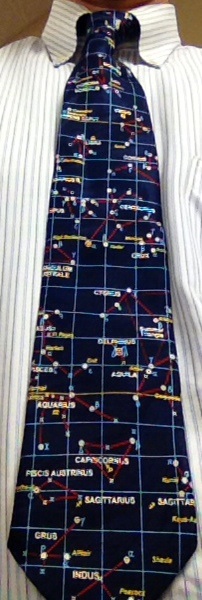
image In Parashat Lekh Lekha, Abram (later re-named Abraham) hears the call from God to uproot himself from everything that is familiar to him and go to Land that God will show him so that he will become a great nation. One problem: he and his wife Sarai (later re-named Sarah) are elderly and childless. Abram goes along with God’s instructions but later expresses angst that he has no offspring and no heirs. The text in Genesis 15 reads: “3 Abram said further, “Since You have granted me no offspring, my steward will be my heir.” 4 The word of the Lord came to him in reply, “That one shall not be your heir; none but your very own issue shall be your heir.” 5 He took him outside and said, “Look toward heaven and count the stars, if you are able to count them.” And He added, “So shall your offspring be.” 6 And because he put his trust in the Lord, He reckoned it to his merit.” With God calling upon Abram to look to the stars for hope and inspiration, this week’s tie reminds me of this moment of renewal for our patriarch.

#TieBlog #Noah’sArk

2 Oct
Noah's Ark

Noah’s Ark

As we turn to Parashat Noah, we are faced with the perplexing challenge posed by the first verse, “Noah was a righteous man, perfect in his generation.” Why does the text say “in his generation”? The rabbis of old had a debate. Some say that if Noah could stand out in his age when surrounded by depravity, all the more so in other ages when he would have other decent people around him. Other rabbis aren’t so sure. He was certainly better than the people around him, but he would have paled in comparison to an Abraham or Moses who intervened before God on behalf of people condemned to die. Noah never says anything. He builds his ark and goes on his way. His action (or inaction) stands in contrast to Abraham challenges God directly when Sodom and Gomorrah are doomed to destruction. “Will the Judge of all the earth not do justice?” (Gen. 18:25), Abraham pleas, hoping the depraved cities would be spared for the sake of even ten righteous people. Abraham intervened with God on behalf of the righteous. Moses takes it a step further and intervenes to save the guilty, the people of Israel who commit the sin of the Golden Calf (Exodus 32). The trajectory of the Torah suggests that Noah was righteous for his time, but would have paled in comparison to the giants of later generations.

#TieBlog #SimhatTorah and #Beresheet

25 Sep
On Simhat Torah we celebrate our completion of the Torah reading cycle, and we begin again--from the beginning.

On Simhat Torah we celebrate our completion of the Torah reading cycle, and we begin again–from the beginning.

It’s a #TieBlog doubleheader as we head into the last round of fall holidays. On Simhat Torah, we engage in the powerful ritual of completing the book of Deuteronomy and immediately returning to read the beginning of Genesis. I think these ties speak for themselves. Hag Sameah!

#TieBlog #Sukkot and #SheminiAtzeret

24 Sep
"And you shall rejoice on your festival...and you should be especially happy."

“And you shall rejoice on your festival…and you should be especially happy.”

Of the ties in my Torah Tie collection, I especially like the ones that have explicit scriptural references. For Sukkot and Shemini Atzeret, this tie is particularly apt. Deuteronomy 16, which is read in the Diaspora on Shemini Atzeret morning, describes the calendar of holidays. With respect to Sukkot, the Torah commands (verse 14) “And you shall rejoice on you Hag (Festival, referring specifically to Sukkot)” and then adds shortly thereafter (verse 15) “And you shall be especially joyful.” The tie conflates these verse fragments into one statement, which is a popular song at this time of year: V’samachta b’hagecha, v’hayyita ach sameah. May the season bring joy to all.