Tag Archives: Judaism

#TieBlog #Sukkot & #EtrogandLulav

7 Oct
The four species that are brought together on Sukkot, as described in Leviticus, 23:40.

The four species that are brought together on Sukkot, as described in Leviticus, 23:40.

In time for Sukkot, here is the newest tie in the #TieBlog collection. Two central commandments from the Torah related to this harvest festival are dwelling in the Sukkah (booth) for 7 days. The other is to gather four species of plants and wave them (based on Leviticus 23:40).

The Midrash (Lev. R. 30:9-12) notes that each of the species has different qualities. The Etrog (citron) has both a sweet taste and a fragrant smell. The lulav (date palm branch) has no smell but its fruit tastes sweet. The Hadas (myrtle) has a fragrant smell and no taste. The Aravah (willow) has no taste and no smell. Taste and order represent Torah and good deeds, respectively. Some Jews possess both, some perform better at one and some do not perform well at either. Yet we gather the species together to symbolize the unity of Israel. For more on Sukkot and Etrog and Lulav, watch the following YouTube videos:

Introduction to Sukkot

Introduction to Lulav and Etrog

How to Make the Lulav Shake

Just One More Song

4 Oct
Robin Williams (1951-2014) as "Mork" (circa 1980) and Rabbi Joel Wasser (1963-2014)  on steps of Philadelphia Museum of Art (1987).

Robin Williams (1951-2014) as “Mork” (circa 1980) and Rabbi Joel Wasser (1963-2014) on steps of Philadelphia Museum of Art (1987).

One evening a Cherokee Indian told his grandson about a battle going on inside him: “My son, it is between two wolves. One is evil: Anger, envy, sorrow, regret, greed, arrogance, self-pity, guilt, resentment, inferiority, lies, false pride, superiority and ego. The other is good: Joy, peace, love, hope, serenity, humility, kindness, benevolence, empathy, generosity, truth, compassion and faith.”

The grandson thought about it and asked his grandfather, “Which wolf wins?”

The old Cherokee replied, “The one that I feed.”

We all have similar battles that take place in our minds. Our actions, positive or negative, often result from the wolves we feed–the impulses that come out of these struggles. Sometimes we do great things. Other times we make mistakes but are able to repair them. Once in a while, the human impulse brings about great tragedy.

Several weeks ago, the world was shocked by the untimely passing of actor Robin Williams. Many of us asked how it was possible that a man who brought so much joy and laughter to so many millions of people over many decades would feel so tortured by demons on the inside? When news broke that this comic genius had taken his own life at the age of 63, the world was shocked. Print and electronic media were filled with outpourings of love for Robin Williams as both a performer and a person. His untimely death awakened society to the inner sufferings of people afflicted with the diseases of depression and substance addiction.

A few months earlier, a rabbinic colleague and teacher of mine, Rabbi Joel Wasser, z”l, died. He was only 50, and he took his own life. Like Robin Williams, Rabbi Wasser was a comic genius. I laughed convulsively at his jokes and stories. Moreover, he used his amazing natural gifts and charisma to make Judaism fun and inspiring, particularly for younger Jews. In 1987, he was one of my advisors on USY on Wheels, a cross-country bus tour. I was a high school student, and he was a young rabbinical student. He sat next to me on long bus rides and taught me how to lead services. Beyond the technicalities of how to chant the prayers, he brought me into the liturgy so that it came alive for me. I owe my interest in Jewish text and tradition and my ultimate decision to enter the rabbinate in large measure to my bus rides with Joel. I had lost touch with Joel over the years. However, nearly four years ago, when I was facing a moment of transition in my life, he called me out of the blue to offer his support and encouragement. I will never forget that simple act of kindness.

Rabbi Wasser spent the bulk of his rabbinic career at Congregation Kol Ami in Tampa. I attended his funeral there in May. He had already been away from the community for several years, but the impact that he had on hundreds of people of all ages was palpable. Like Robin Williams, it is a mystery that Rabbi Wasser who brought joy, a sense of purpose and a love of Judaism to so many people could be haunted by inner demons that would lead him to such a tragic demise. Both of these extraordinary men fell victim to the diseases of depression and addiction that cut their lives short when they still had so much left to give.

Hayim Nachman Bialik, the Hebrew Poet Laureate of Israel of the early 20th century prior to Israeli statehood wrote a poem titled Acharei Moti/”After My Death,” that captures the essence of losing dear ones before their time.

AFTER MY DEATH
Say this when you mourn for me:

There was a man – and look, he is no more.
He died before his time.
The music of his life suddenly stopped.
A pity! There was another song in him.
Now it is lost
forever.

There’s hardly any tragedy as great as losing a loved one to suicide. It’s something that surviving loved ones often never get over. To make matters worse, few losses carry as much stigma and shame for the survivors. And yet, suicide has nothing to do with the moral character of the victims or survivors. According to estimates, some 8,000,000 Americans contemplate suicide each year, resulting in 1,000,000 suicide attempts and nearly 35,000 deaths. Suicides outnumber homicides 2:1. Suicide expert Joanne Harpel notes that suicide is not a sign of weakness, a character flaw, or an easy way out. It’s a fatal complication of an underlying illness, the same as dying of heart disease or cancer. Harpel adds that when we pray for healing in the Mi-Sheberach prayer, we ask for refuat hanefesh u’rfuat ha-guf, healing of spirit and body. Depression afflicts both, and suicide is the ultimate breakdown of these two systems.

According to Harpel, laypeople cannot diagnose, but with compassion we can encourage those we care about to get professional help. Harpel writes, “When we are worried about someone, we can say, ‘I’m concerned about you. Are you thinking of hurting yourself?’ If the answer is yes, we should call the National Suicide Prevention Lifeline: 1-800-273-TALK.” She suggests that this is a number we should all have in our phone contacts for easy access and give it to loved ones who might be at risk.

Within the Jewish world, We should also know about Elijah’s Journey: A Jewish Response to the Issues of Suicide Awareness and Prevention. It is a non-profit founded in 2009 that has created a vital support network in the Jewish community to raise awareness of this crisis and provide comfort and support to people who are suffering.

When we reflect on beautiful souls like Robin Williams and Rabbi Joel Wasser, we are reminded of life’s mystery and fragility. They were both complex and ironic men who suffered greatly inside even as they brought great joy to others. When I think about them on Yom Kippur, I’m reminded of Yom Kippur’s great irony. Today is both solemn and joyous.

There is no doubt about the great solemnity to this day. We fast; we beat our chests in sorrow over past mis-deeds; we mourn the absence of loved ones during Yizkor. Some may have lived out the fullness of their years, while others may have passed before their time. No matter the circumstances, we are likely to yearn for one more song that they may have had left. We long for their closeness, the laughter they aroused in us, the tears they shed with us. At the same time, Yom Kippur is regarded by the Sages as the most joyful of days. It is the day in which we are cleansed of our sins. We are reminded that while so many tragedies happen that are beyond our control, our destiny is still in our hands. U’teshuvah u’tefillah utzedakah maavirin et roa hagezeira–Repentance, prayer and righteousness lessen the pain we suffer from life’s travails. We have the power to make a difference in the lives of others.

Unfortunately, we don’t have the power to bring departed loved ones back to life. The music of their lives has stopped. Here’s what we can do: we can deepen the relationships with those near to us now so that nobody feels alone. Use this relationship worksheet as a guide. It asks you to identify people who are close to you and complete the following sentences: Thank you for…; I’m sorry for…; I forgive you for…; and I love you for…. This worksheet may help trigger important conversations in your families and social networks. In turn, we may be able to heal untreated wounds. We may hear songs not yet sung. We may discover pain in others we were not aware of. We may even save lives.

First, say thank you. We can’t say thank you enough to people. When we are in the habit of saying thank you, we cultivate an ongoing feeling of gratitude, the foundation of a happy life. In the prayer book, the first thing we say is Modeh ani lefanecha, Melekh chai vekayam, shehechezarta bi nishmati b’chemlah, rabbah emunatecha. “I am grateful before You, everlasting Sovereign, who has mercifully restored in me my soul; your faithfulness is great. When we begin our day with words of gratitude to God, we are more likely to feel gratitude and convey that sense to others. Expressing our gratitude towards other people benefits their self-esteem as well as our own.

“I’m sorry for….” I work under the assumption that we are all basically good people. None of us wakes up in the morning and thinks, “Gee, how much can I destroy today?” We go through our day to day lives trying to do the right thing, and we are not perfect. We all make mistakes both by things we do and say and by things we fail to do say. Because each of us is a decent person at heart, it’s hard for us to admit our mistakes. We justify our actions. Our relationships suffer as a result. It takes courage to humble ourselves before another person. One of life’s great ironies is that when we show vulnerability through a genuine apology, we actually gain strength in the eyes of the offended.

“I forgive you for….” A favorite teaching I’ve mine that I’ve quoted before is from the renowned Hasidic rabbi and psychiatrist, Abraham Twerski. He writes about patients who are paralyzed by resentment and the liberation that forgiveness brings about. He quotes one of his patients saying: “I came to realize that hanging on to anger was not affecting the people who hurt me. They don’t have headaches, indigestion, or insomnia. I do. Why should I suffer because of their wrong behavior? So I just stopped thinking about them and my anger evaporated. Hanging onto resentment is akin to letting people you don’t like live rent-free inside your head without paying rent. I’m not the kind of person to let people do that, so I evicted them from my head.” Forgiveness is as much for our own benefit as the person being forgiven, and it brings tremendous healing.

“I love you for….” In Disney’s animated hit “Frozen,” the Trolls sing in their song “Fixer Upper” “People make bad choices when they’re mad or scared or stressed. But throw a little love their way, and you’ll bring out their best.” Reminding our loved ones that we love them and why–and doing so repeatedly–reflects our ultimate commitment to the wellbeing of relationships. Love brings out our best.

With these four simple statements, imagine the healing we can generate. Imagine the renewed joy and laughter when there had once been tears and hurt. Imagine the self-esteem we build up in ourselves and others. Imagine the songs we will hear that we never knew existed. Imagine the lives we might save.

We cannot bring back to life loved ones who died whether by suicide or by other causes. But we can resolve–we must resolve–that they did not die in vain. Yom Kippur gives us space to mourn, but it also calls upon us to grow, change, and redefine ourselves. It is a day to cleanse ourselves of that which is broken and to create and reinforce everlasting bonds of trust, hope and love. Let us listen to and savor one another’s songs before the music stops. So may it be God’s will.

#TieBlog #YomKippur 5775

2 Oct
Goats sacrificed on Yom Kippur

Goats sacrificed on Yom Kippur

The goats on my tie are of course in honor of the goats of the ancient Yom Kippur ritual in the Temple. This ritual is mentioned in the Torah:

Leviticus, Chapter 16: “7 Aaron shall take the two he-goats and let them stand before the Lord at the entrance of the Tent of Meeting; 8 and he shall place lots upon the two goats, one marked for the Lord and the other marked for Azazel. 9 Aaron shall bring forward the goat designated by lot for the Lord, which he is to offer as a sin offering; 10 while the goat designated by lot for Azazel shall be left standing alive before the Lord, to make expiation with it and to send it off to the wilderness for Azazel.”

We no longer have the Temple nor this arcane ritual. We instead offer our sincere prayers, fasting and genuine teshuvah (return to the ways of God). May we be inscribed for life and good health.

Drawing hope from the depths of despair: Rosh HaShanah Message, September 25, 2014

28 Sep

There’s an old story about the political science professor who was asked to sum up the situation in Israel in one word. He thought about it for a while, and finally said, “Good.”

Then he was asked, “All right, if you had one more word, if you were asked to sum up the situation in two words, what would you say?

So he thought about it for a while, and then he said, “Not good.”

I believe it’s safe to say that if any of us were asked to summarize this past summer for Israel and the Jewish people, most of us would say “not good.” The truth is, we all know it has been a very difficult summer. Even with the benefit of the Iron Dome, Israel was forced to carry out a difficult operation in Gaza to protect its citizens from rocket fire from above and terror tunnels from below. The Hamas terrorists in Gaza fired their rockets against Israeli civilians while hiding their rocket launchers and weapons amidst their own civilians. Imagine what could have been had Hamas spent years investing in science and technology, hospitals, schools and playgrounds. Instead they spent billions of dollars on rockets and terror tunnels and used schools and hospitals they did have as launch sites for the rockets. The moral clarity is crystal clear. Israel uses rockets to protect its children. Hamas uses children to protect their rockets.

As we take a broader view of the world, the scourge of fundamentalist Islam is spreading like a cancer throughout the Middle East. The brutal terror of Hamas was exported to ISIS and honed into barbarism the likes of which we’ve not seen in modern times. The beheadings of American journalists and a British aide worker have sickened us and galvanized our nation to respond militarily.

So how was this summer? It was not good.

Nevertheless, if we dig beneath the surface, we will find reason not to despair. After Operation Protective Edge in Gaza during July and August, the month of June seems like ancient history. Let’s take a look back at June, though, and recall the prelude to Gaza. Three Israeli teenage boys Naftali Frankel, Eyal Yifrah and Gilead Shaar, were hitchhiking their way home from yeshiva when they were kidnapped and murdered by Hamas terrorists. Their whereabouts were not known for weeks until their mutilated bodies were found near Hebron. We all felt pain and outrage over this crime. The only thing that could make it worse would be Jews sinking to that level and perpetrating revenge terror attacks against Palestinians. Indeed, such a horror occurred when Jewish terrorists abducted and burned to death a teenager named Muhammed Abu Khdeir, just one day after the three Israeli teenagers were laid to rest. Amidst this charged atmosphere, Hamas ramped up its rocket attacks from Gaza, and Israel launched the operation to protect its citizens.

With our attention on Gaza and the threat to Israeli citizens that Hamas posed, the murders of the four teenagers faded into the background. With the perspective now of a few months, let’s look back to the aftermath of those murders. While the Israeli families were sitting shiva, the Abu Khdeir family was also mourning their son in their tent of mourning. In the midst of observing shiva, Rachel Frankel, the mother of slain Israeli teenager Naftali Frankel, made a courageous emotional statement condemning Abu Khdeir’s murder. “There is no difference between blood and blood. Murder is murder. There is no justification and no atonement for murder,” she said. Her family went a step further and called the Abu Khdeir family to express condolences from one house of mourning to another. Amidst the most wretched violence humans could afflict upon one another, we must take inspiration from this spark of humanity, decency and courage. The Frankel family reminded us who we are as a people and what Israel is all about. Out of the depths of despair, a bold Israeli family in the depths of mourning dared to be decent. Rachel Frankel’s courage and compassion provided a glimmer of hope that Israel will be ok.

Yossi Klein Halevi, a prominent Israeli journalist, wrote a moving piece this month on how Israelis are able to cope in the midst of anxiety and despair. He writes:
“We cope because we have no choice. This is the only corner of the planet where Jews are sovereign. Many of us continue to struggle to preserve a decent Israel. Despite growing mutual suspicion, coexistence efforts between Israeli Arabs and Israeli Jews persist. The Israeli Supreme Court and Israeli media are among the most vigorous anywhere. In a seemingly endless conflict, we can’t take those achievements for granted. Other democracies have broken under far less pressure.”

Klein-Halevi continues: “And through it all Jews keep coming home. This year, 1% of France’s 600,000 Jews are moving to Israel. Even as the missiles fell on Israeli cities, planeloads of French immigrants continued to land. They are fleeing growing anti-Jewish violence. But these well-educated immigrants aren’t going to Canada, they’re coming to the Jewish state. The final shore.”

Klein-Halevi adds a personal note driving with his 16-year-old son and fighting traffic in Jerusalem. “Here we are, in a traffic jam in Jerusalem,” Klein-Halevi writes. “But sometimes I think about how the most ordinary details of my daily life were the greatest dream of my ancestors.”

His son replied, “I think about that a lot.”
Klein-Halevi concludes: “That was all he said. But that was enough. I knew he would be able to survive here.

Israel is a symbol to the Jewish people and to the world that from amidst despair we must draw hope. In a world of injustice, tzedek tzedek tirdof, justice justice you shall pursue. Bimkom she’ein ish, hishtadel l’hiyot ish, in a place in which there are no decent people, strive to be a decent person. Amidst all of its internal political strife and external threats, Israel inspires us to the ideal that we can dare to make the world a better place. Od lo avdah tikvateinu–our hope is not lost–we stubbornly declare when we sing Hatikvah. The ethos of Israel, drawing upon the well springs of Jewish tradition, is to look forward, to have hope.

As Rabbi Jonathan Sacks teaches, Rosh HaShanah as a holiday bids us to look forward. This is odd. We are starting the Ten Days of Penitence. It would seem that first we should reflect on the past, then resolve to do better in the future. Both steps are essential to teshuvah; however our calendar and our liturgy buck conventional wisdom and the order of actions towards attaining teshuvah. Rabbi Sacks notes that Rosh HaShanah contains no confessions, no penitential prayer. We don’t beat our chests today and say Ashamnu (We have sinned) or Al Het, (“For the sin that we have committed before you…”).We save these for Yom Kippur, ten days into the new year. Why? Teshuvah is driven by two different mindsets: Rosh HaShanah is about the future, Yom Kippur is about the past. Rosh means head, and the default position of the head is to look forward not back. The placement of Rosh HaShanah before Yom Kippur means that our determination to act better in the future takes priority to our feelings of remorse about the past. To which we might add that this is why we blow the shofar on RH. The shofar turns our attention to what lies ahead, not behind.

As Rabbi Sacks writes: “Rosh HaShanah reminds us that to mend the past, first we must secure the future.”  This idea is amplified in the three sections of the Musaf Amidah: Malkhiyot, Zikhronot and Shofarot.

Malkhiyot proclaims the majesty of God. We are reminded that no human ruler or government has absolute authority. As we know, among human beings absolute power corrupts absolutely. Our humility before God as a people and as a civilization will fortify us in the face of today’s current evil regimes such as Hamas and ISIS. As we look ahead to a new year with great anticipation, a sense of humility before God tempers us and leads us to act more wisely and with more compassion.
Zikhronot is about memory, but not about our memory. We call upon God to remember the merits of our ancestors and to credit us in turn. In the process we strive to be worthy of our ancestors’ rewards by refining our own actions. We appeal to the past, but for the sake of a better future.

Finally, Shofarot invokes the image of the shofar, the very symbol of a call to the future. The sounds of the shofar penetrate our hearts, evoking God’s cry to us. We know that we are mortal, and this season we reaffirm our mortality. When we hear the wailing sounds of the shofar, we know each one of us will not live forever. Yet, we defeat death by living by values that live forever. The shofar calls upon us to be compassionate, like Rachel Frankel, and create blessings in this world that will live on after us for generations to come.

There is no doubt that we live in challenging times. Yet, we gather today at the dawn of a new year not to cry about what was but to plant the seeds for a more hopeful future. For inspiration, we must turn to our brothers and sisters in Israel who do this day in and day out. Rachel Frankel sitting shiva for her murdered son refused to be consumed by hate. Israelis went about their business working, celebrating weddings, inventing, affirming life, even as rocket attacks disrupted their daily routine. Immigrants made Aliyah because the Jewish people have no other land to call our own. Jerusalem residents were snarled in traffic in their daily commutes. We have great reason for hope. In fact, we have no choice. Let us resolve in this new year to look forward. Let us be vigilant against those who seek us harm and at the same time stay true to our deepest principles and values that have sustained us throughout the generations. Adonai oz l’amo yitein, Adonai yevarech et amo ba-shalom; may God grant His people strength, may God bless His people with peace. Amen.

Our Communal Mulligan: Rosh HaShanah, First Night, September 24, 2014

28 Sep

Shanah Tovah,
As we begin Rosh HaShanah tonight, I’d like to share with you a thought experiment. Imagine an American activity that for generations has had millions of practitioners. People would devote significant time and money to this activity every week. Strong traditions developed around how one should dress to these activities and what items one had to bring to participate. The activity involved a high degree of skill, and practitioners were expected to adhere closely to the rules. The traditions of this activity were passed down from generation to generation until one day younger people stopped participating in this activity. It took too much time, cost too much money and was too difficult.

The scenario I just described is true; however, I am not talking about Judaism or even religion. I’m talking about golf. According to a recent New York Times article, golf in America has lost some five million participants over the last decade. Like many Jewish organizations as well as many other religious groups, golf clubs are struggling to attract a new generation of golfers. People under 35 have especially spurned the game, saying it takes too long to play, is too difficult to learn and has too many tiresome rules.

Recently, the PGA and other golf industry leaders are so fearful of losing the next generation of golfers that there are now experiments with alternative forms of golf with new equipment, new rules and radical changes to courses. The goal is to alter the game’s reputation in order to recruit lapsed golfers and a younger demographic. There are now–get this–15-inch holes, the size of pizza pans. There are games based on time, rather than completion of 18-holes, with limits at six or nine holes. There are newly designed balls that don’t slice. Some courses have introduced kicking a soccer ball down a fairway, and, yes, most importantly, players are allowed mulligans on every hole. Of course, golf traditionalists are up in arms over the dumbing down of the game. Industry leaders say they have no choice if they are going to pass the tradition of golf to a new generation. They’ve got to make it less time consuming, more accessible and non-judgmental.

Does any of this sound familiar? Indeed, the American Jewish community faces similar challenges. I could speak at length about the many parallels between the challenges faced by golf and those faced by Jewish institutions in terms of how to be relevant to younger generations. Just as golf attempts to reinvent itself, many Jewish institutions around the country are engaged in creative innovation that preserves Jewish tradition while making it more accessible. I’ll let you consider for yourselves the numerous parallels between Judaism and golf. For now, I wish to offer instead a major difference between Judaism and golf.

Judaism has a secret sauce that golf is only just discovering now: the value of renewal and reinvention. Judaism has renewal built into our DNA.

For golf, traditionalists might consider it a heresy to allow mulligans, or do-overs. In Judaism, we allow mulligans all the time. Pirke Avot teaches hashev yom echad lifnei motcha, repent one day before you die. The understanding is that since we never actually know when our final day will be, we must do teshuvah every day. Every day in the Amidah we say to God Slach lanu…m’hal lanu, forgive us, pardon us for our sins. We say this three times a day, every day of the year. And if that’s not enough, we also have Aseret Yemei Teshuvah, the ten days of Penitence that we begin tonight. These ten days are all mulligans all the time. It is a reset button for the entire year. We take stock of our deeds, we make amends, we seek forgiveness from one another and willingly grant it when asked of us.

Among Judaism’s greatest gifts to civilization is the notion that people can change. Nothing is pre-ordained. We find our way through life one mulligan at a time. This notion is not obvious. The ancient Greeks, for instance, believed that we are what we are, and we cannot change. They believed that character is destiny, and the character itself is something we are born with, although it may take great courage to realize our potential. Heroes are born, not made. Before the birth of Oedipus, his fate had already been foretold by the Delphic Oracle, and nothing can avert it.

This is precisely the opposite of the key sentence we say on Rosh Hashanah and Yom Kippur: uteshuvah ut’fillah utzedakah maavirin et roa hagezeirah: “Repentance, prayer and righteousness avert the evil decree.” While difficult stuff happens in the world, we have control over our destiny. No fate that is final, No diagnosis without a second opinion – half of Jewish jokes are based on this idea.

As Isaac Bashevis Singer wittily put it, “We have to be free; we have no choice.”

On these High Holy Days, we renew our tradition of renewal itself. While golf widens holes on the putting green, let us widen our hearts. While golf shortens its games, let us make the time we have with one another in our families and in this synagogue community as meaningful as possible. While golf adds mulligans to allow players multiple chances to hit the ball well, let us reengage in our ancient tradition of Teshuvah, so that we may begin this year truly renewed.

It’s time for us now to tee off on a ten-day journey of introspection and renewal. May God grant us the strength to make these days meaningful and transformative so that we may bring positive change into our lives, our relationships and the world.
Amen.

#TieBlog #Nitzavim-Vayelekh

18 Sep
"It is not in heaven"  (Deuteronomy 30:12)

“It is not in heaven” (Deuteronomy 30:12)

While human beings have acquired the ability to launch rockets and people into space and explore the heavens, Deuteronomy in Parashat Nitzavim tells us that Torah–the totality of our received tradition from God–is “lo bashamayim hi,” “it is not in heaven” (Deuteronomy 30:12). This phrase has been understood that the Torah is not an esoteric document. It is meant for human beings in this world to explore, interpret and reinterpret. This verse plays a central role in one of the most famous passages in the Talmud, Bava Metzia 59b, in which Rabbi Eliezer is in a dispute with Rabbi Joshua and the majority of sages. Rabbi Eliezer performs miracles and even has a divine voice from the heavens call out that the law is in accordance with him. Rabbi Joshua, however, says “Lo bashamayim hi,” “[The Torah] is not in heaven.” God laughs in response and says, “My children have defeated me.” The Torah is meant to be studied and reinterpreted in each generation.

Take the #TTShofarChallenge

18 Sep

The Ice Bucket Challenge is so “last year!” Get into the 5775 groove and take the #TTShofar Challenge!

A Fixer-Upper Shabbat B’Yachad, September 20

14 Sep
Make the last Shabbat of 5774 a "fixer-upper" opportunity for 5775.

Make the last Shabbat of 5774 a “fixer-upper” opportunity for 5775.

#TieBlog #Ki-Tavo

12 Sep
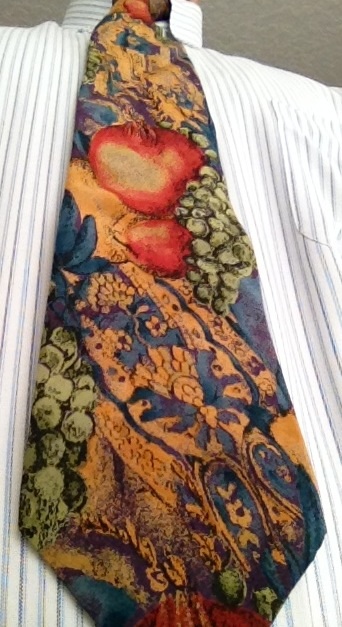
A cornucopia of fruit, reminiscent of the Bikkurim/first fruits

A cornucopia of fruit, reminiscent of the Bikkurim/first fruits

Parashat Ki-Tavo opens with the passage describing the Bikkurim/First fruits offering. The Talmud describes this offering as the centerpiece of Shavuot, the second of the major festivals. One can picture a humble farmer bringing precious first fruits to the Temple for this thanksgiving offering. The Torah provides a specific liturgical text to be said upon presenting this gift to the kohen/priest. The text notes the humble origins of the Israelites, their plight in Egypt as slaves, their miraculous freedom and their return to the Land of Israel. While this text was originally associated with this ritual on Shavuot, after the destruction of the Temple and the end of sacrifices, the rabbis re-appropriated this text as a central passage in the Passover Seder. The cornucopia of fruit on this week’s tie represents the gift of first fruits.

Zakhor: The Meaning of Steven Sotloff’s Death

5 Sep
Steven Sotloff, 1983-2014

Steven Sotloff, 1983-2014

Parashat Ki Tetze, ends with the mitzvah of Zakhor: Zakhor et asher asah lekha Amalek: 17 Remember what Amalek did to you on your journey, after you left Egypt — 18 how, undeterred by fear of God, he surprised you on the march, when you were famished and weary, and cut down all the stragglers in your rear. 19 Therefore, when the Lord your God grants you safety from all your enemies around you, in the land that the Lord your God is giving you as a hereditary portion, you shall blot out the memory of Amalek from under heaven. Do not forget!

This Shabbat we remember Steven Sotloff, z”l. An American journalist from Miami, he was also Jewish. In 2008 he made aliyah and held dual American and Israeli citizenship. As a journalist, he was committed to uncovering the truth, even if it meant putting himself in great danger. While on assignment in Syria last year, he was kidnapped by the Islamic State. When another American journalist, James Foley, of blessed memory, was brutally murdered and beheaded by ISIS, the terrorists announced that Sotloff was next. Despite an emotional appeal by his mother, Sotloff was brutally executed and beheaded this week. Our nation mourns. Within our shock and outrage, we ask how it is that these ISIS terrorists can imagine the brutality that they have committed.

Within our tradition, the rabbis ask the same question about Amalek. In the Midrash, the rabbis ask what was Amalek’s motive? After all, following the Exodus from Egypt, the Israelites showed the world they had God on their side. What could a nation hope to gain by attacking Israel?

The Midrash uses the analogy of a boiling hot bath. The first person that jumps in gets badly burned – but cools the bath off considerably, making it easier for the next person to jump in. Amalek so badly wanted the Israelites destroyed, that they were willing to attack Israel even after having witnessed how God’s powerful hand had protected them. Amalek was defeated, as the Torah tells us, but their gutsy, almost suicidal, attack on the Jews did a lot to alter the prevalent thinking of the time that the Jews and their God were invincible.

The world has a bad habit of standing by watching terrorists brutalize innocent civilians. The world has been particularly tolerant of Hamas terrorists who threaten the lives of millions of Israelis with rockets and tunnels and then put their own children in harm’s way as defensive shields when Israel retaliates against the rocket fire. When the democratic nation of Israel defends her citizens from terrorism, Israel is reviled throughout the world and accused of war crimes. What many around the world fail to understand is that if terrorism fueled by Islamic fundamentalism is allowed to exist in Israel, it will spread to the rest of the civilized world. As Prime Minister Netanyahu says, if Israel is forced to tolerate terror, it will come soon to a theater near you. Tragically, that is what we are witnessing with ISIS. President Obama called ISIS a cancer that must be stopped before it spreads even more. It’s an apt metaphor; however, we must recognize both the source of the cancer and prior failures to fight it.

James Foley and Steven Sotloff are hardly the first Americans to fall victims to the diabolical terror of Islamic fundamentalism. This week, we mark the 13th anniversary of 9/11 when 3,000 people died on our soil. The mitzvah of Zakhor extends beyond words and tributes to those who perished at the hands of terrorists. Zakhor requires further action.

In the immediate aftermath of 9/11, I believe our nation failed to seize the moment to challenge Americans to make our society better and more respected in the world. The mitzvah of remembering Amalek caps a parasha with more mitzvoth than any other parasha: fair weights and measures in business, safe building practices in home construction, and protection of the weaker members of society. It’s as if a message of our parasha is that the best antidote to evil is a society that lives by laws and high moral principles. When there is a breakdown of that structure, Amalek is invited to enter.

In the midst of self-reflection of how we in Western civilization have allowed terrorism to spread, there’s another angle to explore. Rabbi Jonathan Sacks, Former Chief Rabbi of Great Britain, wrote three years ago how Osama bin Laden thought he could get away with it. The same question applies today to ISIS and their genocidal rampage. Rav Sacks writes that bin Laden thought he could get away with it because he saw the West in decline.

Sacks writes about the moral decline of our society and the diminishing commitment to communal values throughout the West. He writes: “Whenever Me takes precedence over We, and pleasure today over viability tomorrow, a society is in trouble. If so, then the enemy is not radical Islam, it is us and our by now unsustainable self-indulgence.
The West has expended much energy and courage fighting wars in Afghanistan and Iraq abroad and defeating terror at home. It has spent far less, if any, in renewing its own morality and the institutions — families, communities, ethical codes, standards in public life — where it is created and sustained. But if I am right, this is the West’s greatest weakness in the eyes of its enemies as well as its friends.”

ISIS, Al Qaeda, Hamas and other radical groups scoff at our values in which preservation of life reigns supreme. Like Amalek generations ago, they willingly jump into a hot bath to show the world that beheadings can be done. Our leaders must have the moral gumption to fight this tyranny and stop it. Moreover, we as citizens must continue to build a society rooted in the highest values of human dignity.

Rav Sacks’ words about 9/11 ring true today. He writes:

“The only way to save the world is to begin with ourselves. Our burden after 9/11 is to renew the moral disciplines of freedom. Some say it can’t be done. They are wrong: it can and must. Surely we owe the dead no less.”

May we be inspired by Parashat Ki Tetze to create a just society that prevents Amalek from rearing its ugly head. That will be the best way we can honor Steven Sotloff’s memory, may his memory be for a blessing.