Tag Archives: Judaism

My relationship with Chicago’s baseball teams: It’s complicated

7 Aug
Opening night at Chicago's Wrigley Field, 8/8/88

Opening night at Chicago’s Wrigley Field, 8/8/88

Twenty-Five years ago today, 8/8/88, the Chicago Cubs turned the lights on for the first time for a night game at Wrigley Field. At the time, I identified as a die-hard Cubs fan. As a native South-Sider, however, I found myself in adulthood gravitating towards the White Sox as the first box score I check in the morning. The White Sox won the 2005 World Series. More recently, the Chicago Blackhawks won their second Stanley Cup in four years, so all of Chicago’s major sports teams have won at least one championship in my lifetime–except the Cubs. What’s more, they haven’t even won a championship in the lifetime of my 99-year-old grandmother. On this momentous anniversary in Chicago sports, here is a sermon that I delivered eight years ago in Cleveland after the White Sox won the pennant in which I describe my complicated relationship with Chicago’s two baseball teams.

Baseball and Sukkot: Lessons in Irony
Rabbi Edward C. Bernstein
10/22/05

This past Monday night as we sat down in our Sukkot for the first time this year, we said the traditional sheheheyanu prayer of thanksgiving in which we express our gratitude to God for giving us life and sustaining us and allowing us to reach this occasion. For me, this blessing had special significance. You see, as a native of Chicago I entered Sukkot with the knowledge that for the first time in my life, a Chicago baseball team was going to play in the World Series. Tonight, the Chicago White Sox face the Houston Astros in their return to the World Series for the first time since 1959 and seek to win their first championship since 1917. I am still pinching myself that this is really happening.

Some of you may be sitting here wondering, isn’t Bernstein a Cubs fan? Two years ago he was kvetching about the Cubs falling short, now we’ve got to hear about the White Sox!? It is complicated, I admit. But the confluence of the White Sox winning the pennant with both Yom Kippur and Sukkot have forced me to reflect on the religious significance of this historical moment in my life.

First, Yom Kippur. It was only a week ago, after all, and the spirit of confession is still in the air. Furthermore, our tradition holds that final, final judgments aren’t made until Hoshana Rabba, the last day of Sukkot, and that it is appropriate to offer confessions through that time. So, I have a confession to make. I always liked the Cubs and the White Sox, but having grown up on the South Side of Chicago, I was originally more of a Sox fan than a Cubs fan. In 1984, when the Cubs made a valiant run for the pennant, I shifted my allegiance to the Cubs. For many White Sox fans, including close members of my own family, this was utter heresy. They accused me of being a fair-weather fan. For various reasons that I won’t burden you with now, I don’t think this was the case. For one thing, time has proven that I have stuck with the Cubs for over 20 mostly futile years. Nevertheless, I have retained an affinity for the White Sox. While they don’t always have the glitz or media attention of the Cubs, there is a certain charm about them. As the second team of the Second City, they are very much the team of common working folks, who, with some justification, see the Cubs as an elitist team that excludes working fans by playing mostly day games. While I think the Cubs’ commitment to baseball in the daytime is family friendly and good for children, I have always respected the loyal White Sox fan. The problem is that over the years their teams have been so darn boring. Until this year.

A few weeks ago as the Cleveland Indians, the team of my adopted hometown, made a serious challenge to overtaking the Chicago White Sox, I was forced to reflect more closely on my views of the White Sox. As my official biography on the Shaarey Tikvah web site notes, I am a Cubs fan. This year, though, with the tremendous season enjoyed by the White Sox, I have been repeatedly asked by members of this congregation how I feel about it. My stock answer has been that I am a Cubs fan, but still support the Sox. Of course, I was rooting for the Indians to make the playoffs, but not at the expense of the Sox. My public confession is that I have a complicated history in rooting for the White Sox, and I hope they win.

With Yom Kippur out of the way, let me turn to Sukkot. Sukkot and Shemini Atzeret are both known as z’man simchateinu, the season of our joy. Certainly, for Chicago White Sox fans, this is a great season of joy. Yet, the name z’man simchateinu is somewhat of a paradox. In Chicago, people are excited about playing a summertime sport on a 40-degree, drizzly October night in Chicago. Furthermore, the history of Chicago sports, particularly baseball, is one of such futility, Chicagoans have a fatalistic attitude. We question if this is really happening and if a World Series victory will ever actually occur. Is another Black Sox scandal looming, God forbid? Will an innocent fan interfere with the game and lead to defeat, as happened with the Cubs two years ago? Will the Sox continue to benefit from the umpires’ calls or will they go against them this time? Or, more prosaically, will the Houston pitching simply be better than their own? If they fail this year to win it all, will it take another 46 years to get this far?

A Bartlett Giamatti, the late Commissioner of Major League Baseball, once wrote about baseball:

“It breaks your heart. It is designed to break your heart. The game begins in the spring when everything else begins again, and it blossoms in the summer, filling the afternoons and evenings, and then as soon as the chill rains come, it stops and leaves you to face the fall alone.”

Giamatti, a New Englander and former president of Yale University, wrote these words in the 1970s after his beloved Boston Red Sox endured another season of just falling short. Little did he know then that Boston would eventually win a World Series in 2004, after an 86 year drought. This year, it is Chicago that seeks to end an 88-year drought, but Giamatti’s fatalistic attitude resonates for us Chicagoans. There is a great paradox in rooting for a Chicago baseball team in October: abundant joy and hope mingled with fatalism and doubt.

Indeed, this paradox precisely parallels the rituals associated with Judaism’s season of joy. For seven days, we leave the comfort of our homes and dwell in sukkot, fragile, open-air booths. We do this not in the summer months when it would be more convenient, but in the fall when the weather is much more capricious. We do not pamper ourselves with luxuries or recline like we do on Passover. The sukkah reminds us not of our strength and security, but of our vulnerability.

There are other practices that contradict the nickname z’man simchateinu. Every day of Sukkot we beseech God, Hosha Na, please save us! In the season of our joy, one of the holiday’s central liturgical pieces cries out that we are mere mortals and that we need God to save us. Is this a declaration of our joy?

In a little while, we will read from the cynical, fatalistic Book of Kohelet (Ecclesiastes). “Vanity of vanities, all is in vain,” Kohelet teaches us. All of life is hollow, meaningless, amounting to nothing. “There is nothing new under the sun.” Our striving for knowledge and power is futile. We are all mortal. So begins the special Biblical book that we read on Sukkot, the season of our joy.

This coming week, on Shemini Atzeret, we will pray that God will bless us with rain so that we don’t starve. Furthermore, we recite the Yizkor memorial prayers in memory of our loved ones who have passed away. The next day, on Simchat Torah, the day we rejoice over the gift of the Torah, we read about the death of Moses. All of this again on z’man simchateinu, the season of our joy.

The renowned theologian Rabbi Neil Gillman calls this paradox “the emotional ambiguity of Sukkot.” This ambiguity is captured in the book of Kohelet, which is why we read it on this holiday. Kohelet’s conclusion is the opposite of our first impressions. Kohelet’s message in the end is that we should not give up. We must confront and live with the inherent ambiguities of life. “We can find joy,” Rabbi Gillman writes, “in the sheer fact of living, in work, in love, in companionship, in the serenity that comes with understanding and accepting our limitations.”

The statement z’man simchateinu, therefore, is a statement of defiance. Despite all of the pain and suffering in the world, we will go on living. Despite it all, we will express joy. Despite all of the curveballs life throws us, we will not be deterred from celebrating life’s blessings.

For a Chicagoan like me, and I suspect for Clevelanders as well, October baseball is a precarious time. We are joyful over the success that helped us reach this point and hopeful for the future. At the same time, we are humbled by the countless failures in the past and cynical, like Kohelet, that it can ever be any different. Baseball, like Sukkot, is a metaphor for life: joy and frustration playing off each other in a never-ending cycle. For Chicagoans of my generation, never has the cold chill of October felt so good, and yet we acknowledge that it is still cold.

During this season, despite our sense of fragility and uncertainty, let us heed the Psalmist’s teaching, ivdu et Hashem b’simcha, serve God with joy!

Amen

#TieBlog #Shofetim

7 Aug
The scales of justice

The scales of justice

“Justice, justice you shall pursue.” This is the clarion call of Parashat Shofetim (Deuteronomy 16: 20). It is in the context of Moses instructing the Israelites to create the institutional infrastructure for a just society. The scales of justice on my tie evoke this central and eternal Jewish quest for justice.

5 Aug

http://www.huffingtonpost.com/rabbi-edward-bernstein/with-great-power-comes-gr_b_3702078.html

With Great Power Comes Great Responsibility

2 Aug


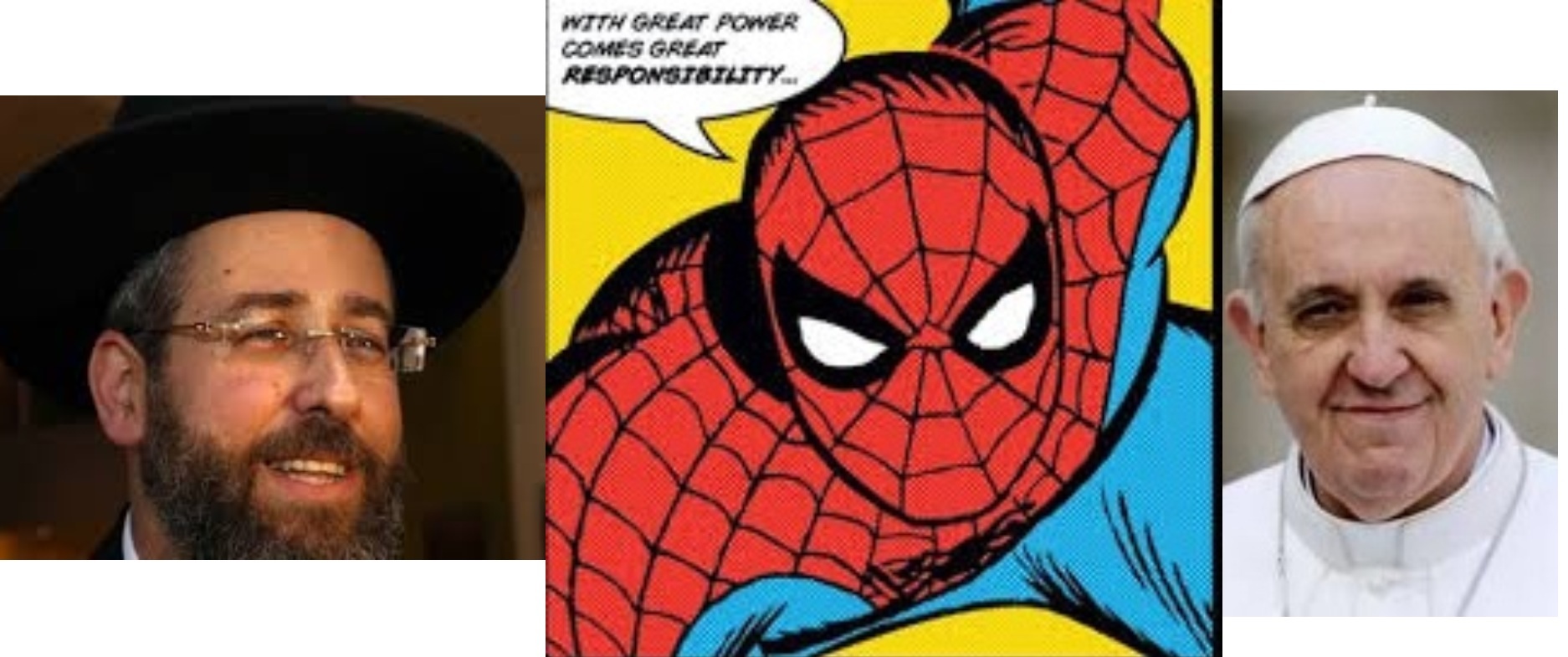
Rabbi David Blau (left), new Ashkenazi Chief Rabbi of Israel and Pope Francis (right) each have displayed different approaches to the Spider-Man credo, "With great power comes great responsibility."

Rabbi David Blau (left), new Ashkenazi Chief Rabbi of Israel and Pope Francis (right) each have displayed different approaches to the Spider-Man credo, “With great power comes great responsibility.”


My children enjoy a good superhero film, as do I. The magnetic appeal that superheroes have on pop-culture may be best summed up by Spider-Man’s Uncle Ben. In his dying breath told his powerful nephew, “With great power comes great responsibility.” There are many claims as to the source that inspired Spider-Man creator Stan Lee to use that statement. I’d like to suggest that the sentiment behind “With great power comes great responsibility” is rooted in the Torah.

More than any other book of the Torah, the book of Deuteronomy is concerned with social justice. Time and again, Deuteronomy expresses concern for the weakest, most vulnerable members of Israelite society: the stranger, the widow, the orphan, the poor and the Levites who were a landless class who subsisted on the donations of the rest of the nation. Other parts of the Torah call for caring for the weak and vulnerable. The book of Leviticus, particularly Chapter 19, frames helping the weak in terms of holiness; the Israelites are set apart through their virtue. The narratives of Genesis and Exodus highlight the triumph of the underdog who taps into inner strength and courage to overcome incredible odds. Deuteronomy takes the advocacy of social justice to another level. It appeals to the people’s empathy. We are reminded repeatedly that the Israelites were strangers and slaves in Egypt. Therefore, they must remember the suffering of the stranger in their midst. As the Israelites become a strong nation in their own right, it is as if Moses reminds them “With great power comes great responsibility.”

Parashat Re’eh hits on this theme at various points. Chapters 14 and 15 address social justice issues explicitly. The aide to the Levites, the remission of debts, the call to lend to the poor and the freeing of slaves all appeal to the nation’s empathy. What is striking is that even in Chapter 16, which is concerned with the observance of the pilgrimage festivals, the Torah appeals to the Exodus experience. Regarding the middle festival, Shavuot, (vv. 9-12) the Torah describes a highly egalitarian celebration:

You shall rejoice before the Lord your God with your son and daughter, your male and female slave, the Levite in your communities, and the stranger, the fatherless, and the widow in your midst, at the place where the Lord your God will choose to establish His name. Bear in mind that you were slaves in Egypt, and take care to obey these laws.”

How striking it is indeed that even in describing a ritual observance, the Torah appeals to empathy and social justice. The great responsibility on the shoulders of the nation is to live an exemplary, ethical life in their daily activities and in ritual observance. Rabbinic Judaism classifies two kinds of law: mitzvot bein adam l’Makom, commandments between people and God (ritual laws), and mitzvot bein adam l’chaveiro, commandments concerning interpersonal relationships. The Torah presents an ideal of laws governing ritual and interpersonal relationships complementing each other. By extension, one can reasonably conclude that responsible leaders of a religious community must embody these norms simultaneously. After all, with great power comes great responsibility.

This past week we saw snapshots of two different prominent religious leaders, each one of whom is fairly new on the global scene. I don’t know how much stock we should put in either of these snapshots, but they may offer a glimpse into larger character. The figures are Pope Francis and Rabbi David Lau, new Ashkenazi Chief Rabbi of Israel.

In a remarkable in-flight news conference on a flight from Brazil to Rome, a reporter asked about his stance on acceptance of priests who have a homosexual orientation. Prior Popes and other Church leaders might have retorted with hard line anti-gay Church doctrine. Instead, Pope Francis said “If someone is gay and he searches for the Lord and has good will, who am I to judge?” This humble statement of compassion towards gay Catholics who had previously felt ostracized by Church hierarchy was like a breath of fresh air to many Catholics. He did not change Church doctrine, but he sure did change the tone. A teacher of mine, Rabbi Brad Hirschfield, Co-President of CLAL, wrote on a blog this week:
“Who is he to judge? He’s the pope. Isn’t that part of his job?! He is the leader of a millennia old institution – one steeped in legal tradition and religious norms. How could he not judge? If not him, then who?

“Has Pope Francis become some kind of relativist? A post-modern paralytic unable to take a stand when asked what many would deem to be a straightforward question, and one with what many more would assume is an equally straightforward answer? Hardly.

“What Pope Francis did in answering as he did, was to distinguish between making a judgment and being judgmental.”

Rabbi Hirschfield elaborates and writes: “The ability to exercise judgment without becoming judgmental is fast becoming something of this pope’s trademark, so it should really come as no great surprise that he answered as he did.”

In contrast to the new Pope’s humility and non-judgmentalism, Israelis this week were treated to an ill-considered statement by the newly installed Ashkenazic Chief Rabbi, Rabbi David Lau. In a recorded interview for a Haredi news service, he exhorted yeshiva students not to waste time watching basketball games in neighborhood convenience stores when they should be in yeshiva studying Torah. He said: “Why do you care about whether the ‘kushim’ who get paid in Tel Aviv beat the ‘kushim’ who get paid in Greece?” In the Bible, Kush refers to Ethiopia, but in modern Israel ‘kushim’ is a derogatory word for anyone with black skin or of African descent. It is regarded by Israelis as equivalent to the “N” word in English or “shvartze” in Yiddish, terms that people of good will should shun. Derogatory terms such as these create a sense of “otherness” for people who are different. To paraphrase Martin Buber, our goal should be to seek “I-Thou” relationships where we regard fellow human beings as created in the image of God. Rabbi Lau later said his basketball comment was intended as a joke. Not too many people were laughing.

Rabbi Lau’s ill-considered remarks were more striking particularly as they stand in contrast to his father Rabbi Israel Meir Lau, who previously held the office of Chief Rabbi. While I was not a fan of the elder Rabbi Lau’s adherence to fervently Orthodox religious policies that I think are detrimental to the pluralistic character of Israel, I have great respect for him as a dignified man of character and integrity. Ironically, his legacy is linked with a prominent African American basketball legend, Kareem Abdul-Jabbar, with whom he developed a friendship. At the age of eight, Rabbi Lau was liberated in Buchenwald by a US Army unit of African-American soldiers. A close friend of Abdul-Jabbar’s father personally liberated Rabbi Lau. The two found each other as Abdul-Jabbar was researching the legacy of this army unit and travelled to Israel to meet Rabbi Lau in 1997. It’s a great “feel-good” story of an Israeli rabbi befriending an African-American Muslim basketball star. Based on the younger Rabbi Lau’s first week on the job in which he denigrated black basketball players, he could learn a lot from his father.

Now, nobody is perfect; however, when you hold the title of Chief Rabbi, I think it’s fair for the public to expect more consideration and thoughtfulness, especially in your first week on the job.

This week we got two glimpses of different models of religious leadership. The Pope displayed humility and sound judgment. The Chief Rabbi displayed a parochial and doctrinaire judgmentalism. I’d suggest he get some executive coaching from Pope Francis. For religious leaders of all faiths, our Torah portion this week teaches us three things: Remember where you came from; remember we are all God’s creatures; remember that with great power comes great responsibility.

#TieBlog #Re’eh

31 Jul
Parashat Re'eh--Look and see

Parashat Re’eh–Look and see

The “eye chart” tie relates to the very first word of this week’s portion: Re’eh/ Look/See. As Moses addresses the Israelites throughout the book of Deuteronomy, he appeals to multiple senses. Many of us are well familiar with Deuteronomy 6: 4, Sh’ma Yisrael/ Listen up, Israel! Adonai is our God. Adonai is one. In the opening to this week’s Torah portion, Moses appeals to the sense of sight in laying out the choice faced by the Israelites: Re’eh/ Look (folks)! I set before you blessing and curse: blessing, if you obey the commandments of the Lord your God that I enjoin upon you this day; and curse, if you do not obey the commandments of the Lord your God, but turn away from the path that I enjoin upon you this day and follow other gods, whom you have not experienced.

#TieBlog #Eikev

24 Jul
Moses breaking tablets

Moses breaking tablets

The rabbinic term for the fifth book of the Torah is Mishneh Torah, repetition of the Torah. This is because the book is a collection of Moses’s sermons that he gave to the people on the banks of the Jordan River shortly before his death. The Greek term “Deuteronomy” is synonymous with “Mishneh Torah.” In Moses’s sermons he reminds the Israelites of their history and exhorts them to stay true God’s law. In recounting 40 years in the desert, our Torah portion this week contains Moses’s recounting of the sin of the Golden calf and his breaking of the tablets of the Decalogue. The original account is from Exodus Chapter 32, Parashat Ki-Tissa. As you read the selection below from Parashat Eikev, it will be clear how this week’s tie connects to the portion.

Deuteronomy Chapter 9
8 At Horeb you so provoked the Lord that the Lord was angry enough with you to have destroyed you. 9 I had ascended the mountain to receive the tablets of stone, the Tablets of the Covenant that the Lord had made with you, and I stayed on the mountain forty days and forty nights, eating no bread and drinking no water. 10 And the Lord gave me the two tablets of stone inscribed by the finger of God, with the exact words that the Lord had addressed to you on the mountain out of the fire on the day of the Assembly.
11 At the end of those forty days and forty nights, the Lord gave me the two tablets of stone, the Tablets of the Covenant. 12 And the Lord said to me, “Hurry, go down from here at once, for the people whom you brought out of Egypt have acted wickedly; they have been quick to stray from the path that I enjoined upon them; they have made themselves a molten image.” 13 The Lord further said to me, “I see that this is a stiffnecked people. 14 Let Me alone and I will destroy them and blot out their name from under heaven, and I will make you a nation far more numerous than they.”
15 I started down the mountain, a mountain ablaze with fire, the two Tablets of the Covenant in my two hands. 16 I saw how you had sinned against the Lord your God: you had made yourselves a molten calf; you had been quick to stray from the path that the Lord had enjoined upon you. 17 Thereupon I gripped the two tablets and flung them away with both my hands, smashing them before your eyes. 18 I threw myself down before the Lord — eating no bread and drinking no water forty days and forty nights, as before — because of the great wrong you had committed, doing what displeased the Lord and vexing Him. 19 For I was in dread of the Lord’s fierce anger against you, which moved Him to wipe you out. And that time, too, the Lord gave heed to me.

Teaching Our Children to Create a Better World

19 Jul
President Obama on aftermath of Zimmerman acquittal

President Obama on aftermath of Zimmerman acquittal

Over the past week, there has been much news coverage in all the media devoted to the acquittal George Zimmerman in the killing of Trayvon Martin. For a year and a half, the case produced headlines on a range of hot-button issues: racial profiling and race relations, gun control and due process of law. We are all familiar with the basic tragic facts of the case. A teenage African-American boy was killed by gunshot in a confrontation with a white volunteer patrol officer. At the same time, Americans of good faith have drawn different conclusions about what the case means, particularly in the aftermath of the verdict. The court trial dealt with legal questions such as criminal intent and self-defense. The court of public opinion is wrestling with larger moral questions that transcend the case itself. We as Jews need to wrestle with these questions as religious challenges. What role do racial stereotypes play in our personal and collective decision making? What are appropriate boundaries of self-defense? By extension, is “stand your ground” an acceptable Jewish principle? As one rabbinic colleague wrote in a blog post: When two people stand their ground, you have a stand off where only 1 person can win. There’s always a loser. Since nobody wants to lose, each person raises the stakes. In this case, the stakes were raised so high that only one of them would come out alive. Nobody felt an obligation to stand down, to de-escalate, to walk away, which was what the dispatcher had told Zimmerman to do. It was a tragic inability to de-escalate.

I am pleased that during the trial and over the last week, demonstrations have been peaceful and that Americans of all perspectives are airing opinions in ways befitting a democratic society committed to the rule of law. We have grown a lot as a nation in over 200 years of American history, but we still have a lot of healing to do. One possible path to healing is found squarely in our Torah reading this Shabbat.

In Parashat Vaetchanan, we read the most central passage in Jewish consciousness: the Shema: Shma Yisrael Hashem Eloheinu Hashem Echad. And you shall love… V’shinantam l’vanecha v’dibarta bam. You shall teach them diligently to your children. This passage, which was lifted from the Torah and made the centerpiece of Jewish prayer, emphasizes teaching our children the mitzvoth, the commandments, that God has bestowed upon us.

The Rabbis in Midrash Sifrei comment on this verse to say that the Torah is not only referring to one’s own biological children. Of course any parent should teach Torah values to their children. Why would the Torah take the trouble to say something so obvious? Instead, the midrash says, ata motze b’kol makom she’ha talmidim kruyim vanim—students are always referred to as children. And since we are all students of one another, “You shall teach them diligently to your children” refers to anyone whose impression of Judaism is likely to be shaped by their contact with you. We are all students or potential students of one another. We all have responsibility as both teachers and pupils. How we act towards people sets an example for others. This is a high responsibility.

I follow a Facebook page by Susan Cain, author of the acclaimed book “Quiet: The Power of Introverts in a World That Can’t Stop Talking.” The book itself is worthy of a full discussion on another occasion, something I plan to do. In the meantime, Cain posted a powerful piece by another author on her Facebook page that for me is so appropriate this week.
Children Learn What They Live
By Dorothy Law Nolte, Ph.D.

If children live with criticism, they learn to condemn.
If children live with hostility, they learn to fight.
If children live with fear, they learn to be apprehensive.
If children live with pity, they learn to feel sorry for themselves.
If children live with ridicule, they learn to feel shy.
If children live with jealousy, they learn to feel envy.
If children live with shame, they learn to feel guilty.
If children live with encouragement, they learn confidence.
If children live with tolerance, they learn patience.
If children live with praise, they learn appreciation.
If children live with acceptance, they learn to love.
If children live with approval, they learn to like themselves.
If children live with recognition, they learn it is good to have a goal.
If children live with sharing, they learn generosity.
If children live with honesty, they learn truthfulness.
If children live with fairness, they learn justice.
If children live with kindness and consideration, they learn respect.
If children live with security, they learn to have faith in themselves and in those about them.
If children live with friendliness, they learn the world is a nice place in which to live.

In creating a decent community and society, we are all responsible for teaching and role modeling Jewish values for everyone of all ages, including and especially for the youngest among us. By adhering to v’shinantam l’vanecha, we cultivate a culture whereby we deal with conflicts that stand down and de-escalate conflict, rather than “stand your ground” and escalate conflict.

During the 1960s, amidst much turmoil in our society, Rabbi Abraham Joshua Heschel said: “Some are guilty, but all are responsible.” In the case of the killing of Trayvon Martin, George Zimmerman was found not guilty in a court of law. Among America’s great blessings are that a person is innocent until proven guilty in a court of law and that guilt must be proven beyond a reasonable doubt. If the jury had reasonable doubt that Zimmerman committed a crime, then he should be a free man, and he is. He will not go to jail for the death of Trayvon Martin, and no one will. Yet, in some sense, we are all responsible for his death. We are responsible to teach and model patience, to teach and model loving kindness, to teach and model peace.

V’shinantam l’vanecha, you shall teach the values of Torah diligently to your children. The Torah calls on each of us to be a teacher so that we may together create a better world.

#TieBlog #Vaetchanan

18 Jul

image

I love my Ten Commandments tie because there are three occasions during the year when I can wear it in connection with a public reading of the Decalogue. They are read in Parashat Yitro, which falls in the winter. They are also read on Shavuot at the beginning of summer. Both of these readings are from Exodus Chapter 20. Parashat Vaetchanan is the one time during the year when we read the version from Deuteronomy Chapter 5. Believe it or not, there some subtle differences. Exodus instructs, “Remember (Zakhor) the Sabbath day….” Deuteronomy instructs “Observe (Shamor) the Sabbath day….” Exodus explains the Sabbath in spiritual terms, invoking God’s initial Sabbath following the creation of the world. Deuteronomy appeals to social justice, reminding the reader that the Israelites were slaves in Egypt and that all human beings and animals that serve them must have a day of rest each week. The Friday night hymn, Lekha Dodi reflects the midrashic view that God gave both versions of the Decalogue in a single utterance. Shabbat, therefore, is simultaneously a time for spiritual renewal and reflection on social justice in the world.

12 Jul

Yeshayahu Leibowitz, 1903-1994

A boat laden with a cargo of wine was attacked by a huge whale. The beast rammed the boat repeatedly and tossed it every which way. The Captain of the vessel feared that the boat might capsize. He ordered the crew to cast overboard the entire cargo. The cartons broke apart in the water and many bottles ended up in the belly of the whale. During the attack, a number of passengers, a Jew among them, were swept over the side and swallowed by the whale. The story has entered the annals of the legends of the sea because of its strange ending. Sometime after the attack on the boat, the body of a huge sea creature was washed ashore. Fishermen rushed to the carcass and began to cut it open. Inside its belly they found the Jewish man selling wine to his fellow passengers (From Rabbi Stanley Schachter, Laugh for God’s Sake: Where Jewish Humor and Jewish Ethics Meet, KTAV, 2008, p. 128).

The contrast of destruction and rebirth, implied in this story, is particularly poignant at this time of year. The period of the three weeks between 17 Tammuz and 9 Av is a solemn time that recalls the siege of Jerusalem and the subsequent destruction of the Temple by both the Babylonians in 586 BCE and the Romans in 70 CE. We are now in the climactic third week, having entered the month of Av this past week. The Mishnah in Tractate Taanit teaches: mi-shenichnas Av me’maatin b’simchah, whoever enters the month of Av reduces his or her joy. This is because of the prominence of Tisha B’Av and the various disasters associated with that day throughout Jewish history.

The late philosopher Yeshayahu Leibowitz (1903-1994, pictured above), notes that precisely at this time of year, we experience one of the great ironies in Jewish tradition. Namely, despite the somber tone set by the Jewish calendar at this time of year, the Torah reading during these three weeks deal largely with themes of promise and hope, particularly the settling and building of the Land of Israel.

Let us look for a moment at today’s reading, Parashat Devarim. The opening phrase of the first verse sets the scene: “These are the words that Moses addressed to all Israel on the other side of the Jordan” (Deut. 1:1). The Israelites have arrived to the banks of the Jordan and are prepared to enter the Promised Land. The entire book of Deuteronomy is essentially a series of sermons and laws that Moses addresses to the people before he dies. While many of Moses’s parting words are rebukes, chastisements, or curses, the underlying message is that the Israelites are about to start a new chapter. If they remain true to God, they will prosper in their new land. If they go astray, they will be punished. This theology of reward and punishment is one of the cornerstones of the book of Deuteronomy. Even as Moses warns the Israelites of the consequences of going astray from God’s path, they gaze upon their new homeland looking forward with high hopes for the new chapter in their lives. And yet, even as our Torah reading projects a message of hope for the future, we are marking this Shabbat as Shabbat Hazon, the Shabbat in which our Haftarah contains Isaiah’s vision of desolation and destruction.

The juxtaposition of hope and despair extends throughout the three weeks. Going back to Parashat Pinchas, we read two weeks ago about the apportionment of the land to the tribes and the petition of the daughters of Tzelofhad to inherit the land from their father in the absence of sons. Last week, in Parashat Matot, we read about the efforts of the tribes of Reuven, Gad and half of Menashe to settle the eastern side of the Jordan River and their pledge to fight in Israel proper for the right to do so. The parshiot of the last two weeks have devoted significant space to describing the borders and territories of Israel and the tribes poised to inhabit them.

And yet, precisely during this season, when we read in the Torah about the great promise of the Israelites building a homeland, our tradition bids us to recall the unraveling of that promise and the shattering of the dream. Prof. Leibowitz notes that the dream is fragile, and it is up to us as individuals and as a nation to make sure that we merit the fulfillment of the dream. At the same time, as the Jewish calendar bids us to recall the destruction of Jerusalem and other calamities in our history, our Torah reading remind us of the promise and the hope of building and maintaining a vibrant nation in the Land of Israel. The Jewish calendar and the Torah reading cycle, therefore, provide us with a healthy tension—a dialectic—between recalling destruction and maintaining hope for the futre.

Without our hope for the future that things can always get better, we never would have survived as a people. There was never any justification for our suffering and persecution; however, after every dark moment in our history, there was an opportunity to rebuild, even as the bitterness of our suffering has not been forgotten.

Dr. Ismar Schorsch, former Chancellor of JTS, writes that our sacred literature was key to our survival. Quoting David Ben-Gurion, he notes: “For 2000 years the Jewish people preserved the Book, even as the Book preserved the people.” Indeed many of the dark moments of our history resulted in the writing and compilation of the most important books of our tradition. The book of Deuteronomy, written as scholars believe in the late 7th century BCE, was a response to the fall of the Northern Kingdom of Israel in 722 BCE. The destruction of the First Temple and the fall of Judah in 586 BCE led to the promulgation of the Torah by Ezra in the fifth century BCE, as the Jewish nation began to reconstitute itself in the land of Israel. The fall of the second Temple in 70 CE spawned the canonization of the entire Tanakh (Hebrew Bible); the Bar Kokhba debacle of 135 CE brought about the editing of the Mishna around the year 200 and paved the way for the further development of Rabbinic Judaism.

From the abyss of destruction, arose great creativity. This theme has been repeated throughout Jewish history. The terrible Khmelnitzky pogroms in the Ukraine in the 17th century were followed by the development of Hasidism and new spiritual creativity in Jewish life. Of course, in the 20th century, the calamity of the Shoah was followed by the founding of the State of Israel. We sing in “Hatikvah,” the Israeli national anthem, od lo avdah tikvateinu, our hope was never lost. This captures the essence of the resiliency of the Jewish people.

Both Leibowitz and Schorsch note in various writings that our observance of Tisha B’Av is much greater than a mourning of the destruction of the Temple. If it were solely about the Temple, Tisha B’Av would be almost irrelevant for a religion that has thrived for 2,000 years without a Temple. Rather, Tisha B’Av encapsulates our mourning for all of the dark periods in our history. It provides a focal point of catharsis after which we can—indeed must—get on with our lives to continue building, dreaming and creating.

On this Shabbat Hazon, we hear the harsh words of Isaiah in the haunting melody of Eicha (Book of Lamenations). We brace ourselves for Tisha B’Av when we mourn so many of the dark periods in our history. And yet, we also read about the Israelites standing me’ever l’Yarden, on the banks of the Jordan River, ready to jump in and begin a new chapter of life. This juxtaposition reminds us that we should not be so distraught over our difficult times that we cannot get on with our lives. We must always strive to create a better future. At the same time, even at the peak of our creativity, we must remind ourselves of how fragile life is so that we may work harder to preserve it.

May God give us the strength to meet the challenge of Tisha B’Av and remember that despite the darkest days of our history, we will continue to thrive in our creativity and constant efforts to bring more justice and compassion into the world.

#TieBlog #Devarim

11 Jul

image

“These are the words which Moses spoke to all Israel on this side of the Jordan in the wilderness, in the Arabah opposite the Red Sea, between Paran, and Tophel, and Laban, and Hazeroth, and Dizahab” (Deuteronomy 1:1).

When Moses is first called upon by God to lead the Israelites out of Egypt he tries to get out of the task by saying he can’t speak. Now, 40 years later, Moses delivers to the people a long succession of speeches that are compiled in the book of Devarim/Deuteronomy. Moses has found his groove as a speaker, and he spends the fifth book of the Torah reminding the people of their sacred mission. His facility with Devarim/ words inspires this week’s crossword-themed tie.