Archive | Uncategorized RSS feed for this section
14 Mar
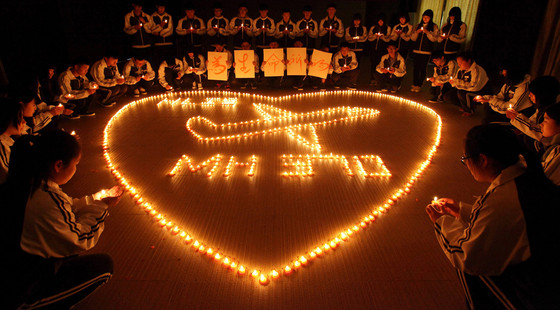
Memorial to Malaysian Airlines Flight 370.

Memorial to Malaysian Airlines Flight 370.

Where is that airplane, and why did it disappear? The mysterious loss of Malaysian Airlines Flight 370 continues to vex security and transportation officials, leaders of government and people of good will around the world. Recent reports suggest that the lost aircraft was airborne for several hours after contact was lost with it and that it had flown west over the Indian Ocean. The prospect of foul play, therefore, seems more ominous. For the passengers on the plane, what did they know what was happening to them and when did they know it? On 9/11, many passengers aboard the four hijacked airplanes were able to communicate with loved ones with their mobile phones before dying. We know that they knew. We don’t as yet have such evidence from Flight 370. At the same time, on this Shabbat Zakhor, we recall acts of terror carried out by violent enemies against our people. The ominous possibility that acts of terror in the skies claimed the lives of innocent people gives us the chills. Even if the fate of the aircraft was a result of mechanical failure, let’s reflect a bit further on what the men and women on board may have been thinking.

The prospect of facing certain death and reflecting on it over a period of hours or minutes is terrifying. On Yom Kippur in 1986, Rabbi Kenneth Berger addressed this very issue at Congregation Rodeph Shalom in Tampa. In a now famous sermon titled “Five Minutes to Live,” Rabbi Berger reflected on the seven astronauts of the Space Shuttle Challenger who perished in the disaster earlier that year. Evidence was found that the astronauts did not die in the explosion but when the capsule impacted the ocean waters. Rabbi Berger said, “For perhaps as much as five minutes, the astronauts were alive and conscious and yet knew that death was certain.”

Rabbi Berger then asked his congregation to consider the question: “What would you do if you had five minutes to live?” He challenged his congregation to live their lives as though they had five minutes left. Not in a cynical way by saying, “What’s the point?” But in a spiritual way; a way that will help us channel our direction. He spoke about serving God in those five minutes and expressing our love for our loved ones.

Less than three years later, in July 1989, Rabbi Berger was with his wife and two of his children on United Airlines flight 232 to Philadelphia. After the engines failed, the flight was forced to make an emergency landing.

In the crash landing 185 out of 285 passengers were killed, including Rabbi Berger and his wife, Aviva, while their children survived. During those moments as the plane was descending rapidly to an uncertain fate, Rabbi Berger probably thought about his own sermon.

On this Shabbat Zakhor, Erev Purim, we reflect on the fragility and preciousness of life. The mitzvah of remembrance is to remind us that innocent lives lost long ago are precious. We resolve to maintain the flame of memory in order to make meaning out of our lives. Why do we have Shabbat Zakhor before Purim? Wouldn’t it make sense to fold the themes of this Shabbat into the somber day of Yom Kippur?

It turns out, there is a strange nexus between Purim and Yom Kippur. Both holidays remind us to ask ourselves what we would do if we had five minutes to live. Various sources in our tradition highlight the connection between Purim and Yom Kippur.

The rabbis of the Midrash ask: “What was the good name that [Esther] earned for herself? That all the festivals may be nullified, but the days of Purim will never be nullified… Rabbi Eliezer says, Yom Kippur, too, will not be nullified. (Midrash – Yalkut Shimoni, Esther 944)

Furthermore, according to the Zohar, the Hebrew name for Yom Kippur — Yom KipPURIM — alludes to the similarity between these two seemingly dissimilar days. Yom KipPURIM [literally means] “a day that is like Purim.” It seems incongruous that a day of joyous revelry and a day of awesome introspection should be more similar to one another than any of the other festivals to one another. What is it about Purim and Yom Kippur that create this relationship?

As Rabbi Sharon Brous writes, “The reversibility of fortune, the capriciousness of life, is a message Purim shares with Yom Kippur…Yom Kippur compels us to reflect on the unavoidable uncertainty of our lives. But on Yom Kippur we dive into this terrifying reality with austerity, reflection and spiritual wakefulness, whereas on Purim we respond by celebrating, imbibing and masquerading.”

Yom Kippur and Purim ask the common question: “What would I do if I had five minutes to live?” Both holidays acknowledge the frailty and uncertainty of life. The answers offered by each holiday, however, seem diametrically opposed to each other.

Yet Yom Kippur is more than a day of somber reflection; it is a Yom Tov, a festival, when we celebrate being cleansed of sin. At the same time, Purim is more than a day of rowdy gluttony. Our tradition has bestowed us with mitzvot, commandments, to perform acts of generosity and community building on Purim: “Make them days of feasting and gladness and of mishloah manot (sending portions of food) one to another, and matanot l’evyonim (gifts to the poor)” (Esther 9:22). As Rabbi Brous writes, “We embrace the confusion and moral ambiguity of Purim with a renewed commitment to social transformation, responding to the mess of life by giving our family and friends sweet gifts and by giving generously to the poor. In other words, the only way to make sense of the absurd randomness of life and the social order is to honor the loving relationships that sustain us and work to address the imbalance of fortunes that leaves some with abundance and others with nothing. Mishloah manot and matanot l’evyonim come to reinforce that while we cannot control the world, we can control the way we live in it.”

When we give to others on Purim, we acknowledge our lack of control over our destinies. After all, life can change drastically in the span of just five minutes. Therefore, we must give generously today, for tomorrow, God forbid, we could be begging for a little spare change.

Three years before his death, Rabbi Berger had the foresight to remind himself and the broader community that life is not forever and that he only had a proverbial five minutes left.” The same is true for us.

On this Shabbat Zakhor, our thoughts are with the families of loved ones on Flight 370 who must be in unbearable pain. Let us resolve to make sure our leaders are vigilant against senseless acts of violence and terror. Let us also resolve to bring more love and kindness into the world.

We might not realize it yet, but we all only have five minutes left. The clock is ticking….

#TieBlog #Purim

14 Mar
Playing dice is a game of chance--much like Haman drawing lots in the book of Esther to determine the date on which he was to kill the Jews of Persia.

Playing dice is a game of chance–much like Haman drawing lots in the book of Esther to determine the date on which he was to kill the Jews of Persia.

Playing dice is a game of chance. In Megillat Esther, Haman plots to destroy the Jewish people. He draws lots and selects at random the date of 13 Adar on which to carry out his deed. After his plot was foiled through the heroism of Mordecai and Esther, the 13th of Adar was established as a day of fasting (the Fast of Esther), and the next day, the 14th of Adar, a day of feasting, Purim. Purim literally means “lots,” denoting the randomness on which the date was selected.

#TieBlog #Tzav

13 Mar
The eternal flame

The eternal flame

Parashat Tzav continues discussion of the order of sacrifices and contains the instruction that the kohanim (priests) maintain a perpetual flame on the altar. That would be enough for displaying my fiery tie this week. However, this week is also Shabbat Zakhor. We remember the attack on our ancestors by Amalek that was a precursor to their descendant Haman’s planned attack on the Jews of Persia as described in Esther. On Shabbat Zakhor we pause to recall all times in history when mightier powers preyed upon weaker and more vulnerable Jews. The eternal flame of remembrance reminds us of these sacrifices as well as the need never to let ourselves prey on the weak and vulnerable in our society.

Feeling God’s presence in Vayikra and in life

7 Mar
Survey of distribution of strands of Biblical authorship through first four books of Torah. Deuteronomy is from an independent source. See: http://en.wikipedia.org/wiki/File:Documentary_Hypothesis_Sources_Distribution_English.png

Survey of distribution of strands of Biblical authorship through first four books of Torah. Deuteronomy is from an independent source. See: http://en.wikipedia.org/wiki/File:Documentary_Hypothesis_Sources_Distribution_English.png

An old Jewish tradition holds that a child’s Jewish education begins with Sefer Vayikra, the Book of Leviticus. This might seem counter-intuitive. Unlike Genesis or Exodus, there is very little narrative in this book. Many of the laws that pertain to the sacrificial system have not been in use for 2,000 years, since the destruction of the Temple. “Small children are pure. The sacrifices are pure. Let those who are pure come and occupy themselves with things that are pure!” (Leviticus Rabbah, 7). A twelfth-century German-Jewish custom includes a child reading the first verse of Leviticus and licking a drop of honey off the writing tablet so that the words of Torah will always seem sweet.

Modern Biblical scholarship has opened up the sweetness of Vayikra for us in different ways. For some traditionally observant Jews, this may sound heretical, but the fact is the Torah does not speak in one voice. The Torah is a composite of different ideologies and perspectives that were woven together into one book that together expresses to us and to the world that there are different, valid ways of understanding and approaching God within Jewish tradition. Indeed, the greatness of the Torah stems in part from the fact that the book as a whole is greater than the sum of its parts. Scholars have identified four major strands of Biblical authorship. They are known as J, E, P and D. J is short for Yahwist, E for Elohist, P for Priestly and D for Deuteronomist. These sources were woven together, and yet their differences were not erased. The unique characteristics of each strand were left exposed for us to derive meaning to this day.

One illustration should suffice: if the book of Exodus were our only book of the Torah, then our observance of Passover would look very different. Each one of us would take a Paschal lamb with our families, slaughter it at our homes, roast it over spit and consume it in one sitting. We would observe this rite anywhere in the world. Imagine how Florida Home Owners Associations would react on Passover night. Of course, that is not what we do. We follow Deuteronomy, which came along and mandated that all sacrifices were to be done only in the Temple in Jerusalem. It follows, that if there is no Temple, there are no sacrifices. In this and other ways, Deuteronomy is the most influential book for us in terms of our daily practice as Jews till the present day.

And yet, Leviticus is still part of our Torah. We still read it every year. Opening Leviticus anew is an appropriate time to wonder why the redactor of the Torah sought to make such fault lines among different sources plainly visible to the critical reader. The P source makes his presence known in various parts of the Torah; however, the book of Leviticus is his crowning achievement. In sifting through the details of sacrifices and ritual purity that are so prominent in P, here is the basic reason. God is with us and could be physically present with us right here right now. If we were kohanim (priests) in the ancient Temple, we would have to believe that, otherwise we would be out of work. God shows up at least once in a while in the Mishkan (Tabernacle), and if so, we’d better be ready to have such a distinguished guest dining in our midst. Therefore, there have to be rules for how we behave in this environment.

These rules take into account another important detail. God is the only God and the source of all life. Any food we put into our mouth should be a reminder that God is its ultimate source. If we are to eat animals, we must not eat the blood because in blood is life. Eating meat, according to P, is done only the context of ritual sacrifice where it is sanctified on the altar, and we acquire permission from God to eat it. Outside the Temple, meat may not be eaten.

Leviticus and the P source come to tell us that God is immanent. That means God is right here with us, and our awareness of the divine Presence mandates order, ritual, decorum and purity such that we merit having God at our dinner table on an ongoing basis.

In contrast to God’s immanence in P, according to D, God is transcendent. God is distant, not readily approachable. God is a distant ruler who gave us laws through Moses as an intermediary. God will reward us for obeying the commandments and punish us for disobeying, but God is pulling the strings from afar, not from a tangible place. Based on the cultural influences around us both from within and outside the Jewish community, most of us feel more at home with the transcendent God of the universe. And yet, the voice of God’s immanence still speaks to us. We want and need to feel God’s presence.

This essential lesson of Leviticus is something that has practical implications for us in our daily lives. Imagine if we knew that God’s presence was right here, right now. How would we conduct ourselves in a way befitting our distinguished guest? In the absence of sacrificing an animal, we might think of other ways of honoring God’s presence. We might refrain from gossiping and tale-bearing about our neighbors to prevent a negative energy from infecting our sanctuary. We might love our neighbors as we love ourselves and seek to understand before we seek to be understood. We might refrain from putting a stumbling block before the blind and seek instead to communicate with one another with honesty, openness and kindness. We might seek to create a communal space of kedushah, holiness, set apart from the cut-throat, dog-eat-dog, back stabbing world in which we live. In case you were wondering, all of these guidelines for personal conduct are also found later on in the book of Leviticus. The book is concerned not only with how we conduct ourselves in the Sanctuary but also how we conduct ourselves as if God were right in our midst all the time.

With this perspective, the practice of children beginning their Jewish education with Leviticus makes more sense. We should all have the taste of honey on our lips when we open the book and read: Vayikra el Moshe, [God] called to Moses. In a Torah scroll and any edition of the Masoretic text, the final aleph of the word Vayikra appears smaller than the four letters preceding it.

Dr. Burt Visotzky of JTS comments on this and says that to be called by God requires a certain amount of diminishment. In order to be called, we need to make ourselves a bit smaller. When God calls to us, we must make ourselves humble before the Creator of all things.
The small aleph in the opening word of Vayikra, reminds us of the humility with which we should approach life. I pray that this message will be as sweet to us as the taste of honey. May we strive to act both within synagogue and outside as if God is right there with us, so that we may merit God’s continued presence.

#TieBlog #Vayikra

7 Mar
Sacrificial lambs

Sacrificial lambs

Parashat Vayikra brings us into the world of sacrifices. As arcane as animal sacrifice seems to us today, it’s helpful to reflect on how our ancestors understood sacrifice. For them, sacrifice was an occasion to feel God’s presence, not out in the distant cosmos, but right at their own table. Society’s view of religion tends to be biased toward the transcendent, more distant, view of God. However, Vayikra presents a strong and equally valid position of the Torah that God is also immanent, right there with us at our meal. When we sit down to a meal with loved ones, particularly on Shabbat or holidays, rather than focusing on the stress we receive from the “black sheep” in our family (see the Tie!), we should focus on the aspects of God’s presence that bring us together. Even if we don’t sacrifice sheep and other livestock as they did in Temple times, they can still be symbols of coming together with dear ones and experiencing God’s presence.

Alice Herz-Sommer: An Inspiration Across Generations

28 Feb
Alice Herz-Sommer, the world's oldest pianist and world's oldest Holocaust survivor, died at 110.

Alice Herz-Sommer, the world’s oldest pianist and world’s oldest Holocaust survivor, died at 110.

On Sunday night, the Academy Awards ceremony will take place. Many of us will watch the coverage of this glitzy annual spectacle. I’m sure if we polled the congregation, we would hear about a number of films that we hope will win an Oscar. Let me tell you what I’m rooting for. In the category of documentary shorts, one of the nominees is a 38-minute film titled: “The Lady in Number 6: How Music Saved My Life.” It is about the life of Alice Herz-Sommer, a renowned concert pianist and survivor of of the Theresienstadt concentration camp. She was known as the oldest living survivor of the Shoah, that is until she died last Sunday at the age of 110. Friday’s New York Times carried her obituary.

Herz-Sommer devoted her life to channeling what she regarded to be divinely inspired classical music through her hands playing a piano. She played up until her death. Well past her 100th birthday, one finger in each hand became immobilized, and she reworked her technique to play with eight fingers.

In reading about this feat late in her life, I was reminded of a text in this week’s Torah portion, Pekudei, and accompanying commentary.

As the Book of Exodus draws to a close, we read about the completion of the Mishkan, the Tabernacle in the wilderness. The text tells us:

Just as The Lord had commanded Moses, so the Israelites had done all the work. (Exodus 39: 42)

The text continues:

And when Moses saw that they had performed all the tasks–as the Lord had commanded, so they had done–Moses blessed them (43).

Absent from this verse is the text of the blessing that Moses offered to the Israelites as their new house of worship was opened for business. Rashi cites the Midrashic work the Sifra that posits that Moses offered the following blessing:

“May it be God’s will that the divine Presence rest upon the work of your hands.”

The rabbis do not pull this blessing out of thin air. In fact, there are 11 Psalms in the Book of Psalms that begin, Tefillah L’Moshe, a prayer of Moses. In Psalm 90, we read:

May Adonai our God show us compassion; may God establish the work of our hands. May God firmly establish the work of our hands (90:17).

Alice Herz-Sommer was a modern day embodiment of the divine presence resting upon the work of her hands. She was born in Prague on Nov. 26, 1903, one of five children of a cultured, German-speaking, secular Jewish family. The family traveled in artistic circles and were friendly with Franz Kafka and Gustave Mahler, both of whom Alice remembered. In fact, she remembered Kafka attending her family’s seder. Alice began piano lessons at five and at 16 began conservatory studies. Before her 20th birthday, she was giving well-received concerts throughout Europe. She married a businessman, Leopold Sommer, and they had a son Stephan in 1937. In 1939, many family members fled Czechoslovakia for Palestine, but she remained in Prague to look after her mother. In 1942, her mother was deported to Theresienstadt and was soon after killed in a death camp. She described this as the lowest point of her life, and she turned to music for solace. She resolved to learn and master Chopin’s Études.

In 1943, Alice, her husband and son were deported to Theresienstadt. Despite the deplorable conditions there, the Nazis used this camp for propaganda. Many Jewish artists, musicians and intellectuals were interned there. The Nazis allowed in the Red Cross three times a year where they would find orchestras playing concerts and leave thinking the Nazis were treating the Jews well. Alice was forced to play on a broken, out-of-tune piano. Through it all, the music sustained her. She performed over 100 concerts in captivity, including all of Chopin’s Études from memory. She said that the music kept her, and the other captives who listened to it, alive. Tragically, her husband was deported to Auschwitz and later died in Dachau.

Alice and her son survived in Theresienstadt until the end of the War. She returned to Prague, but moved to Israel in 1949, where she was a renowned teacher at what is now the Jerusalem Academy of Music and Dance. Stephan grew up to become an accomplished cellist, and in the mid-1980s, Alice followed him to London to be near him. Tragically, he died of an aneurism in 2001 at the age of 64. Once again, she coped with her loss through her music. In her London apartment building, where she occupied Flat No. 6, her neighbors heard her practicing piano constantly. Thus emerged the title of the film that is up for an Academy Award: “The Lady in Number 6: Music Saved My Life.”

Whatever happens at the Oscars on Sunday, Alice Herz-Sommer will remain an inspiration. In the film, she says that it was music that gave her hope in her darkest days. For her, she says, “Music is God.” Indeed, Alice Herz-Sommer mastered one particular expression of Divine energy and channeled it through her hands on a piano. In the time of the Torah, Moses blessed the people by praying that the Divine Presence would rest upon the work of the hands of the people. Let us be inspired by the words of Moses and the music of Alice Herz-Sommer that each of us can bring the Divine Presence into our world through the work of our hands. Our hands may feel broken at times, and the world is often unforgiving, but we can perform the work of our hands literally or figuritively.

May it be God’s will that the Divine Presence rest upon the work of our hands.

#TieBlog #Shekalim

28 Feb
On Shabbat Shekalim, the half-shekels collected from each Israelite eventually add up to real money to support the Mishkan.

On Shabbat Shekalim, the half-shekels collected from each Israelite eventually add up to real money to support the Mishkan.

This week is Shabbat Shekalim. In addition to reading our weekly portion, we read a supplemental reading, Exodus 30: 11-21 from Parashat Ki-Tissa. A census was taken through the collection of half-shekels from adult males. Rich and poor alike gave the same amount, with the funds going towards the upkeep of the Tabernacle.

This portion is read on the Shabbat prior to the month of Adar (in this year’s case, Adar II). It is a harbinger of spring. It is a time when much of the world begins to thaw out from winter and spring cleaning on a small and large scale commences. The Mishnah in Tractate Shekalim describes this as a season of repairing roads and engaging in other major civic projects that require tax revenue. It’s interesting that this happens to be the busy season for American CPA’s, with the looming Apri 15 IRS tax deadline quickly approaching. Factoring inflation over the last 3,000 years, the half-shekel doesn’t go as far as it did in the time of the Torah. So, my tie represents the growth in value of the half-shekel since Biblical times.

#TieBlog #Pekudei

27 Feb
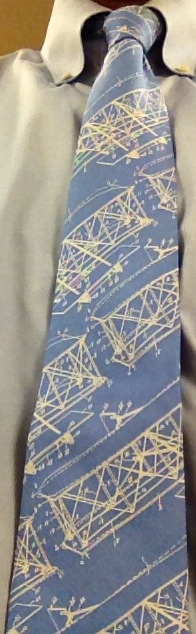
Wilber and Orville Wright's design for their "flying machine"

Wilber and Orville Wright’s design for their “flying machine”

Parashat Pekudei completes the book of Exodus. Combined with the previous portion, Vayak’hel, we read here the Torah’s recapitulation of the blueprint of the Mishkan, the Tabernacle. Under the direction of artisans Betzalel and Oholiab, the blueprint is executed and the Mishkan begins it’s operations. My tie depicts Wilbur and Orville Wright’s blueprint for their first “flying machine.” They brought their drawings into reality and changed the course of history. Similarly, by the end of Pekudei, the blue print of the Mishkan becomes reality. God’s presence fills the Sanctuary, and organized Jewish worship “takes flight.”

#TieBlog #Vayak’hel

20 Feb
The symbols of Shabbat

The symbols of Shabbat

Most of the last five portions of Exodus concern the construction of the Mishkan (Tabernacle). In the middle of these instructions is the Golden Calf narrative that was read in last week’s portion. Flanking the Golden Calf narrative on either side are instructions for observing Shabbat, the day of rest. Parashat Vayak’hel begins with the second of these expositions of Shabbat in this section. The Torah emphasizes that even the sacred work of constructing the Mishkan, representing a divine dwelling place, must not be done on Shabbat. The construction of the Mishkan must mirror God’s creation of the universe–six days of creation, followed by a day of rest. For a fuller exploration of the significance of the text’s juxtaposition of Shabbat and the construction of the Mishkan, read this week’s JTS Commentary by Dr. Eitan Fishbane. In the meantime, I will enjoy Shabbat with my Shabbat tie.

All the World’s a Stage–Moses’s Dramatic Flair in Smashing the Tablets

14 Feb
Moses breaking tablets (Rembrandt)

Moses breaking tablets (Rembrandt)

Expanded upon 2/13/14 blog post

The last couple of weeks have confirmed more than ever how obsessed America is with celebrity. Even when events of much greater consequence to our daily lives occur, more newsprint, more air time and more Internet bandwidth are given to celebrities in the news. Why do we grant equivalent if not greater importance as a society to people who entertain us rather than people who produce for society in other ways, such as manufacturing and teaching? There may be numerous answers to this question. One is that entertainment is a vital human pursuit that makes us, well, human. We need to be entertained to nourish our souls, and the people who entertain us play important roles. Furthermore, the songs singers sing to us; the stories actors perform for us; the games that athletes play for us become part of our individual stories. Their successes and failures become metaphors for our own.

Let’s consider some recent headlines to illustrate this point. Last week marked the 50th anniversary of the Beatles first trip to America and their appearance on the Ed Sullivan Show. It’s amazing how these four men, their music and the moment they stepped onto the American stage all continue to capture our imagination. Their music was transformative in that it feels current, even decades later.

The recent passing of Shirley Temple Black reminded us of the young girl who brought song and smiles to our nation in the midst of the Depression. She then grew up and became a distinguished diplomat and public servant, blazing a trail for women in public service. Sid Caesar, who died this week, revolutionized American comedy, bringing Borscht Belt humor to the masses via television. Pete Seeger, the granddaddy of American Folk music, used joyful song to galvanize multiple social movements including for civil rights, labor and the environment. These were not just three people who grew old and died. They touched people’s souls in personal ways and were transformative figures through their genres of entertainment.

Other entertainers in the news remind us of the fragility of life, its complexity and occasional tragedies. Phillip Seymour Hoffman’s death by a drug overdose reminded us of the dangers of substance abuse and that some of the most accomplished and celebrated actors are not immune from this disease. New public allegations that Dylan Farrow was molested as a child by Woody Allen forces the issue of child sexual molestation back into the limelight. We are forced to confront not just whether or not we think Woody Allen is a creep but whether our society has turned a corner in confronting the seriousness of the broader issue of child sexual abuse.

Any of the celebrities I mentioned and their respective achievements and failures would probably warrant a sermon in his or her own right. I’ve chosen to briefly survey these recent newsmakers to highlight the extent to which people who entertain us grab our attention. We live vicariously through performers such as these because, as human beings, they help provide structure and purpose to our lives.

In this light, perhaps it should not come as a surprise that among the numerous roles that Moses plays in leading the Israelites, he is also a great performer on the public stage. We see his flair for the dramatic on full display in this week’s Torah portion, Parashat Ki-Tissa. The reading contains the famous–or infamous–story of the Golden Calf. The Israelites fear that Moses is not returning from the mountaintop, and they make a graven image–a golden calf–in direct violation of the second of the Ten Commandments that they had just received. God is incensed and threatens to destroy the people. Moses, not having yet seen the idolatry has enough distance to put God “on the couch” as it were, and talk him out of destroying the people. However, once Moses sees the idolatry himself, his rage is so great he throws down and breaks the tablets of the Decalogue.

The above is the plain sense of the text. The Midrash and commentators probe a little deeper to try to get inside the head of Moses to see what he was really thinking and why he would take such an extreme measure.

The Midrash in Shemot Rabbah says: When Moses saw there was no future hope for Israel, he threw in his lot with theirs and broke the tablets and said to the Holy one blessed be He: They have sinned, but so have I with the breaking of the tablets. If you forgive them, forgive me too; as it is said; “and now, if you will forgive their sin” forgive mine too. But if thou do not forgive them, do not forgive me but “blot me out I pray from Your book which You have written.”

According to the Midrash, Moses has a flair for the dramatic, and it is none other than God whom he needs to impress. Abarbanel, the 15th century Spanish commentator agrees that Moses has a flair for the dramatic but takes a different approach: Moses did not break them on the mountain itself when he was first apprised of the sin of the calf, but he broke them in the camp. For had Israel not seen the Tables intact, the awesome work of the Lord, they would not have been moved by the fragments, since the soul is more impressed by what it sees, than by what it hears. He therefore brought them down from the mountain to show them to the people and then break them before their very eyes.”

Moses may have been the great lawgiver, but his job description also included Actor-In-Chief. It’s possible that both the Midrash and Abravanel are correct and that Moses was playing to different audiences at the same time–God AND the people. In this case he gave the performance of his life. Moses shows that a leader is tasked with engaging the soul as well as the mind. He intuitively understood that the people needed a performance. They needed drama. In fact, his absence for forty days prompted their yearning for the ritual performance of the Golden Calf. His clamping down on that act of idolatry had to be even more dramatic in order to get his point across.

Last Yom Kippur, I paid tribute to my late grandfather, Sam Lesner, who was the film and entertainment critic of the Chicago Daily News. His birthday was February 16, and he would have been 105. In a 1978 lecture on the Yiddish theater, he said the following:

“It has been written that ‘[a]ll the world is a stage, and all the men and women merely the players’ (Shakespeare). For Jews everywhere, that is more than a literary catch phrase. It’s a philosophy for living, for surviving. For, do we not daily reenact our traditions? Do we not daily reenact our faith? And do we not daily rededicate ourselves to continuity of a vast, varied and colorful heritage, the Jewish heritage?

“It has also been written that ‘[t]here is that smaller world which is the stage, and that larger stage which is the world’” (Isaac Goldberg, early 20th century journalist).

“And yet another sage has written the theater is not a game. It is a spiritual compulsion. Once it celebrated the gods. Now it broods over the fate of man. Mensch trocht, Gott lacht (Man plans, God laughs).”

My grandfather’s words continue to ring true. So, the next time we read an obituary about an entertainer or a story about a fall from grace of a celebrity, let’s remind ourselves that it’s only human for us to consume such stories because we need performers in our society. But let us also remember that Moses himself was also a performer who mustered his dramatic skills to inspire a nation towards repentance and renewal.

Shabbat Shalom