Archive | Uncategorized RSS feed for this section

#TieBlog #Ekev

14 Aug
Moses breaking tablets

Moses breaking tablets

The rabbinic term for the fifth book of the Torah is Mishneh Torah, repetition of the Torah. This is because the book is a collection of Moses’s sermons that he gave to the people on the banks of the Jordan River shortly before his death. The Greek term “Deuteronomy” is synonymous with “Mishneh Torah.” In Moses’s sermons he reminds the Israelites of their history and exhorts them to stay true God’s law. In recounting 40 years in the desert, our Torah portion this week contains Moses’s recounting of the sin of the Golden calf and his breaking of the tablets of the Decalogue. The original account is from Exodus Chapter 32, Parashat Ki-Tissa. As you read the selection below from Parashat Eikev, it will be clear how this week’s tie connects to the portion.

Deuteronomy Chapter 9
8 At Horeb you so provoked the Lord that the Lord was angry enough with you to have destroyed you. 9 I had ascended the mountain to receive the tablets of stone, the Tablets of the Covenant that the Lord had made with you, and I stayed on the mountain forty days and forty nights, eating no bread and drinking no water. 10 And the Lord gave me the two tablets of stone inscribed by the finger of God, with the exact words that the Lord had addressed to you on the mountain out of the fire on the day of the Assembly.
11 At the end of those forty days and forty nights, the Lord gave me the two tablets of stone, the Tablets of the Covenant. 12 And the Lord said to me, “Hurry, go down from here at once, for the people whom you brought out of Egypt have acted wickedly; they have been quick to stray from the path that I enjoined upon them; they have made themselves a molten image.” 13 The Lord further said to me, “I see that this is a stiffnecked people. 14 Let Me alone and I will destroy them and blot out their name from under heaven, and I will make you a nation far more numerous than they.”
15 I started down the mountain, a mountain ablaze with fire, the two Tablets of the Covenant in my two hands. 16 I saw how you had sinned against the Lord your God: you had made yourselves a molten calf; you had been quick to stray from the path that the Lord had enjoined upon you. 17 Thereupon I gripped the two tablets and flung them away with both my hands, smashing them before your eyes. 18 I threw myself down before the Lord — eating no bread and drinking no water forty days and forty nights, as before — because of the great wrong you had committed, doing what displeased the Lord and vexing Him. 19 For I was in dread of the Lord’s fierce anger against you, which moved Him to wipe you out. And that time, too, the Lord gave heed to me.

#TieBlog #Vaetchanan #Shabbat Nachamu

8 Aug
The Ten Commandments are read three times a year, including this week.

The Ten Commandments are read three times a year, including this week.

I love my Ten Commandments tie because there are three occasions during the year when I can wear it in connection with a public reading of the Decalogue. They are read in Parashat Yitro, which falls in the winter. They are also read on Shavuot at the beginning of summer. Both of these readings are from Exodus Chapter 20. Parashat Vaetchanan is the one time during the year when we read the version from Deuteronomy Chapter 5. Believe it or not, there some subtle differences. Exodus instructs, “Remember (Zakhor) the Sabbath day….” Deuteronomy instructs “Observe (Shamor) the Sabbath day….” Exodus explains the Sabbath in spiritual terms, invoking God’s initial Sabbath following the creation of the world. Deuteronomy appeals to social justice, reminding the reader that the Israelites were slaves in Egypt and that all human beings and animals that serve them must have a day of rest each week. The Friday night hymn, Lekha Dodi reflects the midrashic view that God gave both versions of the Decalogue in a single utterance. Shabbat, therefore, is simultaneously a time for spiritual renewal and reflection on social justice in the world.

Jewish people at war without and within

1 Aug
Max Steinberg, z"l, an American immigrant to Israel who served in the IDF and fell in Gaza.  An alumnus of Taglit-Birthright, pundits have ascribed partial blame to Birthright for his death.

Max Steinberg, z”l, an American immigrant to Israel who served in the IDF and fell in Gaza. An alumnus of Taglit-Birthright, pundits have ascribed partial blame to Birthright for his death.

This Shabbat is Shabbat Hazon, the Sabbath of contemplation prior to the fast day of Tisha B’Av, the day on which the First and Second Temples were destroyed. The Sages of our tradition ascribe the fall of the Second Temple as punishment for sinat hinam, causeless hatred among Jews, that cleared the way for the Roman destruction. In recent weeks, our community has united in support of Israel in its difficult but just campaign in Gaza against Hamas terror. Yet, even in a crisis such as this, unity is not total, and harsh words can be said to one another amidst heated disagreements. In services at Temple Torah on August 2 (beginning at 9:00 AM), join me in a discussion of the classic texts on sinat hinam and reflections on the meaning of Israel to us as extended family. We will refer to this Shabbat Hazon study sheet. Whether or not you can attend, feel free to post on Facebook or Twitter a response to this question: In what ways do you feel that the people of the State of Israel are like family? #Israelisfamily

#TieBlog #Devarim

1 Aug
Parashat Devarim begins "These are the words...." Hence, a crossword puzzle tie.

Parashat Devarim begins “These are the words….” Hence, a crossword puzzle tie.

Parashat Devarim begins: “These are the words which Moses spoke to all Israel on this side of the Jordan in the wilderness, in the Arabah opposite the Red Sea, between Paran, and Tophel, and Laban, and Hazeroth, and Dizahab” (Deuteronomy 1:1).

When Moses is first called upon by God to lead the Israelites out of Egypt he tries to get out of the task by saying he can’t speak. Now, 40 years later, Moses delivers to the people a long succession of speeches that are compiled in the book of Devarim/Deuteronomy. Moses has found his groove as a speaker, and he spends the fifth book of the Torah reminding the people of their sacred mission. His facility with Devarim/ words inspires this week’s crossword-themed tie.

Speaking of words, there is another important link between the Torah portion and the season. This is Shabbat Hazon, the Shabbat immediately preceding Tisha B’Av, the fast of the Ninth of Av commemorating the destruction of the First and Second Temples. The sages teach that sinat hinam, causeless hatred among Jews, easily enabled the Roman destruction of the Temple and Jerusalem. Therefore, this season is a time to reflect on the words we say and how we say them. Let’s focus on words of kindness, rather than words of hatred.

#TieBlog #Mas’ei

24 Jul
"Pray for the peace of Jerusalem."

“Pray for the peace of Jerusalem.”

Parashat Mas’ei concludes the Book of Numbers. The account of the people’s journey through the wilderness is complete. They have completed forty years in the desert and stand on the banks of the Jordan River ready to enter the Promised Land. The book ends on a hopeful note. Ironically, the Jewish calendar is now in the midst of the three weeks leading up to the Ninth of Av, our national catharsis in recalling the calamities of Jewish history. The hopefulness of the Torah reading is tempered by the pain that we recall at this time of year. It happens that as we close Bemidbar this year, the State of Israel is in the midst of a bitter struggle against the violence of Hamas and their firing thousands of rockets into Israel. It is easy to despair. At the same time, the Torah reading reminds us that the pain of our past should not paralyze us. We have reason to be hopeful for a brighter future. My tie bears the message from Psalms 122 “Pray for the Peace of Jerusalem.” So may it come to be.

#TieBlog #Matot

18 Jul
On a Mission from God

On a Mission from God

This tie could work for many Torah portions, but seems particularly apt for Parashat Matot. Throughout the reading we are reminded in different ways that the Israelites are on a mission from God. There are positive and negative applications of this notion. The portion begins with laws about vows. Invoking God’s name in a promise to do something is a big deal and should not be taken lightly, according to the Torah. The particulars of vows as described here are anachronistic; namely, we cannot imagine in a Western society women’s vows being annulled by their fathers and husbands. Nevertheless, the concept of vows should prompt us to think about the power of our words and give us pause, particularly when we swear in the name of God. The contemporary practice of swearing before testifying in court is a vestige of this ancient practice. Whenever we speak, it is worthy to think of ourselves on a mission from God.

The portion’s discussion of the war against Midian exemplifies taking “on a mission from God” too far. Moses is incensed that the soldiers “only” killed the Midianite men and not the women as well. As great as Moses was, this is his low moment. A similar situation is found in http://learn.jtsa.edu/content/translations/shabbat-zakhortzav/haftarah-portion/shabbat-zakhor when Saul does not follow through to the letter on the destruction of Amalek. Samuel, like Moses, condemns Saul’s excessive mercy. Rabbi Louis Jacobs once said in reference to that text, “I believe that Samuel heard it (i.e., the command to destroy Amalek), but I don’t believe God said it.”* I believe a similar interpretation applies to Moses. In this case, he misunderstood God who usually commands kindness towards the stranger. Moses is led astray by his understanding of “a mission from God.”

Moses redeems himself to some extent by insisting that the tribes of Reuven, Gad and half of Menashe join in the efforts to conquer the Promised Land, before they settle in the pasture land east of the Jordan River. Moses insists that the entire people must be all in to fulfill their mission from God.

As we study Parashat Matot this week, let us reflect on what it means to be on a mission from God and how that concept applies to us today.

*Cited in Rabbi Harold S. Kushner, Living a Life That Matters, New York: Anchor Books, 2001, p. 96.

#TieBlog #Pinchas

10 Jul
Batman, a vigilante, is a modern version of Pinchas.

Batman, a vigilante, is a modern version of Pinchas.

Pinchas is the Torah’s “Dark Knight.” He is a vigilante who takes the law into his own hands. When the Israelites were seduced into a mass orgy by the Moabites, God and Moses are incensed. Pinchas is too and pushes the envelope by stabbing to death a prominent Israelite man and Moabite woman who are copulating in public. Parashat Pinchas begins with God rewarding Pinchas, grandson of Aaron the High Priest, with a Brit Shalom, a Covenant of Peace. The rabbis struggle to justify this reward when Pinchas acted outside of any legal jurisdiction to take such action. In the Jerusalem Talmud the rabbis go so far as to say that Pinchas should have been excommunicated were it not for God’s own intervention. Batman is a similarly complex figure who stands for justice but operates outside the established legal system. Hence, the Batman tie.

One additional note: as I post this there is conflict in Israel with Hamas firing rockets from Gaza towards civilian pupulations in Israel and Israel striking back at Gaza. This latest escalation follows the murders of three Israeli teenagers and the retaliatory murder of a Palestinian teenager. In the Masoretic text, the letter vav of the word Shalom (peace) is broken (Numbers 25:12). Perhaps the Masoretes offer their own subliminal interpretation that expresses doubt over the fitness of Pinchas in receiving a covenant of peace. Peace is fragile and broken easily, especially in the face of zealotry. Let us pray for a true and lasting peace for our brothers and sister in Israel and their neighbors.

#TieBlog #Balak #BalaamandTalkingDonkey

4 Jul
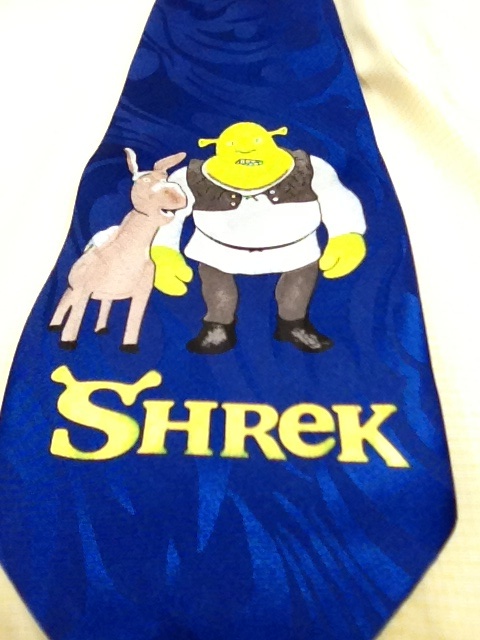
Shrek and his talking donkey friend are reminiscent of Balaam and the talking donkey.

Shrek and his talking donkey friend are reminiscent of Balaam and the talking donkey.

Balak, King of Moab, seeks a cost-efficient means to destroy the Israelites and hires Balaam, wizard extraordinaire, to curse Israel. It’s puzzling that rather than bless his own people, Balak sought to curse another. In today’s world, too often people’s hatred of others is greater than their love of themselves.

In the meantime, every time Balaam the Wizard-For-Hire goes to curse the Israelites, out of his mouth come warm blessings. Balaam is not pleased by his performance that God has caused, and he takes his frustrations out on his donkey–who talks back to him! You can read the dramatic exchange below. As you do, take a look at my tie of the week. You may want to picture in your mind Shrek (voiced by Mike Meyers) as Balaam and the donkey (as voiced by Eddie Murphy)–as the donkey!

Numbers 22

21 And Balaam rose up in the morning, and saddled his ass, and went with the princes of Moab.
22 And God’s anger was kindled because he went; and the angel of the Lord stood in the way as an adversary against him. Now he was riding upon his ass, and his two servants were with him.
23 And the ass saw the angel of the Lord standing in the way, and his sword drawn in his hand; and the ass turned aside out of the way, and went into the field; and Balaam struck the ass, to turn it to the way.
24 But the angel of the Lord stood in a path of the vineyards, a wall being on this side, and a wall on that side.
25 And when the ass saw the angel of the Lord, it pushed itself to the wall, and crushed Balaam’s foot against the wall; and he struck her again.
26 And the angel of the Lord went further, and stood in a narrow place, where there was no way to turn either to the right hand or to the left.
27 And when the ass saw the angel of the Lord, it fell down under Balaam; and Balaam’s anger was kindled, and he struck the ass with a staff.
28 And the Lord opened the mouth of the ass, and it said to Balaam, What have I done to you, that you have struck me these three times?
29 And Balaam said to the ass, Because you have mocked me; I wished there was a sword in my hand, for now would I kill you.
30 And the ass said to Balaam, Am not I your ass, upon which you have ridden ever since I was yours to this day? Was I ever wont to do so to you? And he said, No.
31 Then the Lord opened the eyes of Balaam, and he saw the angel of the Lord standing in the way, and his sword drawn in his hand; and he bowed down his head, and fell on his face.
32 And the angel of the Lord said to him, Why did you strike your ass these three times? Behold, I went out to withstand you, because your way is perverse before me;
33 And the ass saw me, and turned from me these three times; if it had not turned aside from me, surely now also I would had slain you, and let her live.
34 And Balaam said to the angel of the Lord, I have sinned; for I knew not that you stood in the way against me; now therefore, if it displeases you, I will go back again.

#TieBlog #Hukkat

27 Jun
The Red Chicago Bulls logo is reminiscent of the Red Heifer in Parashat Hukkat.

The Red Chicago Bulls logo is reminiscent of the Red Heifer in Parashat Hukkat.

This tie is in honor of the sacrifice of the Red Heifer described in Numbers 19, the beginning of this week’s Parashat Hukkat. One could not enter the precincts of the Tabernacle or Temple in a state of ritual impurity. Only being sprinkled with the ashes of the red heifer would remove defilement from having had contact with the dead. As Professor Jacob Milgrom wrote, the Temple is a place to affirm life. Associations with death are not welcome. Of course, a bull is male and a heifer is female, but why get hung up on small details? Shabbat Shalom.

#TieBlog #Korach #RebelWithoutACause

17 Jun
James Dean was  not the original "Rebel Without a Cause;" he inherited the mantle from Korach.

James Dean was not the original “Rebel Without a Cause;” he inherited the mantle from Korach.

Parashat Korach tells the tale of perhaps the original “rebel without a cause.” A Levite, Korach is jealous of the power and prestige of his cousins Moses and Aaron and stages a rebellion. With an assist from God, the rebellion fails miserably, and Korach and his comrades are swallowed by the earth. Several millennia later, James Dean inherited from Korach the mantle of “Rebel Without a Cause;” hence, the tie of the week.