
Give heed to the sound of the shofar.
Sometimes the tie just speaks for itself. May the sound of the shofar arouse each of us to do good for the world in the coming year. A joyous and healthy new year to all. L’Shanah Tovah.
Give heed to the sound of the shofar.
Sometimes the tie just speaks for itself. May the sound of the shofar arouse each of us to do good for the world in the coming year. A joyous and healthy new year to all. L’Shanah Tovah.

“It is not in heaven” (Deuteronomy 30:12)
While human beings have acquired the ability to launch rockets and people into space and explore the heavens, Deuteronomy in Parashat Nitzavim tells us that Torah–the totality of our received tradition from God–is “lo bashamayim hi,” “it is not in heaven” (Deuteronomy 30:12). This phrase has been understood that the Torah is not an esoteric document. It is meant for human beings in this world to explore, interpret and reinterpret. This verse plays a central role in one of the most famous passages in the Talmud, Bava Metzia 59b, in which Rabbi Eliezer is in a dispute with Rabbi Joshua and the majority of sages. Rabbi Eliezer performs miracles and even has a divine voice from the heavens call out that the law is in accordance with him. Rabbi Joshua, however, says “Lo bashamayim hi,” “[The Torah] is not in heaven.” God laughs in response and says, “My children have defeated me.” The Torah is meant to be studied and reinterpreted in each generation.
The Ice Bucket Challenge is so “last year!” Get into the 5775 groove and take the #TTShofar Challenge!

Make the last Shabbat of 5774 a “fixer-upper” opportunity for 5775.
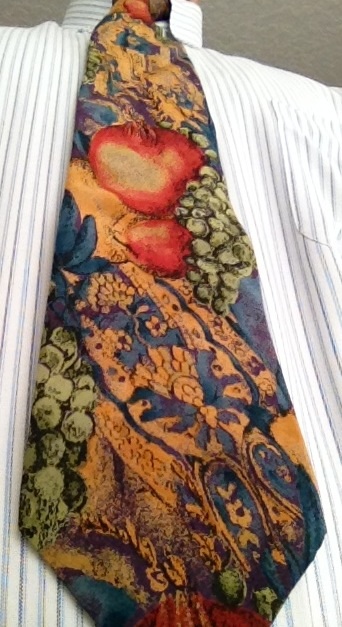
A cornucopia of fruit, reminiscent of the Bikkurim/first fruits
Parashat Ki-Tavo opens with the passage describing the Bikkurim/First fruits offering. The Talmud describes this offering as the centerpiece of Shavuot, the second of the major festivals. One can picture a humble farmer bringing precious first fruits to the Temple for this thanksgiving offering. The Torah provides a specific liturgical text to be said upon presenting this gift to the kohen/priest. The text notes the humble origins of the Israelites, their plight in Egypt as slaves, their miraculous freedom and their return to the Land of Israel. While this text was originally associated with this ritual on Shavuot, after the destruction of the Temple and the end of sacrifices, the rabbis re-appropriated this text as a central passage in the Passover Seder. The cornucopia of fruit on this week’s tie represents the gift of first fruits.

Steven Sotloff, 1983-2014
Parashat Ki Tetze, ends with the mitzvah of Zakhor: Zakhor et asher asah lekha Amalek: 17 Remember what Amalek did to you on your journey, after you left Egypt — 18 how, undeterred by fear of God, he surprised you on the march, when you were famished and weary, and cut down all the stragglers in your rear. 19 Therefore, when the Lord your God grants you safety from all your enemies around you, in the land that the Lord your God is giving you as a hereditary portion, you shall blot out the memory of Amalek from under heaven. Do not forget!
This Shabbat we remember Steven Sotloff, z”l. An American journalist from Miami, he was also Jewish. In 2008 he made aliyah and held dual American and Israeli citizenship. As a journalist, he was committed to uncovering the truth, even if it meant putting himself in great danger. While on assignment in Syria last year, he was kidnapped by the Islamic State. When another American journalist, James Foley, of blessed memory, was brutally murdered and beheaded by ISIS, the terrorists announced that Sotloff was next. Despite an emotional appeal by his mother, Sotloff was brutally executed and beheaded this week. Our nation mourns. Within our shock and outrage, we ask how it is that these ISIS terrorists can imagine the brutality that they have committed.
Within our tradition, the rabbis ask the same question about Amalek. In the Midrash, the rabbis ask what was Amalek’s motive? After all, following the Exodus from Egypt, the Israelites showed the world they had God on their side. What could a nation hope to gain by attacking Israel?
The Midrash uses the analogy of a boiling hot bath. The first person that jumps in gets badly burned – but cools the bath off considerably, making it easier for the next person to jump in. Amalek so badly wanted the Israelites destroyed, that they were willing to attack Israel even after having witnessed how God’s powerful hand had protected them. Amalek was defeated, as the Torah tells us, but their gutsy, almost suicidal, attack on the Jews did a lot to alter the prevalent thinking of the time that the Jews and their God were invincible.
The world has a bad habit of standing by watching terrorists brutalize innocent civilians. The world has been particularly tolerant of Hamas terrorists who threaten the lives of millions of Israelis with rockets and tunnels and then put their own children in harm’s way as defensive shields when Israel retaliates against the rocket fire. When the democratic nation of Israel defends her citizens from terrorism, Israel is reviled throughout the world and accused of war crimes. What many around the world fail to understand is that if terrorism fueled by Islamic fundamentalism is allowed to exist in Israel, it will spread to the rest of the civilized world. As Prime Minister Netanyahu says, if Israel is forced to tolerate terror, it will come soon to a theater near you. Tragically, that is what we are witnessing with ISIS. President Obama called ISIS a cancer that must be stopped before it spreads even more. It’s an apt metaphor; however, we must recognize both the source of the cancer and prior failures to fight it.
James Foley and Steven Sotloff are hardly the first Americans to fall victims to the diabolical terror of Islamic fundamentalism. This week, we mark the 13th anniversary of 9/11 when 3,000 people died on our soil. The mitzvah of Zakhor extends beyond words and tributes to those who perished at the hands of terrorists. Zakhor requires further action.
In the immediate aftermath of 9/11, I believe our nation failed to seize the moment to challenge Americans to make our society better and more respected in the world. The mitzvah of remembering Amalek caps a parasha with more mitzvoth than any other parasha: fair weights and measures in business, safe building practices in home construction, and protection of the weaker members of society. It’s as if a message of our parasha is that the best antidote to evil is a society that lives by laws and high moral principles. When there is a breakdown of that structure, Amalek is invited to enter.
In the midst of self-reflection of how we in Western civilization have allowed terrorism to spread, there’s another angle to explore. Rabbi Jonathan Sacks, Former Chief Rabbi of Great Britain, wrote three years ago how Osama bin Laden thought he could get away with it. The same question applies today to ISIS and their genocidal rampage. Rav Sacks writes that bin Laden thought he could get away with it because he saw the West in decline.
Sacks writes about the moral decline of our society and the diminishing commitment to communal values throughout the West. He writes: “Whenever Me takes precedence over We, and pleasure today over viability tomorrow, a society is in trouble. If so, then the enemy is not radical Islam, it is us and our by now unsustainable self-indulgence.
The West has expended much energy and courage fighting wars in Afghanistan and Iraq abroad and defeating terror at home. It has spent far less, if any, in renewing its own morality and the institutions — families, communities, ethical codes, standards in public life — where it is created and sustained. But if I am right, this is the West’s greatest weakness in the eyes of its enemies as well as its friends.”
ISIS, Al Qaeda, Hamas and other radical groups scoff at our values in which preservation of life reigns supreme. Like Amalek generations ago, they willingly jump into a hot bath to show the world that beheadings can be done. Our leaders must have the moral gumption to fight this tyranny and stop it. Moreover, we as citizens must continue to build a society rooted in the highest values of human dignity.
Rav Sacks’ words about 9/11 ring true today. He writes:
“The only way to save the world is to begin with ourselves. Our burden after 9/11 is to renew the moral disciplines of freedom. Some say it can’t be done. They are wrong: it can and must. Surely we owe the dead no less.”
May we be inspired by Parashat Ki Tetze to create a just society that prevents Amalek from rearing its ugly head. That will be the best way we can honor Steven Sotloff’s memory, may his memory be for a blessing.

“When you go out to war…” (Deut. 21:10)
This week’s Torah portion, Ki-Tetze, begins and ends with accounts of war. The midrash interprets the various laws of the opening section (Deuteronomy 21: 10-21) as a narrative thread underscoring the ravages of war. A soldier in the heat of battle covets a female prisoner and, under the power of lust, marries her (vv. 10-14); in the end, he will lose feelings of affection for her and for the children he fathers with her (15-17), and those children will grow up disrespectful (vv. 18-21) of their parents.
The very end of the portion (25: 17-19) recounts the Amelekites’ surprise attack on the Israelites in which they preyed upon the most vulnerable. We have the paradoxical instructions both to “Remember!” and to “blot out the memory of Amalek.” Rashi notes that immediately prior to this section we have the commandment to keep fair weights and measures. He says that the juxtaposition of these texts shows that when we are lax in business ethics, we open ourselves up to communal disaster in which the weakest members of the community will pay the steepest price. Indeed, all of the laws in Ki-Tetze underscore what Rabbi Harold Kushner calls “the irreducible dignity and worth of a human being.” Without this societal norm, we are vulnerable to the scourge of war.

The scales of justice
“Justice, justice you shall pursue.” This is the clarion call of Parashat Shofetim (Deuteronomy 16: 20). It is in the context of Moses instructing the Israelites to create the institutional infrastructure for a just society. The scales of justice on my tie evoke this central and eternal Jewish quest for justice.

Parashat Re’eh–Look and see
The “eye chart” tie relates to the very first word of this week’s portion: Re’eh/ Look/See. As Moses addresses the Israelites throughout the book of Deuteronomy, he appeals to multiple senses. Many of us are well familiar with Deuteronomy 6: 4, Sh’ma Yisrael/ Listen up, Israel! Adonai is our God. Adonai is one. In the opening to this week’s Torah portion, Moses appeals to the sense of sight in laying out the choice faced by the Israelites: Re’eh/ Look (folks)! I set before you blessing and curse: blessing, if you obey the commandments of the Lord your God that I enjoin upon you this day; and curse, if you do not obey the commandments of the Lord your God, but turn away from the path that I enjoin upon you this day and follow other gods, whom you have not experienced.
Karen James was 19-years-old when she competed as a swimmer for Canada in the 1972 Munich Olympics. An innocent teenager in a more innocent time than our own day, she was walking back to the Olympic village. Rather than walk all the way around to the main gate, she and a teammate climbed over the chain-link fence near her dormitory. Four decades later, she is now telling her story of bearing witness to one of the most horrific acts of terror the world has ever known, the murder of the 11 Israeli athletes.
I heard Karen James speak last Sunday at the BB & T Center in Sunrise during the opening ceremonies of the JCC Maccabi Games that brought together hundreds of Jewish teens from around the country for athletic competition and Jewish solidarity. Temple Torah’s own Sam Bernstein and Harlan Kagan participated and many of our members volunteered to make the games a success. Karen James, in her address, described that when she climbed the fence, she noticed a group of men hiding behind a bush who climbed the fence shortly after her. She only realized later, after her dorm was on lockdown, that those men were terrorists who were holding the Israelis hostage. After the athletes were murdered and the games continued as if nothing happened, Karen went home. She had worked her whole life to make it to the Olympics, but now she couldn’t wait to get home. Karen is Jewish but grew up secular and for many years did not speak about Munich. In recent years, she has been speaking publicly about her experiences. She said that doing so has brought her closer to her Jewish roots.
Karen James’s message on Sunday night was sobering in that the world does not seem to have gotten much more peaceful in the last 42 years. The world is still pathetically indifferent towards violence and terror and hostile towards Israel in its effort to combat terror. Nearly 200,000 Syrians have been murdered by the Assad regime. The brutality of the Islamic State of Iraq and Syria has been largely unchecked until America’s action last week to save the Yazidis from genocide. Israel’s recent operation in Gaza to protect its citizens from rockets from above and terror tunnels from below highlighted much of the world’s indifference to terrorism against Jews and their outrage at Israel’s response to defending itself from terrorism. There have been no mass demonstrations demanding the world fight genocide in Syria and Iraq. Yet, throngs have people have gathered in European capitals spouting vicious anti-Semitism that has also reared its ugly head in pockets of America, including Miami. In a world that seems so helplessly out of control, what are we to do? We find some guidance in today’s Torah portion.
In Parashat Ekev, we encounter the theme of reward and punishment that is especially prominent in Deuteronomy. Serve God well, and you’ll receive abundant blessings; fail to serve God, and you will suffer the consequences. In this context, Moses relates to the people: V’atah Yisrael, Mah Adonai Elohecha shoeil mei-imach, And now, Israel, what does God demand of you? Ki im l’yirah et Adonai Elohecha lalechet b’chol d’rachav—Only that you revere the Lord your God, to walk in His paths, to love Him, and to serve God with all your heart and soul.
The Midrash Sifre comments on the phrase lalechet bidrachav, to walk in all His ways. Quoting Exodus, the Midrash says, “These are the ways of the Holy One—“gracious and compassionate, patient, abounding in kindness and faithfulness, assuring love for a thousand generations, forgiving iniquity, transgression, and sin, and granting pardon (Ex. 34:6). Just as God is gracious and compassionate, you too must be gracious and compassionate…Just as the Holy One is faithful, you too must be faithful. As the Holy One is loving, you too must be loving.
In the face of helplessness and despair over a brutal, violent world, our sacred teachings remind us that it’s in our power to bring loving kindness into the world. The Talmud notes further “Hakol bidei shamayim hutz mi-yirat shamayim” Everything is in the power of heaven except for the fear of heaven. God can’t control how we feel and think, nor can God control the choices that we make. This is a good thing. Imagine if we were robots and every action was pre-programmed. It would be a boring world. We are free to choose between good and evil, between following God’s ways and rejecting them. We cannot be compelled to be good. The decision whether to love God and to follow the Torah’s teachings is totally under our control.
The Torah empowers us to engage in the world and demands that we not sit idly by. When people are hungry, we have the ability to feed them. When a friend is suffering, we have the ability to reach out and offer support. The tragic death of Robin Williams has awakened our society to the inner suffering of individual with depression and our duty to offer help. When our brothers and sisters in Israel and Jews around the world are under attack, we have the duty to bear witness to the truth, lobby our officials to support America’s democratic ally, Israel, and, if possible, to visit Israel and be there with our people in person.
Karen James told Jewish teenagers this week about when she witnessed first-hand horrific violence in the making. However, embedded in her message was great hope. The Maccabi Games themselves testified that despite all of the challenges in the world, hundreds of Jewish teens can gather proudly as Jews and engage in friendly, sportsmanlike competition. The Maccabi Games remind us that lalechet bidrachav, to walk in God’s ways, means that God expects us to engage in society and affirm life. Through our efforts in this endeavor, let us find the strength to bring about peace and loving kindness into our world.
 From Huffington Post
 Rabbi Ed Bernstein