Archive | Uncategorized RSS feed for this section

Why I wrote “The Roar of the Cat Rabbi”

6 Feb
JTS hosted a panel discussion on "Keeping Faith in Rabbis," Feb. 2, 2015. L to R, Rabbi Ed Bernstein, Rabbi Hayim Herring, Rabbi Daniel Nevins, Barbara Wiston, Jay Wiston, Carolyn Kantor, Rabbi Danielle Upbin

JTS hosted a panel discussion on “Keeping Faith in Rabbis,” Feb. 2, 2015 at Temple Torat Emet in Boynton Beach. L to R, Rabbi Ed Bernstein, Rabbi Hayim Herring, Rabbi Daniel Nevins, Barbara Wiston, Jay Wiston, Carolyn Kantor, Rabbi Danielle Upbin

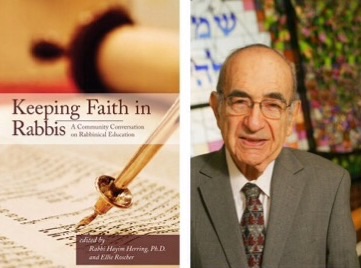
The following is adapted from remarks I delivered February 2, 2015, during a JTS panel discussion on the book Keeping Faith in Rabbis: A Community Conversation on Rabbinical Education, edited by Rabbi Hayim Herring and Ellie Roscher. A podcast of panel discussion is available here.

This week’s Torah portion, Yitro, ties in well with what I attempt to accomplish in my essay, “The Roar of the Cat Rabbi: The Vital Role of Introverts in the Congregational Rabbinate” in the book Keeping Faith in Rabbis. Yitro, Moses’s father-in-law, finds Moses overwhelmed in his job. He is mired in the minutiae of day-to-day problems, he’s at risk of burn-out and he’s neglecting his own family. We already know that Moses has worked hard to overcome his own poor self-assessment of himself in taking on the mantle of leadership. God let Aaron serve as Moses’s spokesman, but eventually Moses gains confidence and asserts himself and speaks in his own right. Yitro knows Moses. He knows that he’s trying to do the right thing. He may also know that Moses’s harshest critic is himself, a common trait among introverts. From afar, Yitro can see the bigger picture and steps in to offer Moses some guidance to streamline his work load with the help of others. Moses is able to use the tools offered by Yitro so that he is able to grow as a leader.

Self-Awareness and personal growth are at the heart of my essay: “The Roar of the Cat Rabbi: The Vital Role of Introverts in the Congregational Rabbinate.” You may be interested to know that not everyone at Temple Torat Emet agrees with that assertion. (How could we be Jewish if that weren’t the case?) In fact, a few weeks ago, a lady who regularly comes to my Talmud class and was among the first to buy the book came up to me after services a few days later and said, “Rabbi, I disagree with you,” she said. I was bracing myself for the critique. She said: “You are NOT an introvert! I see you mingling with people in synagogue all the time.”

I was tempted to regurgitate the main points of my essay; then I caught myself and thought why throw a wet blanket on a well-intentioned compliment. I just said thank you. Let me take this opportunity to share why I wrote this essay and what I hope is the biggest take aways for our community. In short, here are the basics: 1) I am an introvert 2) I accept that 3) There are no “cookie cutter rabbis”–every rabbi brings different strengths to the table, and in our era we need all hands on deck and 4) Whatever our personality traits, each one of us is best served when we seize opportunities to grow.

Now for some backstory:

Exactly 20 years ago, an article appeared in the CCAR Journal titled “Dog Rabbis and Cat Rabbis.” The author, Rabbi Dan Cohn-Sherbock, asserted that dog rabbis–or extroverts–are better suited for the pulpit rabbinate than introverts (“cat rabbis”). Cohn-Sherbock described himself as a “cat rabbi” who struggled in several pulpit positions early in his career then shifted to academia where he has flourished for several decades. In assessing his pulpit woes, he writes: “I tried and tried and tried–yet over and over again I failed to satisfy the demands of my congregation. I fell into every trap. I just couldn’t be the friendly, enthusiastic, sympathetic, and attentive pastor that my congregation wanted.”
He describes his journey to congregations on multiple continents. “I shriveled up inside when I had to act as master of ceremonies. I dreaded bar mitzvahs. I loathed weddings. I detested kissing each lady ‘good Shabbos.'”

Now, I empathize with Cohn-Sherbok’s agony in the pulpit, yet he makes assumptions and generalizations that are neither realistic nor helpful in providing guidance to current and aspiring rabbis in the 21st Century.

In the two decades since Cohn-Sherbok’s article appeared, psychological and social science literature has exploded with groundbreaking research on personality traits. Susan Cain’s best seller Quiet: The Power of Introverts in a World That Can’t Stop Talking synthesizes the scientific literature and argues for a fresh look at the significant role that introverts played in history and can continue to play with greater awareness and sensitivity throughout society. I argue that the Jewish community will benefit from looking anew at the strengths of introverted rabbis.

I learned from Cain’s work that the basic difference between introverts and extroverts is how each processes and reacts to stimuli. Introverts are wired to reflect and inspect, extroverts are wired to react and respond. These traits are hard-wired from birth. Our American society has evolved towards favoring high octane, high volume, highly stimulating people and environments. Just think of the pyrotechnics of last night’s Superbowl Halftime Show. Yet, many people, perhaps as many as half of us, get exhausted when we’re exposed to high levels of stimuli over a period of time. It’s not good or bad, it’s just that evolution has endowed us with different mechanisms for survival in our world.

Anyone who enters the rabbinate does so, I assume, because of a deep sense of personal mission towards serving God and the Jewish people. Certainly, I did. Extroverts and Introverts alike both bring natural gifts to bear in their rabbinates. As an introverted rabbi, I used to envy extroverts for their natural ability to schmooze and light up a room. I was misguided by the dog rabbi-cat rabbi dichotomy, and I was frustrated with myself. I got stuck in a position of envy of something that I was not. Over time, I came to a position of acceptance of who I am and the essential gifts I bring to the table that I believe serve me well in the rabbinate. Once I got unstuck from the mindset of “Woe unto me that I’m not x,” I embraced a mindset of growth (The term “mindset” I derive from Susan Dweck’s masterful work by that name). With that mindset, I am more open to Susan Cain’s metaphor of a rubber band, whereby I can stretch myself beyond my comfort zone in order to fulfill my mission. Some rabbis are personally nourished by exposure to large amounts of people in a social setting. For me, when I schmooze with people at Kiddush, as was noticed by my Talmud student, I do so with the mindset that forging relationships with my congregants is part of my mission of serving as a rabbi. Therefore, I make sure I have the right tools in my toolkit to fulfill my mission.

To come back to Parashat Yitro, when Moses felt stuck, he reframed and retooled. Moses teaches us that self-reflection and growth are essential qualities for leadership, and they are great tools for life in general. Every rabbi, Seminary and synagogue should embrace the growth mindset for the sake of serving God and the Jewish people. When we accomplish this, we have lots of reason to keep faith in rabbis.

#TieBlog #Yitro #TenCommandments

5 Feb

Rabbi Ed Bernstein

The Ten Commandments The Ten Commandments

Parashat Yitro tells of the Israelites’ encounter with God at Mt. Sinai. It is not enough for the people to have obtained physical freedom from slavery. They need spiritual freedom that is framed by a system of law. The Ten Commandments provide this basic framework that is essential for a society rooted in law.

View original post

#TieBlog #Beshalah #ShabbatShirah

30 Jan

Rabbi Ed Bernstein

Shabbat Shirah/Sabbath of Song Shabbat Shirah/Sabbath of Song

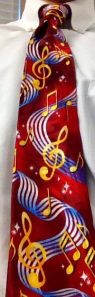
Parashat Beshalah contains the climactic moment of the Israelites crossing of the Sea and their assured redemption from slavery in Egypt. Moses and Miriam lead the people in song and dance celebrating their salvation. The Shabbat in which this portion is read is traditionally called Shabbat Shirah/Sabbath of Song. The theme of of music and song is expressed by this week’s tie.

View original post

#TieBlog #Bo

22 Jan

Rabbi Ed Bernstein

"They shall eat [the Paschal lamb] roasted over fire with matzah and bitter herbs" (Exodus 12:8). “They shall eat [the Paschal lamb] roasted over fire with matzah and bitter herbs” (Exodus 12:8).

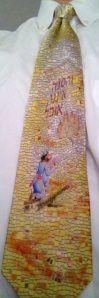
When people see me wear this tie in the winter they often fret that Passover is around the corner and that they have to start preparing their kitchens to be kosher for Passover, an arduous rite of spring. Have no fear, that’s still three months away. However, our Torah reading this week, Parashat Bo, describes the final three of the ten plagues. As a prelude to the climactic tenth plague, the slaying of the first born, the Torah describes the ritual of the Passover sacrifice that becomes the basis of the Passover Seder observed to this day. The roasted lamb must be eaten with matzah (unleavened bread) and maror (bitter herbs). The Passover rituals are designed to spark discussion about the significance of the Exodus from Egypt in Jewish consciousness. Even if it’s…

View original post 12 more words

#TieBlog #Va’era

16 Jan
"Frogs here, Frogs there. Frogs were jumping everywhere."

“Frogs here, Frogs there. Frogs were jumping everywhere.”

Many of us learned the song in pre-school as we were preparing for our Passover Seders:

One morning when Pharaoh awoke in his bed
There were frogs on his pillow and frogs on his head.
Frogs on his nose and frogs on his toes,
Frog here, frogs there, frogs were jumping everywhere.

This week in Parashat Va’era, we read about the first seven of ten plagues that God sent to Egypt to pressure Pharaoh to let the Israelites go free. With the children’s song about the frogs, it’s easy to make light of the plagues and even laugh about them. However, at the Seder we remind ourselves not to rejoice by removing a drop of wine from our wine glasses as we recite each plague. We rejoice that the plagues led to freedom for an enslaved people; we do not rejoice that human beings suffered as a result, so we temper our joy. #TieBlog deems it’s not out of bounds to wear a frog-themed tie when reading about the plagues, so here’s my tie of the week.

We are our brothers’ and sisters’ keepers

9 Jan
"Am I my brother's keeper?" (Gen. 4: 9) The Torah turns Cain's protestation into the essence of Judaism.

“Am I my brother’s keeper?” (Gen. 4: 9) The Torah turns Cain’s protestation into the essence of Judaism.

(This D’var Torah was inspired by a D’var Torah delivered by Rabbi Daniel Nevins at JTS Rabbinic Training Institute, January 8, 2015)

As we begin reading the book of Exodus, it’s fitting to review one key aspect of the previous book, Sefer Bereshit, the book of Genesis. Normative Judaism, unlike Christianity, does not have a concept of original sin. We are all born with a clean slate, and we have free will to do good or evil and shape our destiny. Further, one can argue that Adam and Eve should not really be considered to have committed the first sin by eating the forbidden fruit because 1) They didn’t hurt anyone; 2) God bears responsibility for planting the tree of knowledge of good and evil in the first place; 3) How could God have NOT desired that humans understand the difference? As far as the direction of the Torah and Jewish tradition is concerned, the first real sin in the Torah is when Cain kills Abel. Not only does he kill him, but he denies responsibility. When God asks him אי הבל אחיך–where is your brother Abel?–Cain answers: לא ידעתי–I don’t know–השומר אחי אנוכי Am I my brother’s keeper?

Cain’s contempt for his brother and his brutal violence set a tone for the rest of Genesis. There is terrible sibling rivalry. Brothers are not their brothers’ keepers. True, we don’t see another fratricide, but we come close. Esau almost kills Jacob. Joseph is almost killed by his brothers. Even sisters Rachel and Leah have a painful rivalry, even if it is not physically violent. Brothers are not kind to brothers, sisters are not kind to sisters and brother are not kind to sisters, such as Laban treating his sister Rebecca like a piece of chattel to sell for a significant sum. Simeon and Levi’s response to Dina’s liaison with Shechem–they’re not protecting her, they’re protecting their honor through horrific violence. One chapter after another, generation after generation, and our ancestors are not their brothers’ or sisters’ keepers.

Then, suddenly, when we least expect it, there is a change. Judah breaks the spell when he stands up before Joseph and protects his endangered brother Benjamin. Joseph, in a position to avenge the brutality of his brothers from years before backs off. He relents. He says אני יוסף אחיך–I am Joseph your brother. He welcomes them into his palace in Egypt. This is the first recorded act of forgiveness in human history. Genesis closes with siblings serving as shomrim, guardians for one another.  Genesis begins with a question–will siblings guard one another?After generations of struggle, by the end of the Genesis, the answer is finally yes.  This resolution sets the stage for the opening of Exodus.

A new Pharaoh arises who enslaves the Israelites and afflicts them with pain. Despite the pain, the Israelites are not broken. As the narrative zeroes in on one family, we see a reason why. An infant Moses is guarded closely by his sister Miriam until he is safely in the care of Pharaoh’s daughter. An adult Moses is called upon by God to lead the people out of bondage. He’s terrified and tries mightily to avoid the task. God tries to impress him with a fiery bush not consumed by fire. God turns Moses’s staff into a snake and turns his hand white as snow only to cure it just as instantly. God presents one final ace in the hole: Moses won’t be alone. His brother Aaron will be by his side to help. Only then Moses goes forward.

Exodus presents a new model. Siblings are each others’ keepers. They support one another and care for each other. The Torah is making a powerful statement. Sibling rivalry is natural. However, when siblings are there for one another, other people who are not biological siblings are more capable of looking out for one another. Indeed, a nation is born. When a nation of disparate tribes comes together, they have the capacity to enter a covenant with God.

The power of brotherhood, sisterhood or, if you will, siblinghood is as real for us today as it was for our ancestors. This weekend we join with people of good will of all faiths and persuasions in abject horror over the brutal terrorist attacks in France this week. The massacre of at least 12 people at the satirical newspaper Charlie Hebdo and the apparent murder of at least four at a kosher market in a related incident on Friday remind the world that the   depravity of militant Islam knows no bounds. Every time a horrific incident like this occurs, whether in Israel, Europe, the U.S. or anywhere, we hope that maybe, just maybe, the world will finally understand the Torah’s teaching that we are all created in God’s image and that we are our brothers’ and sisters’ keepers. After all, what does it take for the world to get it?

It is easy to fall into despair when we observe such evil and horrendous violence in our world. To a large measure it’s beyond our control, and we feel powerless. And yet, time and again we answer the call of our tradition to affirm life and attempt to bring loving kindness into the world.

This weekend, our community is celebrating a historic moment in the life of our congregation. We honor the trust, the fellowship, the sense of responsibility to the Jewish people that brought together two congregations, Temple Torah and Temple Emeth, to form one vibrant congregation, Temple Torat Emet. Our new name means the Torah of truth, a powerful phrase that is found throughout our liturgy, including the second blessing we say in a Torah aliyah. How do we discover the truth of the Torah? By acting as guardians of our brothers and sisters as we see in today’s Torah reading.

Our new venture as Temple Torat Emet came about through courage, trust and a great sense of responsibility to the Jewish people. Our success in the future depends on choices we make based on the Torah’s guidance. As a Kehillah Kedoshah, a sacred community, our task is to create a sense of caring for one another as if we are all brothers and sisters. Let us build a community in which we see one another, listen to one another, rejoice with one another, and, when necessary, weep with one another. We must ensure that all activities in our building are conducted with dignity and respect. At every service and program, we must remember the higher purpose to which we are called in creating this sacred community. Our sense of community and fellowship must extend beyond the walls of this building and include Shabbat and holiday meals in each other’s homes where we will build true and lasting friendships.

Our world is, tragically, a vicious place. We need a refuge. We need a laboratory for goodness and loving kindness. That is what Temple Torat Emet must be for our community.  If we can model for the broader community the meaning of shemirah, looking out for one another, we will give ourselves and the world a desperately needed gift. Let me close with the words of the Psalmist:

הנה מה טוב ומה נעים שבת אחים גם יחד

“How good it is when brothers and sisters dwell together in harmony.”

May we be worthy of this sacred task.


#TieBlog #Shemot

9 Jan

Rabbi Ed Bernstein

"And the bush was not consumed"  (3: 2). “And the bush was not consumed” (Exodus 3:2)

In Parashat Shemot , Moses bursts onto the scene as the man appointed by God to go before Pharaoh to demand freedom for the Israelites. He hears the call from a humble bush–indicating that God’s presence can be found in places both majestic and modest. Moses was astute enough and open enough to experience God’s presence in the burning bush. As inscribed on the tie, “V’hasneh einenu ukal,” “And the bush was not consumed.”

View original post

#TieBlog #Vayehi

2 Jan

Rabbi Ed Bernstein

Egyptian-themed tie Egyptian-themed tie

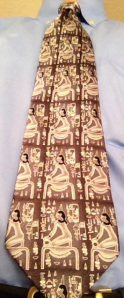
Several years ago, I visited the King Tut exhibit at the Field Museum of Natural History in Chicago. Naturally, I was drawn to the gift shop afterwards and found this tie that I knew would be just perfect for Parashat Vayehi. The patriarch Jacob dies, and Joseph has him embalmed–Egyptian mummy style–so that the children of Israel could escort their father’s remains on the long journey back to Canaan where he was to be buried. Later, Joseph dies. While he too leaves instructions to be buried in Canaan, his remains will be taken when the children of Israel leave Egypt permanently. In the meantime, he too is embalmed and entombed in Egypt. So, Parashat Vayehi is the one Torah portion with mummies, giving it a very King Tut-esque flavor.

View original post

#TieBlog #Vayigash

26 Dec

Rabbi Ed Bernstein

The Lion of Judah The Lion of Judah

In next week’s Torah portion, Vayehi, Jacob blesses his sons and likens Judah to a lion. A lion is symbolic of courage and grace under fire. Judah earns this reputation in this week’s Torah portion, Vayigash, when he boldly approaches Joseph and pleads with him to spare Benjamin from punishment and to take him instead. Hence, this Shabbat my tie bears the lion of Judah.

View original post

Discovering the miraculous in our actions

19 Dec
Rabbi Harold Schulweis, z"l, contributed to the recently published "Keeping Faith in Rabbis." He died December 18, 2014, at the age of 89.

Rabbi Harold Schulweis, z”l, contributed to the recently published “Keeping Faith in Rabbis.” He died December 18, 2014, at the age of 89.

What is the job of a rabbi? We can all think of many things based on our experiences. A rabbi often functions as service leader, preacher, teacher, spiritual counsellor, manager, writer, mediator, strategic planner, fundraiser and many more.

The modern rabbinate continues to evolve. In 21st Century America, we have to ask how contemporary challenges that our Jewish community faces will shape the rabbinate and how the rabbinate must respond to challenges to shape the Jewish community. A new book, Keeping Faith in Rabbis: A Community Conversation on Rabbinical Education, edited by Rabbi Hayim Herring and Ellie Roscher, is a collection of essays that explore the evolving American rabbinate. I am proud to say that I am a contributor to this volume with the publication of my essay “The Roar of the Cat Rabbi: The Vital Role of Introverts in the Congregational Rabbinate.” In coming weeks, I hope to discuss my essay further. For now, I want to turn to another essay in the book, “The Loneliness of the Rabbi,” by Rabbi Harold Schulweis. Rabbi Schulweis died on Thursday at the age of 89. He had an illustrious career as the Rabbi of Valley Beth Shalom, a vibrant Conservative synagogue in Los Angeles. I did not know him personally but was inspired by his writing and teaching. He was a powerful and engaging speaker, a brilliant yet accessible theologian and a passionate advocate for social justice. He was a Gadol Hador, one of the giants of the Jewish world in our generation. In his essay in Keeping Faith in Rabbis, he addresses rabbis directly as to their sacred duty.

He writes:
“Rabbis, you are the children of prophets. In you is the solace that comes from loyalty to the conscience that has led you to this sacred vocation. In you is the moral passion that kept the prophet alive, who when he confessed that he felt the derision against him, and was tempted not to mention God’s name was overwhelmed by the word that was “in my heart as a burning fire shut up in my bones.”

There are many things that a rabbi does, but based on Rabbi Schulweis’s teaching, I would like to suggest a common purpose among our various forms of service: the rabbi’s job is to guide others to seek out and discover God’s presence in one another and in our world. When we help others achieve this and add meaning to their lives, we are successful.

The task of finding God’s presence in one another and in our world lies at the heart of Shabbat Hanukkah. On Shabbat Hanukkah we wrestle with two questions: 1)What exactly is the miracle of Hanukkah that we celebrate? 2) Why does Shabbat Hanukkah always coincide with Parashat Mikketz (and is there a connection between the two?—OK, that’s a third question.)

Let’s address these questions. Our ancestors saw miracles in the story of Hanukkah, but differed on precisely what the miracle was. There are two separate Hanukkah miracles described by different voices of our tradition. In our liturgy, we say the prayer Al HaNissim, which praises God for the miracle that delivered a military victory of the weak over the strong, the few over the many, the pure over the impure, and the righteous over the wicked. In the Talmud, however, we find the legend of the single cruse of oil that miraculously burned for eight days instead of just one. Our tradition gives voice to both of these founding myths, and both are valid and important.

So, what does Hanukkah have to do with the central episode of the Joseph story that we read this Shabbat, Parashat Mikketz? They always fall together, but why? On the surface, this is a pure coincidence. Our Torah reading cycle was not coordinated with the cycle of festivals and special days on the Jewish calendar. For this reason, we have the separate Maftir Torah reading and special Haftarah reading that are singled out today for Hanukkah. Nevertheless, our annual mingling of the story of Joseph in Egypt with our commemoration of the Maccabean revolt against their Greek oppressors, begs for closer examination.
The Joseph story is itself the most naturalistic narrative in the Torah. On the surface, God is not an active player. Every event can be read in purely naturalist terms in its descriptions of human behavior. We have sibling rivalry, parental meddling, deception, lust, political ambition, guilt, and revenge. We recognize these experiences from our own lives, and we identify with the characters as a result.

At the same time, there are just too many coincidences in the story for it to be entirely arbitrary: Joseph’s brothers sell him as a slave, which leads to his serving in the house of Potiphar, which leads to his imprisonment, which eventually leads to his interpreting Pharaoh’s dreams, which leads to his appointment as Pharaoh’s #2, which leads to Joseph’s brothers coming to bow down before Joseph, begging for food. God is never described by the narrative as the direct cause of this chain of events, but Joseph attributes everything to the hand of God and forgives his brothers as a result.

In the Joseph story, God’s presence is well-hidden. God never speaks but is portrayed as working all along, though in ways not apparent to most of the actors. Joseph himself ascribes God’s role in orchestrating the chain of events in his life that ultimately leads to his reunion with his family and his forgiveness of his brothers (Gen. 45:5).

Rabbi Neil Gillman notes a parallel between the Joseph story and the Hanukkah story. If we look at historical accounts of the second century BCE, we find not only the persecution of the Greeks toward Jews, but the internal struggles between the Maccabees and the Hellenists, Jews who sought to live completely immersed in Greek culture. It is a story rife with political intrigue, assassinations, and civil war. The Maccabees emerged as the winners during this period of great strife. On the one hand, their story can be told in naturalist ways: the story of an oppressed people rebelling against an imperialistic kingdom, fighting to regain their freedom and their right to worship as they wished, and winning because of their military might and political sense. It was only subsequent generations, starting with the Maccabees themselves, who interpreted the series of events as miraculous, the work of God’s hand in human history.

We see an interesting phenomenon in the Joseph story and in Judaism’s response to the Maccabean revolt. In both cases, God is seen as having played a role in the unfolding of events, even as God’s presence is not readily apparent at the time the events are happening. By extension, the coincidence of Parashat Mikketz and Shabbat Hanukkah is perhaps not a coincidence at all. It may be our tradition’s way of saying that God is present throughout our lives. Our openness to seeking out and being aware of God’s presence is a step towards adding meaning to our lives.

Rabbi Harold Schulweis helped countless numbers of Jews encounter God’s presence through guiding them to discover God’s presence in other people. In the process, he helped bring fresh meaning to modern American Judaism. On this Shabbat Hanukkah, I pray that we will follow the example of Rabbi Schulweis. Let us tap into our human ingenuity and compassion to bring about good in the world so that future generations will look back at us and say that through our efforts God performed miracles.
Amen.