Archive | Uncategorized RSS feed for this section

#TieBlog #Matot-Masei

16 Jul

Rabbi Ed Bernstein

Journeys around the world

“These are the journeys.” The last Parashah of the Book of Numbers, Masei, enumerates 42 stations in the desert where the Israelites stopped along the way. Rashi asks the obvious question, why? Aren’t these superfluous details? The answer he provides, derived from the Midrash, is that it was a sign of God’s compassion. No one should say that God decreed the Israelites wander for 40 years without rest. This week’s tie shows travel around the world in slightly more luxurious environs than those experienced by our ancestors in the desert. Summer is a time many people travel. If you are, enjoy the oases God has provided wherever you go.

View original post

10 Jul

Rabbi Ed Bernstein

image

Pinchas is the Torah’s “Dark Knight.” He is a vigilante who takes the law into his own hands. When the Israelites were seduced into a mass orgy by the Moabites, God and Moses are incensed. Pinchas is too and pushes the envelope by stabbing to death a prominent Israelite man and Moabite woman who are copulating in public. Parashat Pinchas begins with God rewarding Pinchas, grandson of Aaron the High Priest, with a Brit Shalom, a Covenant of Peace. The rabbis struggle to justify this reward when Pinchas acted outside of any legal jurisdiction to take such action. In the Jerusalem Talmud the rabbis go so far as to say that Pinchas should have been excommunicated were it not for God’s own intervention. Batman is a similarly complex figure who stands for justice but operates outside the established legal system. A Batman tie, therefore, seems apt this week.

View original post

#TieBlog #Balak #BalaamandTalkingDonkey

3 Jul

Rabbi Ed Bernstein

Shrek and his talking donkey friend are reminiscent of Balaam and the talking donkey. Shrek and his talking donkey friend are reminiscent of Balaam and the talking donkey.

Balak, King of Moab, seeks a cost-efficient means to destroy the Israelites and hires Balaam, wizard extraordinaire, to curse Israel. It’s puzzling that rather than bless his own people, Balak sought to curse another. In today’s world, too often people’s hatred of others is greater than their love of themselves.

In the meantime, every time Balaam the Wizard-For-Hire goes to curse the Israelites, out of his mouth come warm blessings. Balaam is not pleased by his performance that God has caused, and he takes his frustrations out on his donkey–who talks back to him! You can read the dramatic exchange below. As you do, take a look at my tie of the week. You may want to picture in your mind Shrek (voiced by Mike Meyers) as Balaam and the donkey (as voiced by Eddie…

View original post 458 more words

#TieBlog #Hukkat

26 Jun

Rabbi Ed Bernstein

The Red Chicago Bulls logo is reminiscent of the Red Heifer in Parashat Hukkat. The Red Chicago Bulls logo is reminiscent of the Red Heifer in Parashat Hukkat.

This tie is in honor of the sacrifice of the Red Heifer described in Numbers 19, the beginning of this week’s Parashat Hukkat. One could not enter the precincts of the Tabernacle or Temple in a state of ritual impurity. Only being sprinkled with the ashes of the red heifer would remove defilement from having had contact with the dead. As Professor Jacob Milgrom wrote, the Temple is a place to affirm life. Associations with death are not welcome. Of course, a bull is male and a heifer is female, but why get hung up on small details? Shabbat Shalom.

View original post

Tapping into gratitude as summer begins

5 Jun
Facebook COO Sheryl Sandberg with her husband, the late David Goldberg

Facebook COO Sheryl Sandberg with her husband, the late David Goldberg

Another school year is in the books. At this time of year, children exhale a massive sigh of relief as they begin summer vacation. Summer is a wonderful time for relaxation, adventure, travel and renewal. From the perspective of a parent like me, we get a bit of a break from the grueling car pool schedule (the flip side is that by August, we’ll be itching for the kids to get back to school and into a regular routine).

It’s funny that the image of children eagerly leaving school is invoked by one of the major commentators of this week’s Torah portion, Behaalotekha. This portion introduces a profound shift in the tone of the fourth book of the Torah, Bemidbar. The first ten chapters paint a portrait of order and structure in the camp. In chapter 11, everything starts to unravel, and the rest of the book portrays the tension between the stiff-necked people of Israel and Moses, their increasingly impatient leader.

According to Ramban  (Nachmanides), the transition from order to chaos hinges on a single verse, 10: 33: Vayis’u me’har Hashem derekh shloshet yamim, they marched from the mountain of the Lord a distance of three days. Ramban says: “They fled the mountain like a child running from school” lest God give them any more commandments or prohibitions. The Israelites couldn’t wait to go on summer vacation from God. They sought a spiritual, emotional and physical distance from Mount Sinai. It’s precisely at this moment that the book of Numbers spirals from order to chaos.

A few verses later, chapter 11 opens Vayehi ha’am k’mitonenim ra b’oznei Hashem, the people complained bitterly in the ears of God. At first, we’re not even told what they were complaining about—just that they were complaining. Only a few verses later the Israelites wept and said mi yaachileinu basar? “Who’s going to feed us meat?” No wonder God was holding His ears, as it were—the people were complaining about God’s cooking—the miraculous manah that rained down every day was not good enough for the people. They were sick of Tofu-like imitation meat; they demanded the real thing. And so it goes throughout the rest of the book: complaints and challenges to authority. They depart Mt. Sinai, and rather than have a peaceful summer vacation at a desert oasis, all Hell breaks loose. It is remarkable how quickly the people have forgotten the Exodus from Egypt and their salvation from God.

A lesson from Bemidbar is that when we lose our sense of gratitude for life’s greatest gifts, our world turns into disarray. Ironically, all too often it is people who suffer adversity who teach us the greatest lessons of gratitude for what really matters. A case in point is Sheryl Sandberg. Until recently, she might not have been the poster child for adversity. In fact, she is the COO of Facebook and the best-selling author of Lean In, an analysis of women in the workplace in the 21st century. Her husband, Dave Goldberg, was the founder and CEO of Survey Monkey. He was respected in his industry and adored by all who knew him. Then, last month tragedy struck. Dave Goldberg was working out in a gym while on vacation in Mexico. In a freak accident, he suffered a severe head injury and died. Their family had it made. Both husband and wife were captains of industry—the high tech industry. Moreover, they had a beautiful family rooted in Jewish values. They had it made.

One can hardly imagine the emotional toll this tragedy has taken on Sheryl Sandberg. And yet, this week she published a moving and courageous essay on the occasion of the shloshim, the end of the formal thirty days of mourning since her husband’s death. Here are some excerpts :

Sandberg writes:

Today is the end of sheloshim for my beloved husband—the first thirty days. Judaism calls for a period of intense mourning known as shiva that lasts seven days after a loved one is buried. After shiva, most normal activities can be resumed, but it is the end of sheloshim that marks the completion of religious mourning for a spouse.

A childhood friend of mine who is now a rabbi recently told me that the most powerful one-line prayer he has ever read is: “Let me not die while I am still alive.” I would have never understood that prayer before losing Dave. Now I do.

I think when tragedy occurs, it presents a choice. You can give in to the void, the emptiness that fills your heart, your lungs, constricts your ability to think or even breathe. Or you can try to find meaning. These past thirty days, I have spent many of my moments lost in that void. And I know that many future moments will be consumed by the vast emptiness as well.

But when I can, I want to choose life and meaning.

And this is why I am writing: to mark the end of sheloshim and to give back some of what others have given to me. While the experience of grief is profoundly personal, the bravery of those who have shared their own experiences has helped pull me through. Some who opened their hearts were my closest friends. Others were total strangers who have shared wisdom and advice publicly. So I am sharing what I have learned in the hope that it helps someone else. In the hope that there can be some meaning from this tragedy.

I have lived thirty years in these thirty days. I am thirty years sadder. I feel like I am thirty years wiser.

I have learned that I never really knew what to say to others in need. I think I got this all wrong before; I tried to assure people that it would be okay, thinking that hope was the most comforting thing I could offer. A friend of mine with late-stage cancer told me that the worst thing people could say to him was “It is going to be okay.” That voice in his head would scream, How do you know it is going to be okay? Do you not understand that I might die? I learned this past month what he was trying to teach me. Real empathy is sometimes not insisting that it will be okay but acknowledging that it is not. When people say to me, “You and your children will find happiness again,” my heart tells me, Yes, I believe that, but I know I will never feel pure joy again. Those who have said, “You will find a new normal, but it will never be as good” comfort me more because they know and speak the truth. Even a simple “How are you?”—almost always asked with the best of intentions—is better replaced with “How are you today?” When I am asked “How are you?” I stop myself from shouting, My husband died a month ago, how do you think I am? When I hear “How are you today?” I realize the person knows that the best I can do right now is to get through each day.

I have learned gratitude. Real gratitude for the things I took for granted before—like life. As heartbroken as I am, I look at my children each day and rejoice that they are alive. I appreciate every smile, every hug. I no longer take each day for granted. When a friend told me that he hates birthdays and so he was not celebrating his, I looked at him and said through tears, “Celebrate your birthday, goddammit. You are lucky to have each one.” My next birthday will be depressing as hell, but I am determined to celebrate it in my heart more than I have ever celebrated a birthday before.

I am truly grateful to the many who have offered their sympathy. A colleague told me that his wife, whom I have never met, decided to show her support by going back to school to get her degree—something she had been putting off for years. Yes! When the circumstances allow, I believe as much as ever in leaning in. And so many men—from those I know well to those I will likely never know—are honoring Dave’s life by spending more time with their families.

Sheryl Sandberg somehow mustered the strength amidst her agony to produce this gem. She taps into her pain to articulate some of life’s most important lessons, and on top of that she grounds her reflections in a Jewish framework. Over the next few weeks, as we encounter once again the wayward Israelites in the desert crying out to God and Moses with their constant complaints, let’s recall Sheryl Sandberg’s counterpoint that we must pause to appreciate the things in life that really matter.

School is over, summer begins. Let this be a summer in which we are mindful of God’s blessings to us.

Happy Summer.


#TieBlog #Behaalotekha

4 Jun

Rabbi Ed Bernstein

Parashat Behaalotekha begins with instructions to Aaron to light the Menorah. Parashat Behaalotekha begins with instructions to Aaron to light the Menorah.

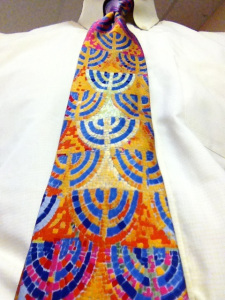
Parashat Behaalotekha begins with instructions to Aaron to light the lights of the Menorah in the Tabernacle. In addition, the haftarah (prophetic reading) is taken from Zechariah and contains the prophet’s vision of the Menorah. This same selection is repeated on Shabbat-Hanukkah. The text of the haftarah inspired the lyrics of Debbie Friedman’s classic song: “Not by might, and not by power. But by spirit alone shall we all live in peace.” May the light of the Menorah inspire all of us to such a vision.

View original post

#TieBlog #Naso The Hair of the Nazirite

28 May

Rabbi Ed Bernstein

image Parashat Naso introduces the laws of the Nazirite, a person who takes a vow of piety for a finite period of time in which the person is prohibited from consuming any grape product, having contact with the dead and cutting hair. The Haftarah for Parashat Naso is from the book of Judges and describes the birth of the most famous Nazirite in history, Samson. He had the unusual especially unusual status of being subject to the vow from birth. He is known for the link between his hair and his physical strength. The hair-care products on this week’s tie remind us of the Nazirite.

View original post

Shavuot, Memorial Day and my personal link to V-E Day

22 May
My grandfather, Sam Lesner, during World War II.

My grandfather, Sam Lesner, during World War II.

This year, America’s observance of Memorial Day coincides with the second day of the Jewish festival of Shavuot when we say Yizkor, the memorial prayers in memory of our departed loved ones. We think of them now as on other holidays since they are not physically present to enjoy the festival with us. This year’s convergence of Memorial Day with Yizkor is striking as it comes on the heels of the 70th anniversary of V-E Day when the Allies secured the unconditional surrender of the Nazis. We recall the hundreds of thousands of soldiers who died in the line of service to our country and the Allies in the effort to restore order and justice to the world. We also always have on our minds the six million Jewish martyrs who were slaughtered in the Shoah. Just as we must never forget their death, we also must never forget the brave soldiers who liberated the remnant of European Jewry.

In recent weeks, since the anniversary of V-E Day, I have been reflecting on my late grandfather, Sam Lesner, of blessed memory, who served as an Army medic in the European theater, particularly in France and Belgium. He was in the Battle of the Bulge and bore witness to the ravages of war. During his entire period in the service from his first day of boot camp to the day he returned home, he and my Grandma Esther, of blessed memory, wrote letters to each other every day. These letters were preserved, and over the last few years my mother Roberta Bernstein and her sister, my aunt Judy Holstein, have transcribed, edited and organized these letters. I’d like to share a few selections from my grandfather from the last weeks of the War and his reflections on V-E Day as it happened.

14 March 1945 Somewhere in Belgium

For several days now truck-loads of liberated victims of the Nazi monsters have been speeding down the highway. I can’t describe just what happens to one as these trucks whirl by and the scarred, dirty, weary faces break into spasms of joy and tears as they shout greetings to us. It hurts inside of you.

May 4, 1945 Somewhere in Belgium

My Darling:

Today the mail brought me your letter of April 15, a sensitive, poignant expression of your feelings and the nation’s at-large over the death of the President [Roosevelt, on April 12]. Our great loss, however, has become our great gain, our salvation, for the events which are following the complete destruction of Nazism, which should be cause for a Roman holiday — these events, because of our great loss, are being viewed seriously, quietly, as they should be.

Far better that we are bowing our heads in prayerful thanksgiving instead of making a mockery of the death cries of our brothers. There has been no attempt here to start a “celebration” of the great victories which are being announced hourly. Just a few minutes ago we heard the news of the millions of “mighty” supermen surrendering unconditionally. Perhaps the weekend will bring the last and final chapter to their horror. I don’t think anyone will feel very gay. Our feelings about this are so deep and so intermingled with the loneliness that pursues us at all times that we are more likely to utter a profound “thank God” and let it go at that.

V-E DAY 7 May, 1945 Somewhere in Belgium

My Darling:

It was about 5 PM today when we heard the official news. We were at chow. There was absolutely no demonstration because every man of us at that instant thought only of home. What are our wives doing? What are our folks doing? What are our sweethearts and friends doing? There was some handshaking and then we returned to the barracks and sat on each other’s’ bunks. “Gee, I wonder how our families feel?” It was repeated over and over and none of us had an answer. But I know what you are feeling, my beloved. Because I am suddenly frightfully lonely, I will follow the crowd tonight. We will simply move in a crowd toward the town and the thing will gain momentum as we go along. I don’t know what I’ll do or what I’ll say. I know, though, that I must move and with each step I’ll hear the beat of my heart. It keeps saying, Esther, Esther, the worst of this is over. My Darling, there is hope now, a real, joyous hope. I must go now, beloved. The day is glorious. Last night I smelled the fertile earth for the first time, and I remarked on it to Max. It was a strange sensation, suddenly being so aware of the fruitful earth. “This is spring at last,” I said, little realizing the morrow would be truly spring again for the world. This day then, May 7, 1945, is the beginning. While much of the world’s war-weary bow their heads, we raise ours high and say “thank God” for His safe guidance and protection. Tomorrow, my Darling, perhaps I can tell you just how it feels. For tonight and every night, my love, undivided, and my thanks for the child you gave me.

May 23, 1945 Ciney, Belgium

Yesterday, I witnessed a sight that filled my eyes and my heart with tears. For some days now, prisoners of war and political prisoners have been returning to their Belgian homes. The small, shabby Ciney is ludicrously decorated with the “palm of welcome” which are small uprooted trees, stuck in the cobblestones in front of the returning man’s
home. Max and I, walking to town, drifted toward the railroad station where a crowd had gathered. We knew then that a trainload of victims was due. Children, their arms loaded with makeshift bouquets of field flowers, dashed about excitedly. Finally, the train pulled in and stopped. The few who were returning to Ciney jumped off as many others stood in the doorways of the long train of boxcars. There was a rush as fathers
grabbed up their kids, crushing them and their flowers. I shall never forget one little girl who was too young to know such emotion, clinging to her “hero” Daddy as he held her high in his arms. That child was sobbing with the suddenly released emotion that was far too mature for a child. Will men remember those moments of reunion with their children and direct their lives toward a world of peace? Or will they forget again and start fighting each other with the hatred and savagery of wild beasts? Even in this small community, already the seeds of future wars and disturbances are being planted. It is a bitter thing to watch. May God grant them the wisdom to settle their differences without violence. So, until tomorrow, my love, Daddy

My Grandfather’s eloquent words speak for themselves and need no augmentation or interpretation 70 years later. I’ll just add that our festival of Shavuot commemorates the pivotal moment when the people of Israel collectively entered a covenant that transformed us into a community bound together by shared obligation. Our Torah was not only God’s gift to Israel, but a gift to the world as a blueprint for justice and human decency. V-E Day symbolized a moment of hope that the global community would stamp out hatred and enter a new era of understanding and cooperation. In 70 years, our world has grossly fallen short of that vision, as my grandfather eerily predicted in post-War Belgium exactly 70 years ago. And yet, we must never forget the heroism of the American GIs who left behind their families and the security of home to fight and defeat the ruthless enemies of that era who enacted unthinkable death and destruction.

As we recall our loved ones during the Yizkor service, let us salute those who have served our country and are still with us to bear witness to their trials. Let us also recall with special deference those who are no longer with us who served our country and defended our freedom. Some of them died in the line of duty, and some were blessed to return and rebuild their lives and families. We honor their memory for the Jewish values and the American values that they bravely defended. May the memory of our all of our departed loved ones inspire us to strengthen our country with the values for which it stands and to pave the way for everlasting peace.

#TieBlog #Bemidbar #Numbers

22 May

Rabbi Ed Bernstein

The Book of Numbers The Book of Numbers

Another numbers tie? Well, that’s because we’re starting to read the Book of Numbers, or Sefer Bemidbar in Hebrew, beginning this week with Parashat Bemidbar. Bemidbar literally means “in the desert.” The English name “Numbers” relates to the census of the people described in the opening of the book.

View original post

Look for the helpers

15 May
Amtrak derailment, 5/12/15 (Photo from NY Daily News).

Amtrak derailment, 5/12/15 (Photo from NY Daily News).

The Amtrak train derailment in Philadelphia was a terrible shock. My thoughts and prayers are with the families of all the victims, including at least eight victims confirmed dead and dozens more who were injured. Among the dead, at least two were Jewish. Rachel Jacobs, a 39-year-old wife and mother was CEO of an education startup organization and an active member of the Jewish community. Justin Zemser was a 20-year-old midshipman at the US Naval Academy. I grieve their loss and that of the six other victims. I’m sure many in my circle are within two to three degrees of separation of passengers on that train. Two former USY counselors of mine reported on Facebook that their son was on the train and was bruised, but not seriously hurt.

The derailment and the destruction it caused underscore the randomness of life events. We go about the routines of our daily lives doing things that we often don’t think twice about, and yet we are vulnerable at any time. The tragedy also underscores the human capacity for error and the dire consequences that can result. Hopefully, the investigation will reveal why the train was speeding at over 100 miles per hour in a 50-mph zone.

As authorities conduct their investigation, I’m reminded of a bit of wisdom from Fred Rogers of Mister Rogers’ Neighborhood. “When I was a boy,” he said, “and I would see scary things in the news, my mother would say to me, ‘Look for the helpers. You will always find people who are helping.’” To this day, especially in times of ‘disaster,’ I remember my mother’s words, and I am always comforted by realizing that there are still so many helpers—so many caring people in this world.”

As we observe the unfolding of this senseless tragedy, it’s important that we focus not only on the loss and destruction, but also those who burst into action to help those in danger. This sensibility is rooted in this week’s Torah reading as we close out the book of Leviticus in Behar-Behukotai.

At the heart of Parashat Behar is the notion that everything in the world belongs to God—ki li haaretz, ki gerim v’toshavim atem imadi—for the Land in Mine, for you are but strangers and sojourners with me. The upshot of this is that all of God’s creation, all matter living and not living, belongs to God not us. We therefore must in the words of the prophet Micah, walk humbly before God.

The second half of today’s reading, Behukotai, closes the book of Vayikra with a series of blessings and curses; blessings for being true to God’s laws, and curses for straying from them. I’m not going to address the challenge of reward and punishment theology that this parasha raises. Taking a bird’s eye view of this parasha, it’s not about the particulars of our lives—it’s about life in general. It’s about the good things in life- the joy, the pleasures, the blessings—such as the joy when we celebrate a wedding or the birth of a child. But the parasha also describes the hardship, the suffering and the pain. The Torah is saying welcome to the real world. Life is often good. Yet, life is often filled with great difficulty. The Torah’s mission is to teach us that we are tenants of God’s world and at the same time, we are very much of the world. We are stakeholders in the world, and it’s in our own self-interest to live a just and righteous life.

In the blessings portion, we read: vishavtem lavetach b’artz’chem…v’natati shalom baAretz—You will dwell in your Land safely, and I will give peace in the Land. According to Hasidic teachings, a question is asked: after the Torah has stipulated that “you will dwell in your land safely,” why does it have to state, “I will give peace in the land”? The reference here, then, is to internal peace, within yourselves, between one another, between one party and another, between one faction and another. I don’t interpret this teaching that bad stuff in the world will never happen. I read it to say that human beings will help one another achieve inner peace amidst great challenges.

As the world’s attention is focused on the Philadelphia train derailment, I believe this Hasidic teaching and the wisdom of Fred Rogers call on us to remember the helpers. The Philadelphia Inquirer and other news outlets reported numerous examples of heroism by first responders, passengers and bystanders.

There were the firefighters who arrived on the scene to pull trapped passengers from mangled cars; police officers who rushed into the train or drove patients to hospitals by the dozens in wagons; passengers who, as their rescuers broke into the cars, asked them to first help the more injured around them. Imagine the presence of mind of these passengers. They’re banged up, they’re bloodied, they may have broken bones. On top of all that, they’re sitting in a train car turned upside down. They are probably frightened beyond belief and want nothing more than to get out. Rescue workers arrive on the scene and, in the midst of this chaos, they directed the first responders towards passengers who needed even more help.

In the midst of human tragedy, it is awe-inspiring the extent to which people can open their hearts to help others in need, even in the midst of one’s own suffering. If human beings have the capacity for such compassion when under such pressure, then all the more so in our day-to-day lives—when we don’t feel immediate danger–we have the capacity for compassion and loving kindness. Today, as we close the Book of Leviticus, let us take to heart its great wisdom for life. As we see today, two of the messages with which the book closes are that we must be humble before God and that we must pursue peace. May God grant us the strength to continue this noble mission.